


Special to Page 2
 Henrik Bramsnæs from Copenhagen, Denmark writes, "I was watching the New Orleans-Carolina game live on Danish TV. With 1:56 remaining, the Panthers had third-and-7 at the Saints' 43, leading 14-10, and the Saints holding no timeouts. When DeShaun Foster broke into the clear, as soon as he crossed the first down marker I screamed aloud 'Get down!' Had he simply dropped to the turf instead of running for a touchdown, victory would have been secured, as Carolina could have knelt three times and run the clock down to all-naughts. Instead Foster scored to make it 21-10, the Saints got the ball back with 1:45 left and scored a quick touchdown; Carolina had to survive an onside kick to win. Why don't coaches explain to running backs that there are times when they should not score?"
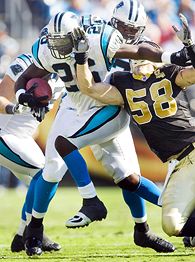
This is an intriguing point. Maybe once a season, there is an endgame situation where a team would be better off if a runner in the clear dropped to his knees -- or, to honor the 1920s rule, came to a stop and said the word "Down!" to the nearest official -- rather than score. The 1997 Buffalo-Indianapolis game, the second-largest regular-season comeback in NFL annals, had a play like this. Once down 26-0, the Bills had rallied to lead the Colts 30-29 with a little more than a minute remaining, the Colts out of timeouts. Antowain Smith carried up the middle and broke into the clear. As soon as he passed the first-down marker, I screamed at the television, "Don't score! Don't score!" Had Smith dropped to the turf, the rest of the game would have been kneel-downs. Instead his touchdown run made it 37-29 with a minute remaining; Indianapolis got the ball back and flew down the field for a touchdown on the final play. That made it 37-35, and Buffalo had to stop a deuce attempt to avoid overtime. One might say to such plays that the runner is more concerned with his yards and touchdown stats than the tactical situation. I think the real explanation is simpler: NFL players are so pumped up on the field, they are incapable of coming to a halt with a touchdown beckoning.
Many readers including Kiersten of Milwaukee, Wis. noted that Paul McCoy of Matewan High School in Matewan, W.Va. ran for 658 yards and 10 touchdowns as his team defeated Burch High School 64-0 on Friday night. Well, at least Matewan wasn't still passing in the second half. But Kiersten asks, "Why was McCoy still in the game?" Bad sportsmanship would be one guess. This night will give McCoy and his friends something to talk about for years, but my suspicion is the "feat" was accomplished against a defense so thin it was effectively no defense, considering Burch has about 20 boys on its football roster. Both these high schools have enrollments of fewer than 300 students -- were they playing six-man, eight-man or regulation football? The National Federation of High Schools, the governing body for most high school sports, says McCoy's night was the highest yardage total ever, besting a 619-yard performance in 1995. Does any reader know if either of these games was an 11-man contest? And yes, this is the town of the 1921 Matewan miners' strike, memorialized in the John Sayles film.
Brian Popp of Columbia, Mo. notes that after the Colorado-Missouri game, lost by the Buffaloes when they went for the touchdown at close range and failed, Colorado coach Dan Hawkins said, "Every statistics professor in America will tell you that if you have the ball inside the five, you're probably better off going for it." That is indeed what statistics professors say; the details are here.
Neither Colts at Jets, Saints at Panthers nor Patriots at Bengals, all headliner games of the weekend, was shown in our nation's capital. Our nation's capital did, however, see Dallas-Tennessee, which was such a woofer that my dog barked when I turned it on. Copenhagen saw Saints-Panthers, as Henrik Bramsnæs notes. Robert Dorman of Dunfermline, Scotland reports that Scottish viewers saw Patriots-Bengals and Colts-Jets live. And Iraq saw Colts-Jets and Saints-Panthers, reports Army Captain Luke Santillo of Wolcott, N.Y., currently stationed at Forward Operating Base Kalsu in Iraq. Last Sunday in Iraq and Afghanistan, Santillo writes, "Armed Forces Radio and Television Service aired Indy at Jersey/B, Bolts at Ravens and Saints at Carolina, plus the Sunday night and Monday night games. The only problem is these games are generally played when we need to be sleeping! Thanks AFRTS for using excellent judgment in which games to show. I will surely miss AFRTS when I'm back at Fort Hood, Texas and must watch the Cowboys and Texans every weekend." Here is the NFL programming that American forces overseas will see this week. And yes, FOB Kalsu is named for Robert Kalsu, who voluntarily left the Buffalo Bills to serve in Vietnam, and died there serving his country in 1970.
A recent Tuesday Morning Quarterback expressed outrage at CEO pay. Rob Jackson, a fellow at Harvard Law School writes, "It's worse than you think! Figures you cite, such as the $245 million paid to the CEO of Home Depot over five years, significantly underestimate the total money CEOs receive. This is because the figures exclude the value of pensions that will be paid to CEOs by the companies during their retirement. Until recently, firms were not required to disclose CEOs' pensions, and so the media and shareholders have been unaware of what the arrangements are worth. Here is a paper that I and a colleague published in 2005 in the Journal of Corporation Law. We found that the median retirement-age CEO was entitled to about $15 million in pension benefits, increasing their pay by a median value of about one-third."
On that topic, David Todd of Santiago, Chile notes that since big business wants a "guest worker" visa program to bring in temporary residents who would work for less than Americans, why not have guest CEO visas? Surely there are thousands of experienced business executives in Mexico and Pakistan who would be willing to work for significantly less than the $168 million the CEO of Exxon Mobil received in 2005, for example. "Guest CEOs" could be hired by the day, or work on a seasonal basis, migrating from company to company. Also, guest CEOs might be willing to do their own document shredding.
Holly Hutchison of Waltham, Mass. writes, and we'll assume she knows, that scripts for the final two episodes of this season's "Stargate SG-1" have not yet been written, giving producers time to figure out how to wrap up the recently cancelled series. Two seasons ago, when the "Stargate" scriptwriters thought their series was ending, in what were originally planned as the last episodes, the writers had a handful of wisecracking Earth commandos armed with nothing but rifles and radios obliterate not one but two super-advanced evil alien species and then, as the icing on the cake, go backward 5,000 years in time to alter history. Now the script team has two episodes in which to have the wisecracking commandos destroy an entire galactic empire of super-advanced beings who are not only evil but immortal. Something tells me all the good guys will need are rifles and radios!

Roman Picheta of Warsaw, Poland commends to our attention the book "Expert Political Judgment" by Philip Tetlock. Tetlock, a psychologist, for 20 years compiled pundit and political expert predictions about election results. His main finding? "Experts do better than a chimp who answers at random, but not much better, and worse than simple forecasting rules based on extrapolation." Picheta adds, "Boy, am I glad that you are no expert."
A recent column said the diving horns in World War II submarine movies sound like they are saying "Arugula! Arugula!" Kyle Meerscheidt of Bridge City, Texas counters, "I always heard them as 'Ayuda! Ayuda!' which is Spanish for 'Help! Help!' This makes a little more sense." Enrique Treviño of Juarez, Mexico points out that Americans call the water between his city and El Paso, Texas the Rio Grande. But Mexicans don't call it the Big River, they call it Rio Bravo, or Wild River. Rio Grande makes no sense as a name, he thinks; Americans should call it either the Rio Bravo or the Big River.
I noted that simply waiting out kings and tyrants once worked because in the past so many people died young, such as Henry V dying at age 34. Les Au of Honolulu, a toxicologist at the Hawaii State Department of Health, reminds us that many kings of the past died young owing to poison. "Several Roman emperors and eligible candidates for emperor were done in by poison. The subtlest one was the painting of figs with a poison, while the figs were still hanging on the emperor's favorite tree in his courtyard. Also, it wasn't necessary to administer the dose by mouth, or jab someone with an umbrella tip containing ricin, a relatively recent KGB assassination tactic. Soaking a candle wick in arsenic or aconite (an alkaloid derived from a plant known as monkshood or wolfsbane), drying the wick, then making a candle out of it, was a popular Middle Ages technique. Lighting such a candle would produce deadly vapors. Aconite would cause irregular heartbeat, chest pain, and death within hours. This method was supposed to have killed Pope Clement VII in 1534 and Emperor Leopold I of Austria in 1705. Pope Clement was 56 years old and Emperor Leopold was 65 years old at the times of their deaths, so their deaths could have been from natural causes. However, for possible motives for murder, Clement was the Pope who alienated King Henry the 8th of England by declaring that Henry's marriage to Queen Catherine of Aragon was still valid, which led to England's split from the Catholic Church, and Leopold's Austria was at war with Louis the XIV's France when Leopold died."
Finally Nathan Meyer of Mahwah, N.J. wrote, "Your column just killed well over an hour of my day, and for this I am eternally in your debt. For the last month I've been all over the web and it is now my opinion that TMQ is the world's leading state-of-the-art time killer. You've given me some natural light, beautiful music, fresh air and a sense of freedom in my fluorescent, white-noised, climate controlled, three-walled world. Plus writing this note just killed another 10 minutes."
In addition to writing Tuesday Morning Quarterback, Gregg Easterbrook is the author of "The Progress Paradox: How Life Gets Better While People Feel Worse," and other books. He is also a contributing editor for The New Republic, The Atlantic Monthly and The Washington Monthly, and a visiting fellow at the Brookings Institution. Sound off to Page 2 here.

Easterbrook