Chase Utley's Swing
2 of 3
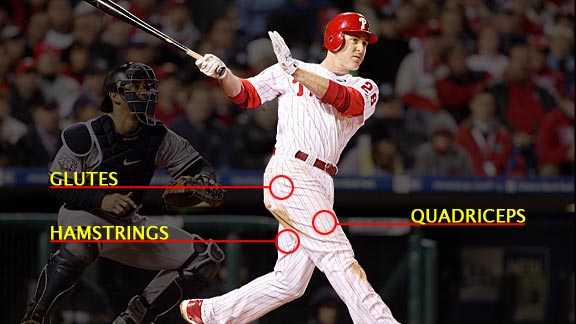
It all starts with the lower body.
Think of your swing as an uncoiling motion that starts at the bottom and works its way up. Generating the initial power with your glutes and hamstrings, the force is transferred to the quads, which in turn thrusts it up the kinetic chain, through your hips and your core, gaining speed and momentum until it ultimately whips your upper body through.
Improving your lower-body strength actually increases the power and velocity of your upper-body swing. Straub recommends the barbell lunge as the go-to exercise in developing your glutes, hamstrings and quads.
Says Straub, "So many athletes will think, 'OK, your glutes, your hamstrings, your quadriceps muscles … I have to squat. I have to be a 300-, 400-pound squatter.' But that's not necessarily true."
Since your swing begins with the shifting of weight from one leg to the other, the transfer of power from the back leg to the lead leg, Straub focuses on single-leg strength when working with collegiate and professional athletes. "You have to make sure you're strong both unilaterally and bilaterally."
"The barbell lunge really taxes the hamstrings and also hits the quads," says Straub. "The single-leg movement puts you in a unilateral or isolateral position so you have to have good core balance to stabilize yourself. It really hits your whole body."



ESPN Conversations
comments