Not that NASCAR is the only offender. All major sports have let performances of our national anthem lapse into loosey-goosey "interpretations" by the "artists."
 AP Photo/Nam Y. HuhJimmie Johnson and his wife, Chandra, have listened to numerous renditions of "The Star-Spangled Banner" -- some good, some not so -- while competing in the Cup circuit.
But NASCAR tries to posture itself as the most patriotic of sports, and yet on any given Sunday, it treats the anthem like just another Nashville hit.
I reached the breaking point on these cheap imitations last Friday, when, for the first time in a long time, I heard our national anthem sung right.
A young tenor named Jerel Ely stood before 3,000 of his fellow graduating seniors (my son among them) and 9,000 or so guests at Auburn University, accompanied by the music department's wind ensemble.
The song rang pure, mighty in its discipline, beyond stirring in its perfect notes and timing, through the coliseum.
There could not possibly have been a dry eye, or a throat without a lump, nor a less-than-heaving chest, in the place.
It was a precious memory of the way I'd heard it as a kid, at football games and heavyweight fights and the World Series, and all gatherings of great importance in this country, when it was all about the anthem, not the "artist" performing.
There was no need in those days for vast waste of military fuel in fighter-jet flyovers for jingoistic jacking up of the crowds. The anthem itself was plenty rousing enough.
And now, having heard it done right, once more, I never again will be able to bear hearing this sort of butchery:
"Oh-wo-wo … sa-ay-ay-ay-ay … kin u see-hee-heee-heeee …
"Bahhhh thahhhh dawn's uuuhly ligh-igh-igh-ight …"
Torturing us on through:
"O'r the la-a-a-nd of tha free-hee-heee-HEEEEEEEEEE!
"And thah ho-wo-wo-wome …
Of tha-ah-ah-ah, brah-rah-rah-ray-yay-yay-yayve …"
And that is just the desecration of the lyrics. The notes themselves are wretched runaway roller coasters from tradition.
Now you may say you love that sort of rendering. If you do, God help you, you are too young to have heard it sung right.
Several years ago, many of us in the NASCAR media grew so sick of these casual renditions that we took to timing the performances for their agonizing length. I think the record was 2 minutes, 5 seconds. This, for an anthem a good military band performs -- correctly -- in about 1 minute, 3 seconds.
I began to wonder if these half-baked country crooners didn't drag it out, hogging the stage, just to get a little more national television time for promotion of themselves and their new CDs.
Want to lead all sports in patriotism, NASCAR? Then take "The Star-Spangled Banner" back from the warblers, the garglers, the whangayangers and the wo-wo-wohers.
And require that it be played with dignity. Every Sunday. It needs no jazzing up. It needs no "interpretation." It just needs playing right.
How sharper than a serpent's tooth it is to have a thankless child!
-- William Shakespeare, "King Lear"
Can you blame Jeff Gordon for being miffed at Jimmie Johnson?
Gordon discovered the guy, gave him a ride, got him a sponsor and heralded him to the NASCAR world.
He has had to eat his protégé's dust ever since and has nobly handled giving up the pinnacle as NASCAR's driver to beat. Mostly since 2002, Gordon has been a Johnson publicist, spending much of his own media-conference time reiterating just how good JJ is.
Now this.
Gordon, who had appeared to be slipping into the twilight of his career, at last is being given race cars as quick as Johnson's. Gordon has been threatening to win on an almost weekly basis lately.
After languishing for eight years as JJ's valet, Gordon wouldn't mind getting another look at the view from the pinnacle.
But JJ has been messing with his mentor enough that "he's been testing my patience and it's about reached its boiling point," Gordon said after their latest incident, Sunday at Talladega.
Gordon got a tremendous run down the backstretch, but Johnson moved down to block -- bad move, Gordon pointed out, when someone's coming that much faster.
Johnson later told The Associated Press that his intention was to link up with Gordon to draft together, and he said he misjudged the closing speed. But if it was misjudgment, it was gross and flagrant -- inconsiderate.
Gordon's momentum was broken so badly that he dropped back and was collected in a wreck seconds later.
This on top of a punch in the right-side door from JJ as they dueled during the previous race, at Texas, and strong words for each other afterward.
The Hendrick organization keeps smoothing things over with how competitive they are -- "stallions," Johnson's crew chief, Chad Knaus, calls them -- and Johnson concedes that "we're both greedy …"
But think back, to when Gordon was anything but greedy toward an unknown driver who just might never have made it without him.
 AP Photo/Mike FuentesJeff Gordon has torn up a few race cars this season, and more than once he's blamed teammate Jimmie Johnson for at least part of it.
To this day, Johnson's career highlight film might consist of one horrific Nationwide crash at Watkins Glen in 2001, in a mediocre car, had not Gordon shown up unannounced at a test at Darlington later that season.
NASCAR's then-top driver noticed how brilliantly the then-unknown driver negotiated the tough old track in a so-so car.
Johnson didn't even realize Gordon had noticed him, but Gordon went back to Rick Hendrick and told him he'd found the guy for a fourth Hendrick team. Gordon was so certain that he took a piece of the action, becoming co-owner of the new team he proposed.
As for sponsorship, Hendrick was amazed at how intensely Gordon could work as a businessman in suit and tie. After one long negotiating session with Lowe's, Hendrick noticed that when Gordon got up from the table, "the back of his dress shirt was wet with sweat."
Gordon came away with the best sponsorship deal in NASCAR, beginning in 2002.
"That was the last time I finished ahead of them in points, 2002," Gordon recalled.
As the team developed, Gordon questioned Knaus as a crew chief for Johnson but deferred to Hendrick's judgment and put in place the man who would contribute enormously to Johnson's success.
Since then, Gordon has been the accompanist to JJ's solo performances for 50 wins and, in the past four years, four straight championships.
Gordon had to work harder for his four championships, winning them the old-fashioned way, since first he beat the toughest title brawler of them all, Dale Earnhardt, in 1995.
Gordon hasn't won a championship since 2001, the year he built the best ride possible for Johnson.
Johnson's side of their recent conflict is that "there comes a point that if you don't stand up for yourself, people are going to continue to push you around, teammate or not," he said at Talladega, referring to the door-punch at Texas.
But there are teammates, and then there are benefactors who become teammates. Isn't there at least a nuance there?
Johnson had retaliated because "for the few laps leading to that contact, he kept pushing the envelope, pushing the envelope, running into the back of me, getting me sideways," he told ESPN at Texas.
But by Talladega, Johnson realized that's how Gordon contends, when he's got a winning car: "He doesn't wreck guys, but he knows how to just get in there and upset you a little bit."
That was the Jeff Gordon of yore, who would gleefully describe how he would get in behind a leader and loosen him up, then drive right by him.
That was Jeff Gordon, before he got so busy making Jimmie Johnson a star.
So now, Gordon doesn't mind if Johnson races him relentlessly. But to race him thanklessly is another matter.
To paraphrase Jefferson Airplane, don't you want somebody to boo?
Don't you need somebody to boo?
Wouldn't you love somebody to boo?
You better find somebody to boo.
In other words, don't you wish Kyle Busch were back?
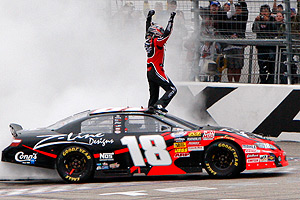 AP Photo/Brandon WadeKyle Busch made NASCAR history Monday at Texas Motor Speedway, becoming the third driver to win five consecutive races at the same track.
I mean the genuine article.
We haven't seen so much as a smashed guitar, or felt the pain of artist Sam Bass, who painted it, or read a verbal shot at Dale Earnhardt Jr. for what seems like ages now.
Let alone seen any new and creative screen names for anti-Kylers on the ESPN Conversation. We're stuck with the same old "Cryle" and "Kryle" stuff. None of his naysayers are creative anymore because they're not fired up anymore.
Whatever happened to the guy who shrugged off thunderous booing by rationalizing that "It's better than a kick in the nuts"?
Or the one who broke the party line that drivers are athletes by observing that "our job entails us sitting on our ass and not doing a whole lot besides moving our arms and legs."
Whatever became of Rowdy? Or Wild Thing?
What we've got now is a guy who is winless this season in Cup, and who after Nationwide wins -- well, take the pure vanilla of Texas Monday evening ...
He was garden-variety polite, first naming off all his sponsors and then going on and on about how it's a team sport, not just naming the generic "all the guys back at the shop" but every department of Joe Gibbs Racing.
True, it's a team sport, and sponsors are vital. But is that the way you want Rowdy the Wild Thing behaving in Victory Lane? I mean, you can get that from Jimmie Johnson anytime, and you roundly consider JJ bland.
Even when JJ and his teammate/mentor Jeff Gordon get a little feud going, as they did with a little beating and banging in the Texas Cup race Monday, JJ squelches the thing and promises they'll settle it "at the shop," and that "there's no need to play it out in the press."
Boooooooooo!
The genuine Kyle Busch used to play out plenty in the media, especially how much better he was doing than the man who replaced him at Hendrick Motorsports, Earnhardt.
Now he has been programmed with the standard NASCAR personality package, which is about as flavorful as a plain omelet with no salt or pepper.
Worse, he has taken to taking only one bow atop his car after a win. From him, you need two -- one to the left, setting off the boos in that part of the grandstands, then one to the right, detonating the thunder there.
Just imagine him deprogrammed. Just think of the bashing you could do if, for example, Toyota fulfilled the promise of those TV commercials where he's in a pink car with kittens and baby seals painted on it.
In this car he goes on a rampage a la 2008, winning and mouthing off and winning some more, then climbs on top of the pink car in his pink uniform and pink helmet and takes two bows and counts off the wins on his fingers.
Don't you want that?
Don't you need that?
Wouldn't you love that?
Of course you would. But you'd never admit it.
In the matter of Carl Edwards, NASCAR got it right. Goldilocks right. Not too hot, not too cold, not too hard, not too soft. Just right.
A meaningless three-race probation is exactly what the situation called for.
What NASCAR had to do was pull off a delicate public-relations maneuver. Edwards' payback bump of Brad Keselowski needed to be acknowledged, what with the public shrieking and eeking over The Flight of the Red Car across half the TV, computer and iPhone screens in America.
It was one of those sensational NASCAR video moments that get the attention of the news networks from time to time.
But Edwards' offense, by the unwritten code as old as NASCAR itself, was a misdemeanor.
My position has been the same since Sunday when I reviewed the video of when Keselowski went upside down at Atlanta after the nudge from Edwards. What I said Monday, on ESPN2's "NASCAR Now" and to ABC News, was precisely what NASCAR president Mike Helton said Tuesday in announcing the formality of a penalty.
Edwards' payback bump of Keselowski was an Edwards issue.
The flight of Keselowski's car was and is a NASCAR issue.
They are separate.
So NASCAR is attending to its own house with regard to the suddenly arisen aerodynamic problem of cars going airborne on intermediate-size tracks, and no longer just the giant restrictor-plate tracks.
Regardless of how the car was launched, with intentional or unintentional contact, the overwhelming issue is to get the cars to stay on the ground. Likely, the return of the spoilers later this month, to replace the misbegotten wings, will resolve the matter.
As for Edwards' probation, anyone who knows NASCAR knows probation is meaningless. But the general public doesn't know -- and they're the ones who needed to be addressed, because when Brad K's car took flight, so did the story, out of control and beyond reason.
So NASCAR publicly acknowledged Edwards' offense, but punished it for what it really was -- as a misdemeanor.
There's no way Edwards, or NASCAR, for that matter, could have predicted that Keselowski's car would go airborne. So there was simply no intent to launch.
Edwards did not cross some line, as has been charged, with regard to NASCAR's licensing of drivers to settle matters among themselves. The flight of Brad K's car made Edwards' action appear to cross some line.
At initial contact, this was routine payback and, under the old code, justifiable payback. And not just because Keselowski had a hand in the wreck of Edwards and Joey Logano earlier in the Atlanta race.
Edwards' grievance was cumulative, and shared by other drivers, dating back to the last Nationwide season, and Keselowski's chronic display of lack of respect for other drivers, and his tendency to crow about it.
"The tougher you race, the more you're rewarded, it seems like," Brad K had said in Victory Lane at Memphis in October after wrecking Edwards and tangling with two other drivers, Justin Allgaier and Mike Bliss.
Wearing that Attitude (with a capital A), Brad K went on to dump Denny Hamlin at Phoenix in November, prompting Hamlin to observe that "there's a lot of guys that owe him."
Keeping his promise, Hamlin spun Keselowski at Homestead-Miami in the Nationwide finale, and that was that.
What Hamlin did to Brad K was what Edwards intended Sunday at Atlanta. Nothing more.
Edwards has caught much heat for retaliating on a high-speed track. Well, Homestead-Miami isn't exactly Martinsville, and there was nothing like this hoopla when Hamlin turned Keselowski at Homestead.
What did surprise me was that Helton denied that NASCAR took into account Keselowski's "body of work," as someone put it, in considering Edwards' penalty.
NASCAR had to see, had to know, that this young driver was as rough as they come -- rougher, maybe, than even the young Dale Earnhardt 30 years ago.
Brad K's peers thought he was getting out of hand, and NASCAR was letting him rip.
NASCAR had told the drivers they could settle things among themselves, and Edwards settled a matter largely on behalf of the garage area as a whole. And NASCAR, much to my surprise, didn't renege on its new policy, even in the face of sensational video.
Good for NASCAR.
There were just three of us in the late Ralph Earnhardt's old garage, out behind the house in Kannapolis, N.C. Dale Earnhardt and I were standing, having just breezed in from one of our around-town pickup truck cruises of the time.
Jake Elder was squatting on the concrete floor.
I don't think I ever saw Jake sit in a chair, except at a poker table. Otherwise, he always squatted or stood -- usually within 3 feet of a race car.
Dale had his own Busch (now Nationwide) team at the time, and Jake ran it for him -- shop manager, crew chief, did probably 80 percent of the labor himself.
Jake squatted near the right front of the car, where the steering and suspension pieces lay disassembled. Then there arose a scene so powerful, so telling about the simple genius of Jake Elder, that years later I would contribute it to the ESPN movie "3," a docudrama about Earnhardt.
Jake picked up an upper control arm and shook it at us.
"You see that thing right there?" he asked, never naming the part.
I'd bet even odds he didn't know the name of the part, or care. Jake was a savant, with total grasp of the interrelationships of suspension pieces.
Never mind that Jake couldn't read or write. As surely as Bobby Fischer with chess pieces, or Mozart with the musical scale, it seemed that Jake was just born knowing.
He could read those parts and he could read playing cards, and that was all he ever needed to make himself a living legend, even by then -- which was sometime in the 1980s.
He'd sent young Mario Andretti to victory in the Daytona 500 of 1967, then David Pearson to NASCAR championships in '68 and '69, then made a winner of young Darrell Waltrip in the '70s, and then taken on his biggest project of all -- wild and reckless young Dale Earnhardt.
"Hell, a young driver don't know what he wants in a race car till I show him," Jake told me when he first showed up to guide Earnhardt in '79. "I'll show him."
I wrote that with Elder, Earnhardt would win a Cup race within a month -- and he did, as a rookie, at Bristol.
"Stick with me, Jake! We'll be wearing diamonds big as horse [droppings]," Earnhardt crowed, fully aware how ironic he was being -- he knew Elder had catapulted him to stardom, not vice versa.
Jake was also born to ramble, and never to take any crap from anybody. Cross him (and that didn't take much), and he'd pick up his tools and quit, thus the nickname "Suitcase Jake." For a long time he could catch on anywhere, but in time, team owners grew wary of his restlessness.
By the '80s, it was Earnhardt who made sure Jake had a job and a paycheck, even though Jake had left memories around the racing world, and I mean that literally -- at Le Mans, before the start of the 24 Hours in 1982, Andretti and I had sat on the pit wall telling stories of "ol' Jake," as Mario always called him.
Even when Jake would throw down his tools and stomp out of Ralph's old garage, quitting, Dale Earnhardt would just stand there with his arms folded and grin. He knew Jake would be back.
And now, back for another stint and another paycheck in Ralph's garage, Jake shook the upper control arm at us.
"That thing'll break at Talladega," he said, and threw it toward a corner of the shop. Then he picked up another control arm that looked exactly the same to Earnhardt and me.
"So we gon' use this thing right here," he said.
Certainly he didn't know the metallurgy of the alloy in "this thing right here" -- just that it was stronger.
Come to think of it, of all the poker hands I saw Jake win, I don't recall hearing him state the name of the hand -- "three kings," or "full house," or whatever.
He would just lay the cards down. To Jake, it was all vision, and verbalizing was a waste of time.
J.C. "Jake" Elder died this week at 73. I just couldn't let such a towering figure of the NASCAR garages and poker rooms pass so quietly.
I just had to tell you how important and how wonderful he really was, how brilliant at star-making, even in his own obscurity, manipulating "this thing right here" or "that thing right there."
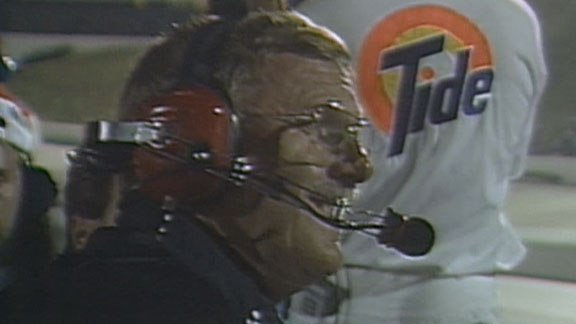
DAYTONA BEACH, Fla. -- Junior Johnson is arguably the most appropriate grand marshal of this race ever. Fifty years ago, Johnson discovered the draft, won the second Daytona 500 and invented the technique that would launch NASCAR to popularity.
 AP Photo/Bob JordanInaugural NASCAR Hall of Fame inductee Junior Johnson is credited with discovering the draft 50 years ago at Daytona.
"I didn't know what it was, to tell you the honest to God truth," Johnson said Sunday morning of the 1960 serendipity.
Johnson was driving a year-old '59 Chevrolet that wouldn't get out of its own way in practice or qualifying. Early in the race he was struggling some more.
Then, "when Cotton Owens came by, I ducked in behind him while we were coming off the fourth turn," Johnson recalled. "When I got down in the first turn, I was running all over him at about half-throttle.
"I couldn't figure it out. I thought maybe Ray Fox [his crew chief] had got the car running a lot better. ... I came in, and he thought he'd fixed it also.
"We put on a new set of tires and went back out, and here came Jack Smith down through there, and I jumped on him the same as I'd jumped on Cotton. And I was running all over Jack when I got down in the first turn, and he had the fastest car here. So I didn't know what it was.
"I went back in, and Ray said he believed he had the thing fixed. But I'd go back out and run by myself, and it would not run. It was something like 15 mph slower than the other cars. I was almost ready to go home ... it was just so slow it was disgusting.
"But I thought maybe if I stayed I could just grab people all day long and ride behind them and be pretty good at it. I didn't ever, ever think I would win the race."
But most of the dominant Pontiacs fell out, except for Bobby Johns, who Johnson said "was in a year-old car like I was." Johns suddenly became the Pontiac flagship trying to catch Johnson's Chevrolet.
Smith's dominant car had lost laps in the pits, and Johnson was ahead of Johns.
"But Jack fixed his car and the Pontiac people got him to go back out and drag Bobby up to me. When Bobby went by, I ducked in behind him, and lo and behold, his back glass just flew out [from the suction of the draft], and his car raised up in the back.
"Round and round he went, and down through the grass. I got so far ahead of him that even if he'd got back out real quick, he wouldn't have caught me.
"So basically I stole the race; I didn't win it."
These 50 years since, drafting of course has been considered anything but stealing at Daytona. It's vital procedure.
Equally appropriately, Johnson is of course among the first group to be inducted into NASCAR's new Hall of Fame this spring.
FORT WORTH, Texas -- So whatever became of Kyle Busch?
You know, the NASCAR prodigy/brat (depending on your point of view) gone silent since summer in the Cup wins column and the headlines?
 AP Photo/Brett FlashnickDave Rogers, above, replaces Steve Addington as crew chief for the No. 18 Toyota.
Don't necessarily expect to rediscover him this season, even though he's got a new crew chief for the final three races.
"This week and the next three weeks are all about finding direction," said Dave Rogers, who took over for Steve Addington as Busch's crew chief this weekend in time for Sunday's Dickies 500. "We've got to look at the long-term goal here."
It's all a shakedown cruise for 2010, said Joe Gibbs Racing president J.D. Gibbs, who made the change on Busch's No. 18 team.
"It's so hard to do it starting at Daytona -- let's get a little advance," Gibbs said Saturday. "Let's just do it now. Let guys feel each other out."
"When I get back," Rogers said, meaning after the season finale at Homestead-Miami on Nov. 21, "we have the best engineering staff in the business. There's some brilliant people who work for Joe Gibbs Racing and what they want from me is … to give them direction of what projects I need to work on throughout the winter.
"That's the question I need to answer …"
"So far, so good," said Busch, who qualified a surprising -- even for him -- fifth for Sunday's race at Texas Motor Speedway. "That was cool. Dave and the guys have done a lot of work and Steve has been helping us as well back at the shop …"
If you ask me, that's about like Ricky Bobby's ex-wife and best friend inviting him to their wedding in "Talladega Nights" -- but whatever on the ever-soap-operatic Gibbs team.
And anyway, Addington is one of the nicest guys in NASCAR, which could have led to his downfall with the -- harrumph -- pretty intense Busch.
The whole thing "is probably my fault," Gibbs said, "for not sitting down earlier this year with Kyle and Steve and saying, 'Look, here's where we're going off track. Y'all get together.'"
How much of this switch had to do with giving the temperamental -- even if he's gone inside the hauler with his emotions in recent months -- Busch?
"I think it's a factor," Rogers said. "I don't think it's everything. … It takes more than just a change in atmosphere, but it will certainly help."
Rogers' most recent résumé includes success with both Busch and Joey Logano in the Nationwide Series, but his deeper background includes a failure that was a sort of crew chief's boot camp.
"Dave really put the 11 team together," Gibbs said of the formation of the JGR branch Hamlin now drivers for. But Rogers was replaced by Mike Ford in 2006 to bring Hamlin along as a rookie. "To not be able to enjoy that success was hard for him."
"I failed at the No. 11 car -- there's no doubt about it," Rogers said. "And I think you learn more from your failures than you do your successes."
The specific lessons learned?
"Leveling the emotions. Not getting as high when things are good and not getting as low when things are bad …"
Now if he can just pass that along to Busch, you might be seeing some bow-taking and counting off the wins on the fingers again … to open 2010 with a bang.
Sudden resurgence of the 18 to close out this season?
"I wouldn't be opposed to it," Gibbs deadpanned. "But the reality of it is, any good race team takes a little time. We'd just rather do it now instead of waiting till next year to kick it off."
 AP Photo/Dan LightonThe show didn't get interesting until late in the race, when drivers such as the flipping Mark Martin had real business to attend to.
If the boss won't talk
Don't take a walk
Sit down! Sit down!
-- Early 1900s union organizing chant
A case could be made that a de facto drivers' union is operating in NASCAR as we speak.
To wit: the sit-down strike on wheels they staged Sunday at Talladega.
Oh, they won't admit it -- they don't even think of it for what it is.
But they've shown they know how to knock NASCAR to its knees: strip the show away. No show, no NASCAR. At least not for long.
Lay the events bare, vulnerable to the chronic criticism of all nonracing enthusiasts that it's all just a matter of cars going around in circles ad nauseam except for the occasional wreck.
Make it all so blatantly clear that even the loyalists, the longtime aficionados, come to agree with the naysayers -- cars going around in circles, all right.
Forty years ago, their notoriously tougher predecessors had walked out on the inaugural race at the track that opened as a white elephant and remains so today. They call it a "boycott" now, but they struck at Talladega, showing Big Bill France he couldn't assume they were all damn fools who would run on tires sure to come apart.
Apparently there is no one left in all of NASCAR's administration who absorbed that lesson. So it is in the process of being retaught -- although not nearly as formally or forcefully as it was taught the first France generation by Richard Petty, the Allisons, Cale Yarborough, LeeRoy Yarbrough, et al.
But this group strikes a lot more smoothly. They don't vacate the factory and leave it wide open for The Man to bring in nonunion labor. They use the old 1920s tactic of sitting down right there on the job, right in the factory, occupying the premises without producing for The Man.
So when NASCAR started pushing them around, they didn't take it any more, in their way, than the raw-knuckled crowd had in 1969.
"I guess they don't think much of us anymore," Ryan Newman said, his tone dripping with black understatement after being pinned in his upside-down car.
I don't care how rich and famous this generation of drivers may be. Nobody likes to be treated and talked-to disrespectfully. Nobody.
 AP Photo/Dave MartinJamie McMurray leading a single-file pack of cars is not what NASCAR -- or fans -- seem to have in mind for 500-mile races.
Ordered not to bump-draft -- the only tactic they had left to make Talladega racing any semblance of a show -- they sat down on the job, buckled in, and rode around, and around, and around, and around, and around … and finally they wrecked because a few of them needed to get something done -- such as Mark Martin and Jeff Gordon struggling to gain points on Jimmie Johnson in the Chase.
Without that, there might have been no show at all. Zero.
And the fans went wild … with rage … at lack of show.
Two years ago, after a similar sit-down strike over NASCAR's mandate of the COT at Talladega for the first time, I heard from deep inside NASCAR that officials knew the drivers were riding around and around that day, and that there wasn't a damn thing NASCAR could do to stop it.
Word, I heard, had gone surreptitiously around the motor coach compound on Saturday night: ride around.
On Sunday, after the meeting with NASCAR officials that so outraged the drivers, this demonstration was much more blatant. They didn't even pretend to make a show of it. They rode around single file. It was a picket line, missing only the hand-painted signs.
No show, no NASCAR. Not for long.
Call them spoiled if you will. Call them wealthy beyond any reason to complain. But 40 years and many millions of dollars can't change the human instinct to resent being treated like damn fools.
And that very wealth is what makes them so much more powerful than their angry predecessors. If every one of these drivers quit right now, for keeps, I can count on one hand the number who would ever have to work again for a living for the rest of their lives.
They don't have to race. NASCAR does.
NASCAR had better remember that.
NASCAR had better heed the black tones of Newman, Gordon ("I'm kind of glad we ran out [of gas] when we did because we were at least able to get back out there and destroy our car") and Martin ("Nothing," he snapped at a question about what he saw before he went tumbling).
My e-mail has been running the same as every one of my colleagues', at every media outlet I know: 100 percent outrage over the debacle at Talladega on Sunday.
One stands out, because it is from a former motorsports editor of mine at another publication, now retired on the West Coast. He just might be the most sophisticated and savvy race observer I've ever known.
Here's a fraction of his take: "Newman's, Martin's and even Gordon's sarcasm were the only honest, watchable moments in the entire endless [unprintable phrase]."
NASCAR had better recognize the dictatorship is over. Finished. NASCAR had better yield, somewhere, somehow, on plate racing -- or, as Johnson boldly suggested as the only alternative, tear down the banking at Talladega and Daytona.
And NASCAR had better yield on the Car of Tomorrow, bring back springs instead of bump stops, bring back spoilers instead of wings, bring back air dams instead of splitters. Then the drivers can race, if only just a little.
Keep up the despotism, the intransigence, and no, these rich, soft -- and very shrewd -- drivers won't strike. But they can sit down, ride around, and end all semblance of a show.
Never has there been a clearer confluence of names and careers than Jimmie Johnson and David Pearson, here, this week. Johnson's four-peat onslaught continues unabated yet uncelebrated, and Pearson, the best NASCAR driver ever, was disgracefully snubbed from NASCAR's first Hall of Fame class.
Johnson is the Pearson of his time. And Pearson was the Johnson of his time.
Pearson is long, long overdue to get his due. And Johnson is decades from getting his.
If they gave Cup points for poignant philosophizing, Jeff Burton would be an eight-time champion by now. So we can turn to him for wisdom on this subject -- especially for projection of Johnson's plight in the decades to come.
"You never get your just due in the era that you're in," Burton said the other day, speaking of Johnson. "Because the people you're competing against don't want to give it to you."
Truth is, Burton continued, "Anyone who should at the very least appreciate and respect what Jimmie Johnson and that team have done, they're not open-minded enough right now. They're just not going to."
Truth is, in my experience, they may never.
I mean the whole NASCAR realm, from deep inside the garages to the grandstands and beyond.
Pearson's plight is ominous for Johnson.
So who, you ask, deems Pearson the greatest ever? The serious, the savvy, the longtime, deep-inside observers of NASCAR -- Richard Petty foremost among them.
Never have I asked Petty who was the best of all time that he didn't launch into this soliloquy, or something very similar:
"Pearson. Pearson could beat you on a short track, he could beat you on a superspeedway, he could beat you on a road course, he could beat you on a dirt track.
"It didn't hurt to lose to Pearson as much as it did to some of the others, because I knew how good he was."
Never have I asked Pearson who was best that he didn't answer thusly, absolutely no brag about it, just fact: "Me. Can you think of anybody better?"
I never could. I can't now.
But somebody is making a run at him, and could approach or equal him before it's over: Johnson.
But you can see the Johnson travesty coming, because it is in motion today.
This tells you all you need to know: Johnson has 45 wins, and three championships with the fourth imminent, in not quite eight seasons. Dale Earnhardt Jr . has 18 wins and no championships in not quite 10 seasons.
And yet the masses swoon in their riotous worship of Junior, and turn their noses up at Johnson.
So it was with Pearson, when the masses were swooning over Petty, and Pearson beat him with considerable regularity: 63 times they finished 1-2, and Pearson won the heads-up duels 33-30.
"I always told him that was because he had a better car," Petty always says with an ironic grin because everybody knew it was the opposite.
In lesser equipment, running far fewer races, Pearson won 105 races to Petty's 200.
But Pearson was thought of, in his prime, as that guy who kept spoiling the Petty legions' days at the races. He kept beating the King. He was, perennially, the Other Guy.
Johnson is the guy who keeps beating everybody's favorite -- be it Junior, Tony Stewart, Jeff Gordon, Carl Edwards, whoever -- with great regularity. He is the perennial Other Guy.
He just doesn't have the charisma to be The Guy. Neither did Pearson.
Pearson was a plain-spoken, humble man, and that added up to very little charisma. Johnson is plain-spoken, humble. In both, you have to look deep to find the quiet self-certainty in pure driving performance.
There has been such a mushroom cloud outrage over Pearson's omission from the Hall that he'll probably get in next year -- NASCAR could not stand any further smudging of its Hall as unjust from the outset.
Johnson can four-peat, five-peat, six-peat. And all that will be said of him is that such dominance is bad for the sport.
So turn your backs on Johnson, NASCAR fandom. Just as your predecessors did on Pearson decades ago.
Your predecessors missed the career of the greatest NASCAR driver ever, because they were looking the other way.
And now you're missing the career of Pearson's only challenger among active drivers.
When was the last time you heard this one?
You win, NASCAR fans.
You were heard. Taken seriously. Given more than lip service by drivers as part of the victory-lane litany ordered by NASCAR this year.
You held sway.
Next year, races are going to start when they're supposed to: 1 p.m. ET for 28 of them, 3 p.m. ET for West Coast races, and 7:30 ET for night races.
David Hill, the colorful chairman of Fox Sports, will "hold up my hand and say, 'guilty,'" to initiating the time-tampering, he told a teleconference Wednesday. Further, he confessed, TV shouldn't have tampered with tradition in the first place.
Here's the thing about you at the tracks: You're going to show up at the crack of dawn, whether the race starts at 1 p.m., 2 p.m., 3:30 p.m., 5:30 p.m. or 8:00 p.m. It's long-cemented habit with you.
The longer you have to wait, the wearier you get. And the ornerier you'll be in the black-of-night traffic jams, trying to get out of there all at once after the race is over.
But, very sad to say, you, as a ticket-buyer, hotel-price-gouging victim and restaurant-line stalwart, might not have been heard, let alone held sway.
The late, legendary Smokey Yunick used to say of NASCAR fans, "You can treat 'em like crap, rain on 'em, sunburn 'em, starve 'em, cover 'em with dirt and tire dust, keep 'em waiting for hours in the heat or the sleet, run 'em clean out of beer, and they just won't go away."
For all that, you wouldn't have won this one.
But here's your power.
Here's the thing about you at home. You are a TV viewer, part of the mightiest public force in American society today.
If you're in the Eastern time zone, chances are you go to church, come home and have Sunday dinner, and sit down to watch NASCAR on TV at 1 p.m.
But whether you're in church or sleeping in, you're ready for action after lunch.
Emphasize action. Creature of habit that you are, you still sit down at 1 p.m. … and you wait … and wait … and wait.
The latest gossip about Dale Earnhardt Jr., or the latest video of Jeff Gordon and family, are fine, in their place, but …
Action.
Ned Jarrett, the broadcaster who was the very voice and face of NASCAR's rapid rise into the mainstream in the 1980s and '90s, told me recently that the thing television networks should remember, simply but overwhelmingly, is that "Fans just want to watch the race."
Jarrett is still concerned that you have too many people talking at you on too many topics during a race telecast. But that's an issue for another day.
You won this one. You forced it. This was not a purely charitable act by the networks nor by NASCAR, whose ratings have been sinking by and large.
They recognize that in their expeditions foraging for new audiences in the late-afternoon hours, they not only weren't making headway but had run off and left the core constituency.
You knew that, have been e-mailing me about it in droves for years, and you didn't just feel forlorn, but furious.
Now they've turned around and are coming back to meet you, and your biorhythms, in 2010.
There is little risk involved. Look at the NFL, which has remained steadfast and successful with its 1 p.m. and 4 p.m. kickoffs.
And there's a meteorological bonus built in: fewer rainouts in the summertime.
Take Watkins Glen last July. I sat there for hours watching the radar as a massive and ferocious front moved down from Canada, across Lake Ontario and into New York State, while everybody at the track dabbled and lounged around, waiting for a 2:30 p.m. start.
Just seconds before the command to start engines, the lightning started. Then the deluge. Then they came back and ran Monday. Nobody won that one -- fans, networks, teams, NASCAR itself.
If only they'd started at 1 p.m. (actually it'll be a little after, what with prerace ceremonies), they'd have had half the race in by the time the tempest hit.
Bring the same storm down from Toronto at the same time on race day next year, and they'll get it in.
Now if only NASCAR would listen to you about that confounded COT …
ABOUT THIS BLOG

Ed Hinton
Ed Hinton is a senior writer covering motorsports for ESPN.com. He has nearly 40 years' experience covering NASCAR, open-wheel racing and other major sports for several metro daily newspapers and two national publications.
Ed joined ESPN.com in 2008, most recently having been senior reporter for motorsports at the Tribune Co. newspaper chain, where his work appeared in the Chicago Tribune, the Los Angeles Times, Newsday, The Baltimore Sun, the Orlando Sentinel and other papers. Previously he was a senior writer at Sports Illustrated and a national writer for The National Sports Daily.
Ed has written two books and won numerous awards for motorsports and general sports writing, including the Scripps Howard Foundation First Amendment award.
Ed holds a B.S. degree in journalism from the University of Southern Mississippi, and also attended the University of Mississippi.