DAYTONA BEACH, Fla. -- Welcome to a cluster function -- to a day that would be hell if it really mattered.
Six a.m. on the beach, still dark, drizzling, well into the second cup of coffee, and on the local cable news channel the sports anchor chirps:
"Daytona Media Day today. We're all over it!"
Everybody's all over it, all over the drivers, all over each other.
This'll be a cluster function, all right. As usual.
Out the door, down the elevator, into the rental car, across the Port Orange Bridge as the rain intensifies, up Clyde Morris Blvd., out to International Speedway Blvd., all in the predawn gloom.
The cluster function starts officially at 8 a.m. but you'd better be there an hour early if you want space in the working area. Once set up in the big tent, you deal with some pretty rough coffee and wait … and get glad-handed by the steady stream of publicists.
First you congratulate the NASCAR people on their slick scheduling move. They've made Jimmie Johnson the first up, at 8 a.m. That'll draw the brunt of the media in early. And that should get all the Truck series drivers booked around Johnson some interviews they wouldn't otherwise have gotten.
In years past, media types didn't have a very good record at showing up early for Truck and Nationwide drivers. Johnson forces everybody's hand.
The NASCAR people chuckle and nod, never denying they planned it this way, with Johnson as the drawing card.
But Johnson spoils my angle right on the dot at 8 a.m. when I ask him how it feels to be dragged out early as media bait.
"I picked the time slot," says JJ, morning person.
"I've always been that way. My dad, working construction, was always up early and out the door. I'd get up and have some breakfast with him before I got ready for school.
"So it's just kind of been my wiring since childhood."
Good thing they've got one star who's a morning person. Dale Earnhardt Jr. won't be in until 12:30 p.m. -- and that's early for him.
 HHP ImagesDanica Patrick is never short of media attention.
Nine a.m. and here I sit in the work area, just off the main stage of Speed Channel's ongoing live talk show, squinting into the lights, listening to my digital recorder.
You should hear what I have to hear. Here's Johnson, the softest-spoken driver in NASCAR, barely discernible at best, and somebody's had the great judgment to put his interview booth right next to a roaring blower for the big tent's ventilation system.
On top of that, just as I think I've extracted a mumbled Johnson phrase from the recording of the blower's roar, laughter explodes from the guys on the Speed set as somebody cracks a joke.
Back up the recording. Play it back. Back it up. Play it back. So it goes.
Here comes Danica Patrick into the grinder, with her PR handlers. First she's up on the Speed stage for live talk with the panel. Then she'll go to Fox and then ESPN for preseason interviews, then to Sirius satellite radio, then before wide firing lines of local TV crews, then to print media.
That's pretty much the cycle for all drivers today. We call it "the car wash."
Danica arrives at her print interview booth 10 minutes late, and a crowd has long stood gathered round, surrounding her, four reporters deep.
"I thought Jimmie Johnson was over here," she cracks as she sits down.
For all drivers and all reporters, in all booths, before all cameras, the task is the same.
Everybody is trying to think of a question the drivers haven't already been asked during preseason testing and/or the media tour in January.
And the drivers are trying to figure out how to phrase the same answers differently.
And everybody is failing.
This is a cluster function, all right.
 Jason Smith/Getty ImagesMichael Waltrip talked about Dale Earnhardt and his new book during NASCAR's media tour Tuesday.
CHARLOTTE, N.C. -- Michael Waltrip opened Tuesday looking sleepy at breakfast but was as sharp as always at pivoting from tragedy to comic relief on his feet … and managed to promote his new book and his new standup comedy tour in the same motion.
A video outlining his new book, "In the Blink of an Eye," was rife with sadness. "The best day of my life was also the worst day of my life," he said, referring to Feb. 18, 2001, when he won the Daytona 500 only to learn soon after that his car owner, Dale Earnhardt, had been killed on the last lap of the race.
Then Waltrip took the stage, gestured to the screen and announced, "We're doing a comedy tour … and none of that's in it."
By the way, he'll come out of semiretirement to race in all three NASCAR divisions at Daytona in February.
Today's stunner: Richard Childress pulled no punches. "This is the year to kick Jimmie [Johnson] off that throne," he said. "We were close with Kevin [Harvick] last year, but this is the year to do it and I think RCR feels certain. I'll make that prediction."
Then he turned to all four of his Cup drivers and asked, "How 'bout that? That put any pressure on anybody?"
Harvick, Jeff Burton, Clint Bowyer and Paul Menard all just smiled. Based on their Daytona testing, they think they're loaded.
He said what? Pushed about guaranteeing stopping Johnson's title streak at five, Childress didn't exactly backpedal.
"I didn't guarantee it; I just said we're gonna," he said.
And Childress kept pounding. "Nothing lasts forever, and his [Johnson's] time will run out. When it does, RCR wants to be there. … I've got that gut feeling this is the year."
Flattest moment: Charlotte Motor Speedway officials took three busloads of media out to view the construction site for the world's largest HD television board. For all the hype, bottom line was that we stood there for half an hour looking at a pile of dirt.
Best story: In Waltrip's new comedy routine, he talks about being funny by accident, as he has been for years on TV at the tracks, versus trying to be funny on purpose.
"People come up to me at the races and say, 'Hey, man, you're good on TV. … Say something funny,'" he said.
He paused and gave a blank stare, as if at a loss.
"Then I say, 'I don't have anything.'
"And they'll walk off and say, 'That Michael Waltrip's an a------. He wasn't funny at all.'"
Best moment: Childress summarizing the safety revolution since he lost his driver and best friend, Earnhardt, 10 years ago, and how life can come full circle.
"It's sad that we had to lose an icon like Dale Earnhardt for the sport to become so much safer. You look at some of the horrific crashes we've had since then, and the drivers get out and walk away," Childress said.
And then the most poignant line: "I feel much better watching my two grandsons race today."
That is, Austin Dillon in Trucks and Ty Dillon in ARCA.
At the end of the day, at least our staff didn't have to feel like total freeloaders at all those team dinners. ESPN picked up the tab Tuesday night.
You think race fans don't have clout anymore?
The Tennessean, Nashville's primary newspaper, reported this week that more than 1,000 people turned out, spoke their minds for more than three hours and got the city's Metro Council to hold off on demolishing the historic Nashville Fairgrounds Speedway short track.
City officials wanted to raze the track as part of an urban renewal effort for the entire 117-acre fairgrounds site.
Retired NASCAR stars Sterling Marlin and Darrell Waltrip, both of whom began their careers on the .596-mile oval, have been championing an alternative plan that would revitalize both the track and the fairgrounds.
Although the reprieve still needs final approval in a vote next month, it got initial unanimous approval from the council, The Tennessean reported.
Which renewal plan will go forward appears uncertain, but at least some fans got together and kept the bulldozers away for now.
Just goes to show that if race fans feel strongly enough, and unite, they can still get things done -- at least on a local level.
And it's a stand for short tracks in general, which have been on the decline nationwide.
Whether NASCAR Nationwide and Truck racing returns to the old track, as Marlin hopes, remains to be seen. And fair board members have been unhappy with the revenues of Saturday night racing there, the newspaper reported.
But the renewed interest seems to keep snowballing in Nashville, largely thanks to Marlin's efforts.
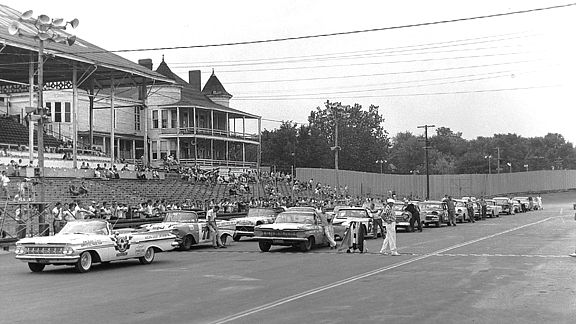 Getty ImagesBlast from the past: The Nashville 300 cranks up at Nashville Fairgrounds Speedway on Aug. 9, 1959.
There's a fight going on right now in Davidson County, Tenn., that could provide a monumental turnaround in the decades-long displacement of American auto racing's most endangered species: short tracks.
Godspeed, Sterling Marlin and Darrell Waltrip, in the effort to save storied Nashville Fairgrounds Speedway -- the short track of all short tracks -- from being plowed under by developers.
Marlin, Waltrip and their investors have an alternative urban revitalization plan that would preserve the .596-mile oval, which has been hosting auto racing for more than a century.
And, they argue, the future is uncertain for Nashville Superspeedway, the 1-mile track that opened in 2001 and took Nationwide and Truck races 20 miles from downtown, to exurban Lebanon. The newer track has failed to secure a Cup race date.
Should the superspeedway close and the fairgrounds flourish again, that would make for just one, but a resounding, about-face in a 20-year trend.
There's been a slippery slope of short tracks closing under the onslaught of boring new speedways built more with revenue-grabbing seating configurations than good racing in mind.
The old fairgrounds track is "the best racetrack in the country," Marlin told reporters at a media conference Thursday in Nashville. "It's the oldest racetrack [dating back to 1904], the best short track laid out ever. You can run side by side for 100 laps."
You'll forgive Marlin and Waltrip for their bias. The track was the cradle of both their careers.
But Marlin happens to be right about the quality of the racing there. Forlorn by Cup racing in 1984 due to its rundown state, the fairgrounds track runs far deeper in racing lore, into the very embryo of all NASCAR racing, the modified cars.
Marlin's group would make major improvements both to the track and the surrounding fairgrounds.
There isn't a NASCAR fan I know, or who e-mails here, or who comments on the ESPN Conversation, who doesn't want more short tracks on the Cup tour.
By and large, fans are fed up with the "cookie-cutter tracks," the boring 1.5-mile tri-ovals, several of them built in recent years, which are configured for good views from the grandstands but seldom produce good racing.
Currently there are only three short tracks left in the Cup series: the notorious half-miles at Bristol, Tenn. (five hours from Nashville) and Martinsville, Va., and the three-fourths-mile at Richmond, Va.
There is a struggling effort to revive North Wilkesboro Speedway in the heart of North Carolina moonshine country, but there's no hope on the horizon for the return of Cup racing.
A huge issue for Wilkesboro, and a chronic threat to Martinsville, is that their markets are rural and small-town. Nashville, on the other hand, is a metropolitan market.
Back in its Cup day, Nashville was paired with Bristol in the same sentences about the beatin'est, bangin'est racing on the tour.
Marlin said NASCAR officials have indicated to him that "if the track does close in Lebanon, they [NASCAR officials] would definitely be interested in coming back out here to the short track with two Nationwide races and two Truck races."
That doesn't at all amount to commitment to a Cup race there, and the Cup schedule is overcrowded as it is, with 36 races.
But we can wish and dream, can't we? And you can bet that, with televising of Nationwide and Truck racing at the old fairgrounds, would come a clamor from the fans for Cup to return to Nashville.
The road back remains long, uphill all the way. But at least two tradition-conscious drivers have turned and made a stand for reversing a fan-infuriating trend and returning to what fans want most.
I ran across what might be a monumental question for hard-core NASCAR fans while going over the transcripts of the postrace media conferences at New Hampshire.
Would a grassroots champion heal your spirit, bring you back, restore your faith in NASCAR as a sport of the common folk?
Would Clint Bowyer ring your chimes?
Is a hero in cowboy boots what you've been missing in NASCAR all this time?
NASCAR hasn't had what you could call a common-man champion in a decade, since Texas-born, North Carolina-raised Bobby Labonte won the old Winston Cup.
 AP Photo/Mary Altaffer) New Hampshire winner Clint Bowyer showed up for last week's Chase media blitz in New York wearing a plaid shirt, blue jeans and cowboy boots.
Some would say Tony Stewart's two titles since then are the exception. But Stewart came in from IndyCar racing, and has been so volatile and candid in his time at the Cup level that he hardly counts as a good ol' boy.
You don't get any more Heartland America than Emporia, Kan., where Bowyer is from. He is off the short tracks, especially dirt tracks. Nothing fancy in between there and the Cup level.
And he is a charging dark horse, to be sure.
All this hit me when I saw that somebody had asked Bowyer following his New Hampshire win about showing up in New York the previous week, for the Chase media blitz, wearing a plaid shirt, blue jeans and cowboy boots. "Reminiscent of you and your old buddy," the questioner pointed out to team owner Richard Childress, apparently meaning the late Dale Earnhardt.
Upon beholding Bowyer's country getup, Bowyer told reporters, Stewart "called me hillbilly."
The questioner persisted to Childress: "The typical fan -- weren't we looking for a guy as likeable as Clint that we can have a beer with?"
"Funny you say that," Childress responded. "Mike Dillon [RCR's vice president of competition] came over to me in [the] winner's circle and said, 'This is the best thing for NASCAR. We need somebody like Clint Bowyer winning races and running for this championship. Because Clint, he came from the short tracks, the dirt tracks. He's worked and earned his way to where he is today. The fans love him. It's what I think NASCAR needs is a new type of hero, blue jeans, plaid [shirt], whatever. It's good.'"
In case you don't know much about Mike Dillon, I will tell you this: He ought to know a genuine, certified good ol' boy when he sees one.
So I'm asking: What do you think?
I mean, a guy in cowboy boots is red hot, having shot from last in the standings to second in just the first race of the Chase.
He's not at all one of the cool kids who've won all the titles since Labonte -- Jeff Gordon, Stewart, Matt Kenseth, Kurt Busch, Stewart again, and then of course Jimmie Johnson, Jimmie Johnson, Jimmie Johnson and Jimmie Johnson these past four years.
Bowyer's is the visage of the common man. His demeanor is a revival of the aw-shucks variety.
And then there is his team owner, Childress himself, the completely self-made man who won six championships with Earnhardt but hasn't won the Cup since 1994.
"Cowboy boots? I've got mine on right now," Childress said.
Would this do it for you, common folk? Would Bowyer as champion redeem NASCAR in your eyes?
I'm just askin'.
The Four's sports bar, near the Boston Garden, was where NASCAR playoff top seed Denny Hamlin and New Hampshire Motor Speedway president Jerry Gappens chose to hang out Monday afternoon.
Though the bar's name originated with the jersey number of Boston Bruins legend Bobby Orr, Gappens now takes it to symbolize all four of Boston's pro sports franchises, whose logos The Four's displays.
He and his track want in on that action. Might they dare hope to make it The Five's someday?
"Yeah. Exactly," Gappens said by cell phone from the establishment.
NASCAR's Chase for the Sprint Cup championship opens Sunday at the Loudon, N.H., track, and although race fans across New England are enthusiastic about that, NASCAR covets more sports hearts in downtown Boston.
Hamlin, coming off his sixth Cup win, best in the series this season, at his hometown track at Richmond this past Saturday night, knew he wasn't exactly in laid-back Virginia anymore.
For sports markets, "I think it's the big three -- it's L.A., it's New York, it's Boston," Hamlin said. "It's amazing to see how almost crazy these fans are about their sports."
But, noting that "Every picture on the wall is Boston-sports related" at the place rated America's best sports bar by Sports Illustrated, Hamlin admitted that "We need to work on the NASCAR pictures, for sure."
"The challenge here that I've found in my two-and-a-half years since moving up here [from Charlotte Motor Speedway, in the NASCAR epicenter] has been just getting on the radar screen with the Boston media," Gappens said.
 AP Photo/Jim ColeNothing says "Welcome to New England" like a big ol' lobster for the winner of races at New Hampshire Motor Speedway.
"When you're in a market with the Red Sox and the Celtics and the Patriots and the Bruins, who have all had great success in their franchise history, you've got to recognize that.
"I tell people that I don't expect New Hampshire Motor Speedway and NASCAR to become more popular than the Red Sox Nation," Gappens continued, "but my goal is that at least when they're talking about professional sports in the Greater Boston area, New Hampshire Motor Speedway and NASCAR are at least in the same paragraph if not in the same sentence."
Not that Greater Boston hasn't helped fill the grandstands since the track -- about a 90-minute drive from Fenway Park, or from The Four's, or from Logan International Airport -- began hosting Cup races in 1993.
"Twenty-two percent of our ticket sales come from Massachusetts," Gappens said. "That's the Greater Boston area. I don't think we're real strong in downtown Boston proper. But in the surrounding areas, there are pockets of communities that are very important to us. There are neighborhoods that we draw very well from."
That just might make NHMS the favorite New Hampshire day trip of Greater Bostonians, except for maybe New Hampshire's state-owned discount liquor stores.
Arguably, the New Hampshire track might never have gotten a Cup race date, let alone two, let alone the opening round of the Chase, if NASCAR hadn't wanted so badly to be in the Boston market.
Yet NASCAR doesn't want to slight its backbone fan base across smaller-town New England.
"The proximity to Boston was a factor [in awarding the track Cup dates], but there are other factors," NASCAR spokesman Ramsey Poston said via e-mail Monday, including "the fact that there is a great racing fan base in New England, in part thanks to the successful NASCAR Modified series" at short tracks around the region.
"Every time we go to New Hampshire, the stands are full, and the fans come early, even for qualifying," Hamlin said. "It's like no matter what sport is going on up here, people go all out or not at all. And that's what I love about it."
This time, because of the tough economy, the track's 93,521 seats aren't sold out for Sunday's race.
"New Hampshire has traditionally sold out, and I think we're doing better even in these economic challenges than a lot of other tracks," Gappens said. "There are a lot of race fans in New England. That's been one of the things that surprised me, coming from Charlotte where I knew there were a lot of race fans, down there in the Southeast, kind of the epicenter of the sport."
Hamlin hasn't won at Loudon since 2007, but his branch of the Joe Gibbs Racing team is so hooked up now that he figures NHMS is as good a place as any to begin what many feel will be his cutoff of Jimmie Johnson's record four straight Cup championships.
"It's been a track where we haven't been our best the last two years or so," Hamlin said. "We finished second in the Chase race here last year, but we just haven't had a great car here in the last couple of years."
But New Hampshire is a 1-mile track -- a short track in Hamlin's book, as is the .75-mile Richmond oval.
"Hopefully we take what we learned at Richmond and apply it," he said. "And if we can, we should be pretty good."
And maybe, just maybe, good enough to get his picture on the wall at The Four's someday.
 Chris Graythen/Getty ImagesAtlanta Motor Speedway has plenty of competition for NASCAR fans' dollars.
My family calls Atlanta home, and although none of us live there now, we hope to move back as soon as possible. We love all 90 miles of it north to south, all 150 miles of it east to west -- reckoned once by "Time" magazine to be the largest settlement, by land mass, in the history and even the archaeology of Homo Sapiens.
I was on the far north side on personal business, in the South's most civilized mountains, when the news broke -- rather, blipped faintly on Atlanta's radar screen and then disappeared -- that Atlanta Motor Speedway is losing one of its Cup races.
In what is now the nation's seventh-largest television market (currently estimated at 5.6 million people), the big three newscasts each gave the report 30 seconds or less. The anchors tried to sound somber, but there was a tacit undertone of good riddance.
That was all the report was worth, what with the Braves hosting San Francisco, the Falcons in camp and the populace's four favorite college football teams -- Georgia, Auburn, Georgia Tech and Florida -- all nationally ranked in the early polls.
By contrast, they're holding a b-i-i-i-g deal media conference Tuesday in the 32nd largest TV market, Cincinnati/Northern Kentucky, to announce that the Cup race removed from Atlanta will land at Kentucky Motor Speedway next year.
There'll be at most a blip on Atlanta TV screens.
You may wonder how and why the South's largest city, by far, and the very birthplace of stock car racing as we know it, could lose a Cup race and not even care.
For openers, Atlanta in fact is losing only one of four annual Cup races, the other two being at Talladega, Ala., 90 minutes away on I-20 and long preferred by north- and west-side race fans due to the easier drive home than from way down in Hampton, Ga., through all that traffic.
The rest of it all came back to me the other day, having lunch in the storied Dawsonville Pool Room, epicenter of Georgia's -- indeed, all -- stock car racing history and the moonshiners who begat it.
The walls are covered with photographs and paintings of the NASCAR cornerstone Raymond Parks, the driving Flock brothers (Bob, Fonty and Tim), Roy Hall, Lloyd Seay, Gober Sosebee, Bill Elliott, and the downtown Atlanta mechanic who birthed the speed in moonshine cars and then NASCAR, Red Vogt.
Dawsonville lies on the northern end of this vastest of all human settlements. Ninety miles to the south, on the opposite end, lies Atlanta Motor Speedway.
Between the pool room and the racetrack, between the cradle and the modern venue, dwell those 5.6 million people, commuting 100 million miles a day -- a day, mind you -- in their cars.
The racetrack's environs have long been more a part of sleepy, less-prosperous rural Georgia than of booming Atlanta. And the far south end has only recently begun to prosper -- and only because the north end is full, all the way to the mountains.
The original track owners went south solely for the cheap land in 1960, when they didn't think Atlanta, or NASCAR, would ever get big enough for location to matter much.
They should have built it up north, nearer the mountains that spawned the 'shine runners who spawned the sport, nearer the passion, nearer the history, and then Atlanta's racetrack for these 50 years would have been the very heart of NASCAR.
It's a geographical mistake that not even the iron-willed track tycoon Bruton Smith could overcome, in nearly 20 years of trying. He thought it was a can't-miss project, considering such a population.
When Smith was acquiring AMS, and I still lived in the ATL, I suggested to his lieutenants that their money would be better spent buying the old track, closing it down, and taking the two Cup dates to a new track somewhere to the northeast, out past Road Atlanta and Atlanta Dragway.
The access not only from metro Atlanta, but from the Carolinas, would have been much better.
But Smith barreled ahead with his spectacular improvements and reconfiguration of the track … and still it was a struggle to draw.
It still is. And it always will be.
The Saturday after the news broke, there was a big reunion of old-timers to reminisce about Atlanta's most beloved old racetrack -- Lakewood Speedway, the 1-mile dirt track long ago razed from inside the city itself, where in the 1930s the moonshiners came down from the mountains to organize a sport called "stock car racing."
Having a few days earlier spoken to a reception at the Houses of Parliament on the state of the British economy, McLaren executive chairman Ron Dennis was speaking with a gaggle of NASCAR reporters in heartland Indiana.
He was touting electronic wares he wants to sell to Cup teams. Considering the unimaginable sophistication of the systems I knew he could offer, I couldn't resist one mischievous little interjection.
"They don't need launch control," I said to him.
For the uninitiated to Formula One, launch control is a computer-driven system with which, for the standing start of a Grand Prix race, a driver simply sits there and does nothing when the light goes green.
Moments later the passenger finds himself in the lead in the first corner, then takes control and becomes the driver.
It's cheating of course -- to a degree of sophistication that would cross the eyes of every crew chief from Junior Johnson to Chad Knaus. It has never actually been caught by FIA inspectors in F1.
But its use has been highly suspected at times, and leaks from within teams have given the stories credence. And there is no doubt that F1 teams are technologically capable of deploying such systems.
NASCAR of course has rolling starts, and so truly doesn't need launch control.
Dennis' reply was barely above a whisper, which is his normal tone of speech: "You're trying to get me to say something to get me in trouble, aren't you?"
And he smiled that tiny smile which is the most facial expression I've ever seen from him, in 20-plus years of various interviews and news conferences. By the way, from our first meeting in 1990 in Phoenix to last weekend at sweltering Indianapolis Motor Speedway, I've yet to see him shed a single drop of sweat.
The man's demeanor is pure dry ice.
That comes across as aloof, even contemptuous, to some upon first encounters with him. But it's actually keen observation, listening before speaking, seeing more than most, telling little of what he has seen.
We all wanted his impressions of NASCAR, which during my time around Formula One was considered an oafish, showbiz form of exhibition that was motorsports' version of wrestling.
Now it's business, and in order to sell fuel injection systems -- and perhaps electronics beyond that -- to NASCAR, Dennis must learn about NASCAR.
"I have a saying which is somewhat morbid: The last thing I'm going to learn is how to die," he said. "Only a fool doesn't learn at every opportunity."
He'd been visiting with some of the team owners in Gasoline Alley as they prepared for the Brickyard 400.
"I find the whole trip so far fascinating -- and not as I expected it to be, to be honest."
I asked how he'd expected it to be, and how he actually found it.
"It's more sophisticated than I anticipated it to be," he said. "The cars are beautifully prepared …
"There's a big commitment from the NASCAR officials to be even-handed." And, "There's definitely a more relaxed atmosphere than what I was expecting."
His big-picture perceptions of NASCAR were keener -- and considerably different -- from what I'd expected from him on his first visit ever to a NASCAR event.
The man from the realm of quantum leaps in technology, then sudden restrictions of it, then quantum leaps again, admires NASCAR's slowness to change.
"I hate change in F1, because it costs money. But the upside is, 'Keep changing things, guys.' Because as a team [McLaren has long been one of the elite, like Hendrick Motorsports and Joe Gibbs Racing here] we're better equipped, more resourced and everything, to adapt to change.
"So if you want to stretch the grid, all you've got to keep doing is introduce change. The top guys will always be on top, because they'll have more brainpower and resources.
"If you want to squeeze the grid, add more stability. And the reason you've got a grid that is constant [in NASCAR, with relatively equal cars and several potential winners], is because they don't keep mucking around with the rules all the time."
At least not as often or as drastically as in F1.
Yet he disagreed with my suggestion that NASCAR has more different winners than F1, where annually there are only one to three winning teams, usually including McLaren.
"I would say 90 percent of all the winning in NASCAR is between four teams," he said, quite reasonably. "You've got 43 cars, which is double the number of cars [on a Formula One grid]."
So percentage of winning teams is "roughly the same. You've got about the same winning cars that we've got. So at the end of the day, it doesn't matter."
On the universal motor racing issue of cheating, he said he can guarantee NASCAR "tamper-free systems."
Again in that near whisper, in his most subtle deadpan, Dennis proclaimed that "I wouldn't accuse any competitor in any form of motorsport of deliberately setting about trying to circumvent a control system."
And then of course the gaggle of reporters busted out laughing, but Dennis' expression remained entirely suitable for the final table in the World Series of Poker.
"But motor racing is full of suspicion," he said. "And if the teams absolutely, categorically believe that it [cheating] can't be done, then they relax and trust in the supplier."
Ah, the sales pitch. To do business with NASCAR, the baron of McLaren is learning NASCAR -- and fast.
Awhile later, out in the garage area, I ran into Chip Ganassi, the versatile team owner who fields cars in NASCAR, IndyCar and the Rolex Series for sports cars, and follows F1 closely.
I told him Ron Dennis was pitching cheat-proof electronic systems.
"Isn't that interesting?" Ganassi said, breaking into that rowdy Pittsburgh grin of his. "Ron Dennis saying cheat-proof."
Are they nuts?
That's the thought that kept flashing -- in neon -- in my mind as Wednesday's stiffly choreographed, yet largely chaotic Indy Racing League "announcement" of its car plans for 2012 stumbled and stammered on and on.
Before the discombobulated display began, I'd thought the best possible scenario would be for the IRL to accept all five car designs that had been submitted. That would bring back diversity and innovation.
Worst possible scenario would be acceptance of only one of the designs. That would further mire the league in the kit-car, spec-racing formula that has left Indy car racing dwindling interest and attendance in recent years.
What was announced was worse than one car: no car.
Essentially, after all that buildup to the unveiling of a bold new design or designs, they continued treading water, put off the real decisions indefinitely.
 Ron McQueeney/Indy Racing LeagueIndyCar Series boss Randy Bernard has a heck of a road trip coming up to get manufacturers to buy into his sport's new vision.
 Oh, they rolled out a rolling chassis. But that's a far cry from a full car.
Whose rolling chassis? Wouldn't you know it? After all that hoopla about wide-open technology, IndyCar is back in bed with its old spec-car partner, Dallara Automobili. Deeper than ever this time, with Dallara agreeing to open a plant in Indiana to hire Hoosiers -- in exchange, of course, for various tax breaks and grants from the state and local coffers. All this to create maybe 100 jobs.
Onto this rolling chassis, the IRL will allow the attachment of various "aero kits" to be approved and announced … well … sometime in the future.
At first the open-ended aero kits seemed something of a way to please all the engineering firms that submitted car designs. BAT, DeltaWing, Lola and Swift are all welcome -- but not their original, highly publicized designs.
They're all welcome to -- er, ah -- resubmit designs compatible with the Dallara rolling chassis.
Also invited are any and all automotive, and even aircraft, manufacturers around the world. Come and bring your own aero packages and make Indianapolis Motor Speedway the cutting-edge proving ground it once was.
"So come on, Ford. Come on, GM. Come on, Lotus, Ferrari, Boeing, Lockheed," cheered British engineer Tony Purnell, a member of the IRL's ICONIC committee that came to Wednesday's recommendation.
Pardon me if it sounded like LeBron James' over-the-top counting last week of "not four championships, not five championships, not six championships, not seven championships …"
The idea that a Ferrari or a Boeing would spend big to develop an aerodynamics package for a 21st century racecar, only to sell it to competitors for a maximum of $70,000 per car, seems tenuous at best.
Every time the IRL lifts off toward new heights of innovation, it applies its same old ruinous brakes, severe cost controls.
Finally, after the Internet-streamed presentation circus abated and we got down to a teleconference, I asked IRL competition president Brian Barnhart if the league had undercurrent commitments from manufacturers, or if this simply amounted to one of the great leaps of faith ever in motor racing?
As for the aerospace industry, "It's kind of a natural to challenge that industry to get involved," Barnhart said. "With regard to the automotive manufacturers, we have had some preliminary dialogue, and it has been exceptionally well received."
The idea is that a Ford-developed aero kit could be called a Ford car, and pack a Ford-developed engine so that in the future, rather than driving a "Dallara-Honda," a driver might simply be driving a "Ford," or "Chevrolet," or "Honda," or whatever.
Which might leapfrog the IRL ahead of NASCAR in brand identification -- except that the "Ford" would really be a Ford on top of a Dallara chassis.
Randy Bernard, the IRL's new CEO, said manufacturers brought into the loop "have said it's very exciting that they could create brand identity with their cars."
Trouble is, "we haven't been able to talk with everyone because we wanted to keep everything as confidential as possible, so we were very selective in our first round," Bernard said.
See? There you go. It's a huge leap of faith, without strong commitments from several manufacturers. Bernard plans a trip to Europe next month to talk with engine manufacturers there, to discuss engine and aero packages that could be called simply "Mercedes" or "BMW."
But that's essentially a sales trip, to make inquiries and proposals.
As the marathon announcement wore on, and they began to make some sense, I decided they're not nuts, but they are very broadly wishful in their thinking.
Here's hoping that it works, that we might again see Indy unveil innovations upon innovations, as it hasn't since the 1920s when the genius Harry Miller and the Brothers Duesenberg were high-tech archrivals. Maybe at least, on the more realistic side, we could see at least the diversity of cars I encountered when I started covering Indy 35 years ago -- the Coyotes, Wildcats, McLarens and various "specials."
But during Wednesday's rambling -- hard to call it an "unveiling" because so much is still so veiled -- through such a lofty, nebulous, unfinished plan, well …
First I got this image of the IRL sprinting headlong toward a cliff and taking a flying leap off … then of it hanging in midair, flapping its arms with all due intensity.
I'm not saying it won't fly. But I am warning: Look out below!

Dale Earnhardt Jr. had to do just this one thing, just this once.
True, it happened in a Nationwide race, NASCAR's version of Triple-A baseball -- but, hey, don't major league teams send pitchers down to the minors for little stints to recover some confidence?
Earnhardt handled it with dignity and confidence, without so much as a crack in his voice, as he told how anything but winning would have been total failure: "If you didn't win, what a waste of time," he told ESPN reporters in Victory Lane.
 Chris Graythen/Getty ImagesFans of Dale Earnhardt Jr. -- and the late Dale Earnhardt Sr. -- hold up three fingers in support of the No. 3 Wrangler Chevrolet during Friday night's Subway Jalapeno 250 at Daytona.
I had honestly thought he was wasting his time, thought it was yet another commercial promotion -- can you blame me, with all the profitable folderol that goes on in NASCAR? And so, honestly, I watched the Subway Jalapeno 250, a prelim to Saturday night's Coke Zero 400, from my hotel room.
Turns out it wasn't all crass promotion, as is so common in NASCAR. "We just carved some money out of the personal services contract," Earnhardt said of the deal he has with Wrangler to do TV commercials.
It was something he wanted to do, had to do, and surely the ghost was whispering to him as he drove through the fourth turn, past where his father was killed in 2001, on the final lap in a car numbered 3 for both of them. Surely the ghost whispered the old Earnhardt mantra, "Second place is just the first loser."
The ghost and the legend began here in a black car. The last year Dale Sr. drove a Wrangler car, blue and yellow, Junior was 13 and in military school, sent there largely on the decision of the stepmother who has troubled him since he was 6 -- his father's third wife, Teresa Earnhardt.
Junior was something of a runt in 1987, and once on the parade grounds at Oak Ridge Military Academy in North Carolina, I saw him break formation on a Friday afternoon and run and hug his father as hard as a kid can hug a father, and Dale Sr. stood there with his arms hung down beside him, seeming not to know, really, how to respond.
It was gut wrenching.
That's the way it always was with them, Junior seeking his father's esteem with all his heart, eventually hurtling uncertainly around racetracks chasing love.
Leaving Oak Ridge that same day, I remember that Dale Jr.'s older sister, Kelley, was unhappy all the way home in the station wagon, no matter how Teresa schmoozed her.
That's the way it was, all the way until 2007, when Dale Jr. and Kelley broke away from Teresa, and signed with the genial and fatherly Rick Hendrick for the 2008 season.
The rest, of course, has been historic disappointment. Junior had won but one points race for his de facto surrogate father, at Michigan in 2008.
But this time, "Everybody pitched in," Junior said Friday night. God, I hate that term, "Junior," and I think he has lived through enough to be called simply "Dale" now, and that's how I always address him: Dale. He has earned that.
Anyway, this "promotion," as The Associated Press called it -- but I don't have the heart to call it that anymore -- was a cooperative effort among Hendrick Motorsports (engines), Senior's longtime car owner Richard Childress (rights to the number), Dale Jr. and Kelley's JR Motorsports, and Teresa.
Dale -- the living one -- also had the benefit of his Cup pit crew from Hendrick.
This was Dale's first win in a NASCAR points race of any kind since Michigan '08, and his detractors -- and they are many -- had spat on his name, that name that is such a burden to bear, as if he were worse than a has-been, as if he were a never-was, even though he has 18 Cup wins.
Others pitched in, too: Kevin Harvick, the one chosen to sit in Senior's seat in the spring of '01, didn't get a very good restart on the final green-white-checkered. Joey Logano pushed Earnhardt way out front on that final restart and then wasn't able to mount much of a challenge those last two laps of overtime.
It was billed as a tribute to Dale Earnhardt. It turned out to be a tribute to the guts, the perseverance, the psyche, of Dale Earnhardt Jr.
He might never win seven championships, and he's a long way from NASCAR's Hall of Fame.
But Friday night, he drove a blue-and-yellow car into Victory Lane at Daytona.
"This is it," said the only living Dale Earnhardt. "No more 3 for me."
ABOUT THIS BLOG

Ed Hinton
Ed Hinton is a senior writer covering motorsports for ESPN.com. He has nearly 40 years' experience covering NASCAR, open-wheel racing and other major sports for several metro daily newspapers and two national publications.
Ed joined ESPN.com in 2008, most recently having been senior reporter for motorsports at the Tribune Co. newspaper chain, where his work appeared in the Chicago Tribune, the Los Angeles Times, Newsday, The Baltimore Sun, the Orlando Sentinel and other papers. Previously he was a senior writer at Sports Illustrated and a national writer for The National Sports Daily.
Ed has written two books and won numerous awards for motorsports and general sports writing, including the Scripps Howard Foundation First Amendment award.
Ed holds a B.S. degree in journalism from the University of Southern Mississippi, and also attended the University of Mississippi.