Multifaceted racing team owner Chip Ganassi and his Izod IndyCar Series driver Dario Franchitti were the stars of the 40th annual All-America Team Banquet staged by the American Auto Racing Writers and Broadcasters Association (AARWBA).
 AP Photo/Terry RennaDario Franchitti, left, and team owner Chip Ganassi wrapped up the 2009 IndyCar Series championship at Homestead-Miami Speedway in November.
Hosted by John and Ashley Force at John Force Racing's spectacular new facility in Brownsburg, Ind., on Jan. 16, the AARWBA banquet brought together several hundred dignitaries from all forms of auto racing. Franchitti won the Jerry Titus Memorial Award, presented by AARWBA to the year's top driver, for the second time in his career.
Yet it was team boss Ganassi who stole the show with a poignant speech about his 47-year love affair with auto racing. Ganassi made a passionate plea for the leaders of the sport to understand that racing's survival in the future depends upon whether it can stay relevant in dramatically changing times for the auto industry. To do so, he said, racing must make a priority of focusing on technical innovation by embracing new, cutting-edge technology -- even if that means upsetting some traditional elements of the sport.
In his speech, Ganassi confirmed that engineer Ben Bowlby (a member of the Target Chip Ganassi Racing IndyCar Series team) has spearheaded research and development of the so-called Delta Wing car that has been proposed as an alternate blueprint for the Indy car of the future. But he was quick to refute the notion that the Ganassi organization claims ownership of the concept, and he also stated that even if the basic blueprint for the radical new car is approved, traditional chassis suppliers including Dallara could still be involved in a manufacturing and distribution capacity.
"Will it work? Will it go fast?" queried Ganassi. "I'm sorry to say I'm not going to announce it here tonight, but next month it's going to debut at a major auto show" -- likely the Chicago Auto Show, scheduled for Feb. 12-21 -- "and I'm confident it's going to achieve those trends and will have the same performance as the current car.
"It's a big step forward in meeting this modern-day challenge of achieving the same performance with far greater efficiency. And if we're going to survive in this industry, that's what we need to have -- greater efficiency with the same performance and the same speed. And that same feeling when you're sitting and watching in Turn 1 at Indianapolis."
Ganassi insisted that the status quo is no longer sufficient for racing to keep fans, sponsors and manufacturers involved and invested in the sport -- whether in NASCAR, IndyCar, sports cars or even Formula One.
"We in the racing industry need to be bold in meeting and demonstrating tomorrow's technology and innovations, showcasing what can be achieved as we embark on a new era of efficiency," he said. "In order to keep the sport of auto racing healthy, it's going to take our collective efforts."
Franchitti earned the Ganassi team's second consecutive IndyCar Series championship in 2009 and third overall. TCGR also claimed four consecutive CART-sanctioned Indy car titles from 1996 to 1999 with drivers Jimmy Vasser, Alex Zanardi and Juan Pablo Montoya.
Dario won his first Titus Award in 2007, when he won the Indianapolis 500 and the IndyCar Series championship while driving for the team now known as Andretti Autosport.
"I love being a part of the Target team, being around like-minded people," said the Scotsman. "I'm going to keep doing it as long as I enjoy it and as long as I'm competitive. I think the two are quite linked, actually."
As a keen enthusiast for all forms of motor racing, Franchitti took delight in touring Force's 300,000-square-foot facility, which incorporates the Eric Medlen Project -- a research foundation sponsored by Ford Racing dedicated to improving safety in drag racing and other forms of motorsports. Medlen was killed testing a JFR Funny Car in March 2007 at Gainesville Raceway.
"I got to meet John Force -- how cool is that?" exclaimed Franchitti. "He's like Jackie Stewart in cowboy boots!
"That's the good news," he added. "The bad news for Chip is that [Force] offered to give me a go in one of his cars!"
Green is the theme at this year's North American International Auto Show, set to run through Jan. 23 at Detroit's Cobo Center.
Racing cars are virtually extinct at the NAIAS, and the show's annual Racing Day is a thing of the past as manufacturers increasingly turn to hybrid and electric technology in an effort to boost fuel economy.
 AP Photo/Carlos OsorioMark Fields, executive vice president at Ford Motor Co., holds up the 2010 North American Truck of the Year award (Ford Transit Connect) and Car of the Year award (Ford Fusion Hybrid) Jan. 11 in Detroit.
Although not as subdued as a year ago, the Detroit Show in 2010 is still a pretty quiet place compared to recent times. The swagger so often exhibited on home turf by America's Big Three automakers is conspicuously absent -- not to mention the massive trucks and SUVs that have dominated the U.S. transportation market for decades.
The combination of a reeling domestic auto industry and rising gas prices has resulted in a massive shift in priorities for the Detroit automakers.
The star of this year's Detroit show is the third-generation Ford Focus, which was developed by Ford's European division for worldwide sale.
It's hugely significant that Ford not only engineered one of its most popular and important models for an international market, but that it chose to debut the new design in Detroit instead of one of the European shows like Paris, Frankfurt or Geneva.
Ford executives are riding high thanks to sweeping the North American Car and Truck awards with its Fusion and Transit Connect models, and the company invested far more money and effort in its NAIAS display than did its domestic competitors, General Motors and Chrysler. Ford's other major news was the introduction of a punched-out 5.0-liter V-8 engine and trim package for the Mustang.
GM's stand featured minimal frills, with the focus devoted to the cars and trucks sold by its remaining brands (Chevrolet, Buick/GMC and Cadillac). Key new production models on display include the American-spec Chevrolet Cruze and the latest iteration of the Buick Regal. The Cruze is GM's chief competitor for the Ford Focus, while the Regal is a badge-engineered version of the Insignia sedan produced by GM's European brand Opel. Another important model for GM is a two-door coupe version of the popular Cadillac CTS, which was also shown in CTS-V trim.
Chrysler's lack of fresh upcoming product was painfully obvious. A curious addition to the Mopar display was a lightly worked-over Lancia Delta hatchback, rebadged as a Chrysler. Other indications of Chrysler's ties to Fiat Auto included a pair of Fiat 500 micro-cars the company hopes to pitch as a rival to premium small cars such as the Mini and the Volkswagen Golf.
VW put on by far the most ostentatious presentation to the estimated 5,000 media representatives on hand for the opening show, featuring strobe lights, smoke machines, thumping music and dancers. From a product standpoint, VW unveiled the New Concept Coupe, a Golf/Jetta based two-door notchback similar to a Honda Civic or BMW 3-series coupe.
In fact, the German manufacturers dominated the show with an impressive display of hardware and hubris. Separated only by an aisle from its former partner Chrysler, Mercedes-Benz debuted the E-Class convertible and showed off the AMG SLS supercar with its gull-wing doors. BMW rolled out its funky hatchback 5-series GT, while Audi previewed the sports coupe of the future with its electric e-tron concept car, believed to be a near-production-ready design to be sold as the R4.
The Detroit show used to be famous for its over-the-top concept-car offerings, especially from Chrysler. This year, at a show almost fully devoid of future preview machines, GM grabbed the spotlight with the Cadillac XTS Platinum, a large sedan set to replace the existing STS and DTS lines.
Whereas recent Cadillac show cars were powered by fantasy league V-16 powerplants, the XTS features a direct injected 3.6-liter V-6 with hybrid capability. All in all, the XTS is a surprisingly accurate glimpse into the future of the large American luxury sedan.
At the other end of the spectrum, Honda unveiled the CR-Z coupe, intended to inject some fun into the hybrid market while still providing upward of 40 mpg. The CR-Z is the first hybrid vehicle available with a six-speed manual gearbox.
The message coming out of Detroit was clear: Although fuel economy has become the priority, performance will not be sacrificed. American consumers should just expect to get their horsepower in the form of turbocharged or supercharged four- and six-cylinder engines rather than the traditional V-8.
In that respect, American automakers are simply -- or, to be more accurate, finally -- falling in line with the rest of the world.
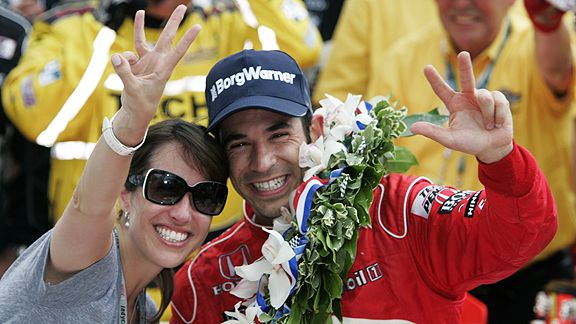 AP Photo/Michael ConroyHelio Castroneves has won the Indy 500 three times. His next goal is winning his first IndyCar Series title.
Every Izod IndyCar Series driver was at the Indianapolis Motor Speedway on Tuesday for physical exams and mandatory winter safety meetings. Helio Castroneves had an additional reason to come to town.
The 34-year-old Brazilian again celebrated his victory in last May's Indianapolis 500 by unveiling his most recent visage on the iconic Borg Warner Trophy and collecting his Herff Jones "Champion of Champions" ring in a ceremony at the IMS Hall of Fame Museum.
With three wins at Indianapolis, Castroneves is indeed a champion among champions when compared to other top IndyCar Series drivers. Although he has never corralled a series championship, Castroneves is the leading money winner in Indy Racing League history with $16,315,178. Nearly $6 million of that total was earned at the Indianapolis Motor Speedway.
Those Indy wins (not to mention a victorious effort on the ABC competition "Dancing With The Stars") also helped make Castroneves the most well known current IndyCar Series driver not named Danica Patrick.
He'll be back for his 11th campaign with Penske Racing, gunning for win No. 4 at Indianapolis and his first overall series title.
"It's just incredible," he said. "I guess I keep doing the right thing. I'm just honored to be in this organization. What I admire the most is the loyalty of Roger Penske and Tim Cindric and everyone.
"It's great just to be involved and race for that organization. You have a chance to win no matter what."
Castroneves was the first Indy winner since 2004 who didn't go on to become the IndyCar Series champion. Dan Wheldon (2005), Sam Hornish Jr. (2006), Dario Franchitti (2007) and Scott Dixon (2008) did the Indy/series championship double.
***
The IndyCar Series confirmed at the winter safety meeting that it will eliminate the cockpit fuel mixture switch from its cars for 2010. The change has allowed Honda to almost double the horsepower boost from its overtake assist system.
"It will allow the drivers more strategy during the event," said Indy Racing League senior technical director Les Mactaggart. "If they want to save fuel, they can by controlling the throttle and equally so the overtake assist will be more effective because they'll have more horsepower."
 AP Photo/Paul Beaty, FileThe IndyCar Series has some difficult decisions to make regarding its engine and chassis package.
More significant questions involving the development of a new engine and chassis for the 2012 season remain unresolved, and it appears battle lines are being drawn.
Honda recently indicated it is planning to build a turbocharged V-6 engine for Indy car racing. That goes against the wishes of a group known as Delta Wing LLC, which is developing an envelope-pushing new chassis designed to accept a four-cylinder power plant.
The Delta Wing project is led by Ganassi Racing designer Ben Bowlby, and several IndyCar Series team owners have endorsed building a prototype for testing and analysis.
Honda has repeatedly stated its objection to building a four-cylinder engine, but all signs point to Honda's being the only major auto manufacturer that is interested in participating in Indy cars in the future. IndyCar Series officials had been courting the Volkswagen Group and its VW, Porsche and Audi brands, but VW Group motorsport chief Kris Nissen has all but ruled out their participation.
"I am not 100 percent sure of the latest status, but I think it is not realistic for the moment that the VW group will do it," Nissen told Autosport.com. "Also IndyCar needs to settle down, and it looks like it is getting better. America needs to settle down, the car market needs to be stable again."
Caught in the middle is IndyCar Series competition president Brian Barnhart, who is believed to favor an evolution of the current Dallara chassis. Barnhart is under fire from teams and manufacturers for dragging out the decision with regard to the future direction of the series, and a fan group recently started an online petition to encourage his removal.
Barnhart and IndyCar Series officials must decide who they can most afford to lose: Honda and/or Dallara, or Ganassi and the majority of team owners who seem to favor a more radical shakeup of the rulebook and parts-supply system.
With the calendar now showing 2010 and the thermometer near zero, the Izod IndyCar Series is beginning to emerge from its offseason hibernation. Preseason media and test days at Barber Motorsports Park are less than seven weeks away, and information about new team/driver combinations is starting to trickle out.
Here's a recap of recent IndyCar Series news and developments:
Hunter-Reay confirmed at Andretti Autosport: The team formerly known as Andretti Green Racing confirmed that it will continue to field a series-high four cars in 2010, with the returning Tony Kanaan, Marco Andretti and Danica Patrick set to be joined by former IRL Rookie of the Year Ryan Hunter-Reay for at least a partial schedule.
 AP Photo/Tom StrattmanRyan Hunter-Reay will drive the No. 37 car for Andretti Autosport at the 2010 Indianapolis 500, among other races.
Hunter-Reay, who was instrumental in bringing the Izod brand into Indy car racing, will drive the No. 37 car with sponsorship from Izod at the Indianapolis 500 and a to-be-determined selection of other races. AA owner Michael Andretti is optimistic that funding can be sourced to run Hunter-Reay for the full season.
"We are excited about what we've put together with PVH [Phillips-Van Heusen] and Ryan, and believe we can grow this program substantially over the next several months," Andretti said. "How far we take him into 2010 is still in the works, but we feel good about the potential that we will add Ryan to our driver lineup for the full season."
Hunter-Reay is the only driver to have won races in CART, Champ Car and IndyCar Series competition. He drove for Rahal Letterman Racing in 2008 and split time between Vision Racing and AJ Foyt Racing in 2009.
"Michael Andretti is as hungry to win races today as he has ever been, and it is an honor and a privilege to drive for the same person I looked up to as a young karter," said Hunter-Reay. "Joining a team of Andretti Autosport's caliber has been my goal for the entire 16 years of my racing career, and being able to strengthen my ties to everyone at Izod through this effort is tremendous. This is the opportunity of a lifetime, and I am ready to give 120 percent to the program."
Japanese connection: There are likely to be two Japanese drivers on the IndyCar Series grid in 2010 as former Formula 1 racer Takuma Sato looks set to move to the American open-wheel scene with de Ferran Motorsports. Sato has an existing relationship with team boss Gil de Ferran, who served as the Honda F1 team's sporting director several years ago.
De Ferran has ceased its Honda-funded, Acura-branded American Le Mans Series program to eliminate conflicts of interest and allow its transition into the IndyCar Series, where all competitors are powered by spec Honda engines.
Hideki Mutoh, a veteran of two years in the IndyCar Series, is looking to move to Newman/Haas/Lanigan Racing, which is likely to field three cars in 2010. Emerging star Graham Rahal returns for his fourth season with the team, while Alex Lloyd hopes to complete his first full IndyCar campaign.
On a FAZZT track: The FAZZT Racing team made its on-track debut recently for testing at Homestead-Miami Speedway. Alex Tagliani drove the No. 77 car, which will unveil its livery Jan. 14 at the Montreal International Auto Show.
"These two days have been unbelievable," remarked Tagliani. "It has been the best days at the track for me in a long, long time. The team showed up, and by all appearances you would think we had been working together for 10 years."
Tagliani is a principal in the new team, along with Jim Freudenberg and Andre Azzi. Veteran Rob Edwards is team manager.
"This is a new team, but it is a group of individuals with many years of experience, and that was evident in the smoothness of the operation over the course of the test," Edwards said. "It was as much a test of the equipment as it was a test of our crew and how they would work together as a team, and I must say I believe we met our goals this week."
One-liners: The IndyCar Series' annual winter meetings take place in Indianapolis on Monday and Tuesday. Drivers will take their annual physicals, and details will be revealed to the teams about the March 14 opener in Sao Paulo, Brazil. ... The Dallara-Honda package will feature a reverse gear in its spec six-speed gearbox for road course events in 2010. ... Honda Performance Development and the IRL are discussing modifying or eliminating the driver's ability to control the fuel mixture during races. HPD's Roger Griffiths also indicated that the future IndyCar engine formula will be a turbocharged V-6. ... IndyCar owner/driver Sarah Fisher is writing a motivational book for women to be published in May and has started a campaign to lure talk show host Ellen DeGeneres to the 2010 Indy 500. Interested fans can encourage Ellen via a Twitter account created for the project: @ellen2indy500. The Indianapolis Conrad Hotel has already pledged accommodations for Ellen should she accept the invitation.
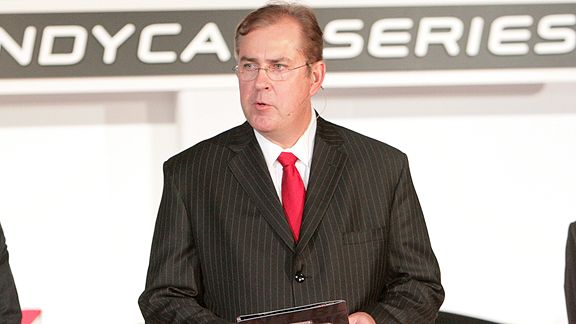 Ron Hoskins/Getty ImagesJeff Belskus has been a speedway and league insider for years.
One of the most important stories in Indy car racing during 2009 was the boardroom coup that resulted in Tony George being removed from power at the Indianapolis Motor Speedway. Even more surprising was George's subsequent decision to relinquish leadership of the Indy Racing League and the IZOD IndyCar Series, which he founded back in 1996.
George's roles with the IRL and IMS were taken over by Jeff Belskus, a longtime associate of the Hulman-George family who has worked for IMS since 1987. Like the Hulman family and many key members of Speedway management, Belskus is a native of Terre Haute, Ind., and he has been a friend of George through high school and into their time at Indiana State University.
A certified public accountant by trade, Belskus has long been known as the money man in the background of the IMS hierarchy. But with George's ouster from IMS and surprise move to distance himself from the IRL, Belskus found himself thrust into the spotlight.
Shy by nature, Belskus was somewhat unfairly roasted by Indianapolis Star columnist Bob Kravitz following his first public appearance in his new roles. But the key constituents of the Speedway and the IndyCar Series are comfortable with their new leader, mainly because he was quickly able offer a sense of calm and a "business as usual" approach to the issues faced by the track and the league.
"I think it has gone as well as anyone could expect it to go," Belskus said of his first three months as the outright leader of IMS and IRL. "I'm pleased with the way it has gone. Tony and I have a good working relationship and I'm happy about that. I'm still spending a lot of time learning the lay of the land in some respects. It's been a great learning experience so far and I feel good about the way it has gone."
Belskus' longterm association with the Indianapolis Motor Speedway Corporation gave him an insider's view of the workings of the company, a huge advantage over hiring an outsider to take over the notoriously private family business. He's not concerned that he could be stretched too thin by being in charge of multiple facets of the company.
"We have a good team in place at IMS that is very experienced and we depend on them," he remarked. "Even though I'm not there, I get e-mails and phone calls, but I have responsibility for running the Indianapolis Motor Speedway."
After relying solely on the Indianapolis 500 through 1993, the Speedway now hosts three major events a year. In 2009, attendance was down for the NASCAR Brickyard 400 and the second running of the Red Bull Indianapolis MotoGP race, but Belskus is not significantly concerned.
"Renewals [for the Brickyard] have been strong -- they are in line with last year," he said. "It's a higher quality product when you don't have to stop every nine or 10 laps for a competition yellow [as happened in 2008], so we hope those problems are behind us and we can win back the fans we lost as a result of that.
"Having said that, it seems like NASCAR in general, whether it's the economy or whatever it is, has certainly had their share of attendance issues this year. It's a good event for us and we hope it continues to be a good event for us. We met expectations this year. We planned for it to be off, but I think that was as much about the economy as it was about the event."
A bigger adjustment has been required in terms of managing and being the public face of the IRL. One of the toughest tasks he already dealt with was cutting staff by approximately 40.
"It's an ongoing process," Belskus said. "We're doing what we can to review everything for efficiencies to try to be as productive as we can be. I know my way around the racetrack pretty well and there haven't been too many surprises about what's going on with the League at these events. Terry Angstadt [Vice-President of Marketing] and Brian Barnhart [Vice-President of Competition and Operations] are working hard and doing a good job, and I think we deliver a lot of value."
The IndyCar Series got a huge boost in early November when it was revealed that apparel manufacturer IZOD signed a multi-year contract for title sponsor rights. Most importantly from Belskus' perspective, IZOD is essentially going to pick up the tab for the TEAM subsidy program that pays each full-time competitor up to $1.2 million annually in lieu of prize money.
"Getting the right [title sponsor] was important," Belskus said. "We spent a lot of time talking about 'fair value' and what the series is worth. We're very excited about being associated with IZOD, a brand that we feel good about."
The other bullet the IRL dodged was Danica Patrick's potential move to NASCAR. In the end, America's favorite female racer elected to remain with Andretti Autosport in Indy cars fulltime for at least the 2010 season while beginning to sample the world of NASCAR with a limited schedule for JR Motorsports in the Nationwide Series.
"She's great for our series and an important part of our series," said the IRL leader. "We hope to see her as a part of it for many years to come. I won't say it's absolutely necessary, but we'd prefer to have her here, given our druthers. My hope is that she's going to continue to be an Indy car driver first and foremost."
Belskus said that Indy car racing fans shouldn't expect radical changes to the IRL schedule or the Indianapolis 500 during his watch. However, at a Dec. 9 meeting, the IMS board did approve a plan to shorten the month of May Indy activities to include just one week of practice and a single qualifying weekend.
"We will still be primarily a North American series, though international events are important to us," Belskus said. "We need a compelling reason to do the international events and it is important from that perspective. For Japan, it's because of Honda. We're looking at three or four international events as the most. I don't see it as a significant portion of our schedule."
Danica Patrick (The Celebrity), representing Danica Patrick (The Brand), appeared on ABC's "Good Morning America" on Monday to announce that Danica Patrick (The Race Car Driver) will continue to make competing in the Izod IndyCar Series her primary occupation for the next three years.
Joined by Andretti Autosport owner Michael Andretti, Patricck revealed that her No. 7 car will enjoy primary sponsorship from GoDaddy.com, the controversial Web domain vendor and Web site developer. No mention was made of the N-word (NASCAR).
Although the news is good for the IndyCar Series, which can now theoretically count on keeping its most recognizable and marketable star for the foreseeable future, my initial reaction was: Who cares?
Honestly, this non-story has been festering for the past 10 months. I asked Patrick questions about her contract year back in February at IndyCar Series media days, and, frankly, she was more forthcoming about it then than would prove to be the case throughout the summer and fall.
A series of red herrings (Patrick to Chip Ganassi's IndyCar team! Danica to Team USF1! Patrick to NASCAR!) got Patrick offsides with the specialty motorsports media and did little to disguise the fact that her only realistic career option moving forward was to continue in the IndyCar Series with Andretti, who has employed her since 2007.
The two top teams in open-wheel racing -- Team Penske and Target Chip Ganassi Racing -- passed on the opportunity to employ Patrick, because Roger Penske and Chip Ganassi are motivated by performance, not publicity.
And it's in that regard that Patrick (The Race Car Driver) has fallen short of expectations during her three years with the team formerly known as Andretti Green Racing. Sure, her public profile is higher than ever -- thanks in part to those suggestive (some might say tasteless) GoDaddy commercials. But despite the historic first Indy car victory for a female driver she achieved in April 2008, Patrick is arguably less competitive on a regular basis these days than she was as a rookie driving for Bobby Rahal's team back in 2005.
She led 63 laps back in '05, but only 47 in the four years since. She claimed three pole positions in her rookie campaign but hasn't been the top qualifier since.
Certainly, Patrick is a more consistent performer these days. In 2009, her third-place finish in the Indianapolis 500 and fifth-place overall in the IndyCar standings represented career bests. But she never actually ran near the front or threatened to win a race.
Admittedly, the entire Andretti Autosport team has been in a state of decline for the past two years, and Patrick -- not to mention Michael Andretti -- must be hoping that the once-dominant organization that won three IndyCar Series championships and two Indianapolis 500s between 2004 and 2007 finds its competitive mojo again.
AA's major problem for the past couple of years appeared to be a lack of cooperation and consideration between the drivers. The "me first" attitude that Patrick and Marco Andretti seem to share is in direct contrast to the team-oriented outlook espoused by former AGR drivers Dario Franchitti, Dan Wheldon and Bryan Herta.
Lost in the euphoria of the IndyCar Series maintaining ties with Patrick and AA inking GoDaddy.com to a three-year contract is the fact that the team and the series are losing a blue-chip sponsor in Motorola. The electronics giant was represented on the CART or IndyCar Series grid since 1994.
Questions also remain about Patrick's long-term commitment to Indy car racing; she has openly courted NASCAR teams for the past two years and it appears likely that her GoDaddy.com connections will land her a part-time Nationwide Series deal with JR Motorsports, the team owned by Dale Earnhardt Jr.
That potential pairing already has pundits poking fun at the notion that America's two most popular drivers are almost indisputably America's two most overrated racers. Despite dominating mainstream media headlines and merchandise sales, Patrick and Earnhardt have combined for exactly two fuel-strategy-driven race wins in the past three years.
The bottom line: Now that Danica Patrick (The Brand) and Danica Patrick (The Celebrity) are firmly established, maybe it's time for Danica Patrick to refocus on becoming a top-flight race car driver.
Isn't that why she started racing in the first place?
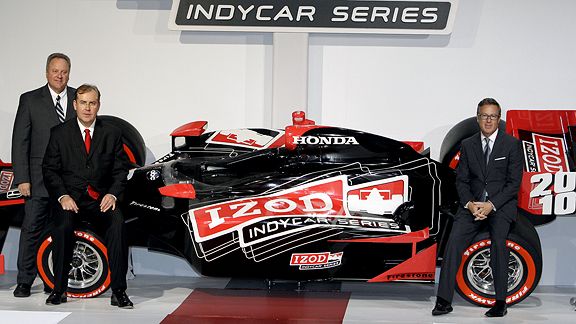 AP Photo/Michael ConroyIRL president Brian Barnhart, left, and president of Indianapolis Motor Speedway Jeff Belskus, left center, scored a major coup with the help of Mike Kelly of the Phillips-Van Heusen Corp., bringing a major sponsor -- Izod -- into the sport.
"Let's get the party started!"
With those words from Indy Racing League vice president of public relations John Griffin, the IndyCar Series rolled out the red carpet for its first title sponsor since 2001. With the marketing muscle of Phillips-Van Heusen Corp. behind it, the Izod IndyCar Series may finally get noticed as "The Fastest Race in the World."
At first glance, the notion of an apparel brand and a racing series teaming together doesn't add up. But if you look at the initiatives taken (not to mention the promotional dollars spent) since Izod entered Indy car racing as a personal sponsor of American star Ryan Hunter-Reay 16 months ago, it starts to make sense.
"It obviously has been a long time since we've had a title sponsor, and to be honest with you, it's probably the first legitimate title sponsor we've ever had," said IRL competition president Brian Barnhart, without mentioning short-lived former partners Pep Boys (1998-99) and NorthernLight.com (2000-01).
"I think the best thing about it is going to be the activation aspect of it because they're going to spend a lot of money raising the awareness of the series and increasing the amount of eyeballs that are watching our sport. That's the first step in raising the value of participation in this series."
It certainly sounds like the way the six-year deal (with an option for Izod to extend) has been structured will benefit everyone involved with Indy car racing. Aside from the cash influx the Indy Racing League needed at a critical juncture for the company, Izod's money will be allocated to participants as part of the TEAM revenue-sharing program. It's a given that PVH will promote the sport through aggressive television, print and Internet media ad buys and driver appearances at Macy's stores.
Izod is likely to reserve plenty of track signage and work closely with promoters in local race markets.
"We expect to be very aggressive in our spending," said Mike Kelly, PVH executive vice president of marketing and creative.
The title backing, worth upward of $10 million annually, is part of PVH's strategy of building Izod's brand image through sports marketing, including securing naming rights for the Meadowlands arena that the New Jersey Nets call home.
The IndyCar Series also offers PVH the opportunity to cross-market its premium brands, including Calvin Klein, Timberland and Sean John, to the demographically upscale open-wheel audience.
Kelly was Hunter-Reay's guest at the 2008 Indianapolis 500 and said, "It took about four seconds before the needle was in my arm."
By the Watkins Glen race on July 4 weekend, RHR had earned a personal sponsorship contract from Izod. The driver arguably responsible for delivering the Izod title sponsorship to the IndyCar Series affirmed his enthusiasm for the partnership during the presentation at the Indianapolis Motor Speedway Pagoda Pavilion on Thursday.
"This is a fresh start for the IndyCar Series," said Hunter-Reay, who is reportedly on the brink of clinching -- with Izod's support -- the open fourth seat with Michael Andretti's team. "This is what we've been waiting for. They're more a marketing company than anything else and the sky's the limit right now."
With the economy in a continued tailspin and Indy car racing's public profile at a low point, Izod couldn't have picked a better time to get on board with open-wheel racing and the chances of the sport making a comeback increased significantly with Thursday's title sponsorship announcement.
"As a corporation, if you see what we're doing across all of our brands, we have not pulled back in our marketing spend even though the environment became difficult," Kelly said. "We have grown, our brands have grown, we've grown in market share -- we believe in share of units, share of dollars, also share of voice and share of mind.
"While our competition has pulled back on their spending, we see it in the marketplace. We've been aggressive with the spend. We're fortunate to be able to do so as a healthy company. It's bearing fruit for us."
Kelly said he and PVH were captivated by the potential of using the Indianapolis Motor Speedway Centennial Celebration as a marketing platform and believe Indy car racing can regain the stature it enjoyed in the 1980s and '90s until the battle for control of the sport between the IRL and CART/Champ Car killed whatever momentum the formula carried.
"The assets are so rich," Kelly said. "If you think about the power of [Indy car racing] during the '80s and the '90s on the American racing landscape, now you've got a next generation that just doesn't realize how sexy and cool this sport is. I think we have a lot to offer the league, but the league has a lot of great assets to tell a story with.
"It's an opportunity, no question," he added. "If everything was rosy and the series was mature after the unification, I'm not sure we could afford it. I think it's right time, right place, and we do see upside. If you think of it as a toddler that's on its feet now, that's the kind of position we like. We want to be part of it, because we're not just committed for the short term."
By luck or design, the Indy Racing League's scoring system has created remarkably close championship battles, and for the fourth year in a row, the IndyCar Series title was not settled until the final lap of the season. Dario Franchitti edged his Target Chip Ganassi Racing teammate Scott Dixon, with Team Penske's Ryan Briscoe right in the mix as well.
At about this time a year ago, I wrote a column in which I used point-scoring systems from several other forms of motorsport to determine whether the results of the IndyCar Series championship hypothetically would have changed. I calculated that the IndyCar Series would have had a different champion in eight of the 15 scenarios I created, with the biggest shakeup coming to the 2006 standings, where Sam Hornish Jr. tied Dan Wheldon on points but won on a tiebreaker using the IRL points distribution.
Four drivers went into the final championship round that year with a shot at the title, and had either the CART or current Formula 1 scoring system been in use, Helio Castroneves would have won the title rather than finishing third. Castroneves would have won another crown in 2008 if either CART or Champ Car World Series points had been awarded.
Castroneves was out of championship contention this year, but once again, an alternate scoring system would have crowned a different champion. Let's crunch the numbers …
Formula One
The classic F1 points distribution rewarded excellence, and until 2002, only the top 6 finishers in a Grand Prix were awarded points. Expanding the points to the top 8 did little to slow down the Michael Schumacher express, but it did create more interesting F1 title races about half the time since then.
Prior to establishing himself as an IndyCar Series star, Briscoe had F1 aspirations, and the Australian would today find himself as the 2009 IndyCar champion if points were awarded F1 style. Despite scoring fewer race wins than either of the Target/Ganassi drivers, Briscoe's eight second-place finishes would have benefited him handsomely this year and he would have emerged as champion had the classic or current F1 system been in use. That's despite the fact that he suffered four finishes outside the top 12, compared to three for Dixon and just two for Franchitti.
It was feast or famine for Briscoe, who never finished lower than fourth except in his four bad events. He would have scored 81 points using the old F1 system, compared to 76 for Franchitti and 73 for Dixon. Using the current F1 points, Briscoe would have racked up 104 markers, with Franchitti second on 101 and Dixon third with 96.
CART
CART paid out points to the top 12 finishers, and also awarded single bonus points for pole position and leading the most laps.
Franchitti would have triumphed as this year's IndyCar Series champion using the CART system, with 226 points, but Briscoe would have beaten Dixon into second place with 221 points to the New Zealander's tally of 215.
With four poles and five races in which he led the most laps, Briscoe was the bonus point leader (Dixon had one pole and led the most laps six times, while Franchitti started the most races from the pole with five and topped the laps led chart only three times), but it wasn't enough for him to overcome the extra points Franchitti gained by winning five races to Briscoe's three.
Champ Car
Champ Car spread the points down to 20th place, and was also more generous with the bonus points, awarding them for pole position, laps led, most positions gained and fastest race lap.
Briscoe yet again dominated the bonus points, racking up 22 to Dixon's 18 and Franchitti's 17, but once more it was not enough to deliver him a championship. In fact, using the Champ Car system, he remained third in the final reckoning, scoring 396 points compared to 399 for Dixon and 409 for series champion Franchitti.
NASCAR
Dixon matched Briscoe with 90 NASCAR-style bonus points, which are dispensed in five-point increments for any driver who leads a lap and to the driver who leads the most laps in a race. Franchitti racked up 70 NASCAR bonus points but still came out on top of the mythical championship standings, with 2,818 points, plus-5 on Dixon and plus-36 on Briscoe.
Ultimately, the fact that Briscoe scored more poor finishes than the Target Ganassi drivers proved to be his undoing. Dixon and Franchitti salvaged bad days by finishing anywhere from third to seventh, and Franchitti was particularly effective in terms of damage control.
In fact, had Dario not suffered a brake failure leading to a crash at Kansas Speedway (where he probably would have finished second to Dixon) and an off-course excursion at Watkins Glen while avoiding another driver's accident, he would have put together an almost perfect season and won the championship by a landslide.
No matter what scoring system was in use.
The top spot in ESPN.com's IndyCar Series Power Rankings got passed around as often as the lead of the series championship this year.
We started the practice in the lead-up to the Indianapolis 500, and since then, Scott Dixon has topped the charts five times, including the final ranking for the 2009 season. Dario Franchitti was No. 1 on four occasions, Ryan Briscoe twice, and Helio Castroneves once.
After midseason, Castroneves was firmly planted at No. 4, while Briscoe, Dixon and Franchitti swapped the first three places almost on a weekly basis.
In the end, even though he didn't win the 2009 championship, I placed Dixon at No. 1, mainly on the basis that I believe the rankings represent a driver's potential going into the next race. In other words, if whatever race that kicks off the 2010 IndyCar Series season were next week (it could be St. Petersburg, because things have gone awfully quiet on the Brazil front), I'd put my money on Dixon to win it.
I agonized about ranking series champion Franchitti second and wrote, "I'll probably hear from Dario after ranking him No. 2, yet he probably won't argue that Dixon deserves to be No. 1."
Indeed I did hear from the Scotsman, who made a credible case for why he should be ranked No. 1 over his Target Chip Ganassi Racing teammate. There was no animosity or ego involved, just the well-crafted thoughts of a passionate racer who takes every part of his craft seriously -- right down to media relations.
To wit, Franchitti felt he deserved to be ranked No. 1 for several reasons:
• He led the IndyCar Series in pole positions with five, plus the one taken away at Kansas Speedway because of a minor infringement. That's proof that over one lap, at least, he was the fastest driver in Indy car racing, and the poles came on all types of tracks -- short ovals, speedways, road courses and street courses. His five wins were also thoroughly diverse, from his strategy-driven victory in the finale to his dominant flag-to-flag run on the Infineon Raceway road course.
• His fuel-strategy win at Homestead was countered by losing the Richmond race to Dixon on fuel mileage.
• His only real mistake was getting crossed up while avoiding an incident between Ed Carpenter and Mario Moraes at Watkins Glen.
"For the first year at a team and first year back, I'd say it was pretty good," he said. "I'm not normally one to sound my own trumpet, but … anyway, the case for the defense rests."
To restate: Franchitti was the better qualifier, with five-plus poles to Dixon's two; matched Dixon on race wins with five; had one more top-10 finish than his teammate (15 versus 14 in a 17-race season); and made fewer mistakes -- Dario's only DNF was a crash at Kansas caused by a brake problem.
Is he right? I'm not sure. I probably would have been happiest listing the Ganassi teammates as co-No. 1s, but that would have been a cop-out.
You certainly can't diminish what Franchitti achieved this year -- my own words were: "Returned to Indy cars motivated and refreshed after his NASCAR sabbatical, matched Ganassi teammate Dixon with five wins and thoroughly deserved to emerge as series champion."
But I'm going to stand by my choice of Dixon as the No. 1 driver in the IndyCar Series Power Rankings. And I hope Franchitti and his fans don't take being listed as an oh-so-close No. 2 as an insult. If you happen to read this rebuttal, Dario, we will have to continue this argument over a couple of beers. And maybe include Dixie to hear what he has to say about the matter.
Besides, had there been just one timely caution in that Homestead race, Briscoe could have emerged as IndyCar Series champion, and there would have been a different name at the top of the Power Rankings.
HOMESTEAD, Fla. -- Danica Patrick leads the IndyCar Series in terms of column inches and television time.
But Scott Dixon tops the charts in all the important statistics that matter to racers. Like laps led, races won and championship points.
The 29-year-old New Zealander can notch another statistical hallmark Saturday afternoon at Homestead-Miami Speedway if he emerges from the Firestone Indy 300 as a three-time IndyCar Series champion. Dixon leads the points standings heading into the season finale, and he has the opportunity to match Sam Hornish Jr.'s if he wraps up title No. 3, to accompany the crowns he earned in 2003 and 2008.
 AP Photo/Shuji KajiyamaScott Dixon set himself up for a third IndyCar Series title with a clutch victory at Motegi last month.
It won't be easy. Dixon has a slim five-point lead over his Target Chip Ganassi Racing teammate Dario Franchitti, and eight points in hand over Ryan Briscoe of Team Penske. But at the same time, the math is pretty simple: If Dixon finishes ahead of Franchitti and Briscoe on the track, the championship is his.
The odds are stacked in his favor. Dixon is a two-time winner at Homestead, and both victories came during his championship seasons. Already established as the most successful driver during the IndyCar Series-sanctioned era with 21 victories, Dixon's mission now is to put his marks out of reach. But he knows that Franchitti and Briscoe have goals of their own to shoot for.
"For me, trying to go for records and going for three [championships] would be fantastic," he said. "Obviously that's the reason I'm pushing. Dario's [reason] would be from winning the championship in '07 and trying to come back and do the same thing once he has a full season in IndyCar again, and obviously, with Ryan, it would be his first. So I think all of us have the motivation.
"For me it's more about records," he added. "I think agendas from all of us are a little different. But ultimately I think the goal is by all means the same. I think the motivation is the same from all of us."
Back in April, it would have been difficult to envision Dixon being in this position. His season started badly with a pair of poor finishes on street courses, which are usually his bread and butter. But five race wins, culminating in a dominant run three weeks ago at Motegi, Japan, have put the Kiwi on the brink of a third series triumph.
He's happy that the title decider will be held at Homestead, which is unique among the six 1.5-mile speedways the IndyCar Series visits.
"I've been in the IndyCar Series for seven or eight years and it's always been the kickoff event, the first race of the season," he said. "It's in a lot of ways quite fundamental in how the championship rolls out, because the person who has won the first race at Homestead has a lot of the time gone on to win the championship.
"But I think it's a perfect scenario. It's Florida, it's Miami in October, and it's hot. It's going to be a twilight race, which is even better. I tend to like the scenario of being at Homestead a little more than being at Chicago, because Chicago's almost pretty much just straight-out speed, whereas Miami-Homestead, is definitely a little more technical. There's a little more grip reliance, to make sure you have a car mechanically that's quite good and the driver can manipulate that quite a bit. It's more of a team effort for whoever wins at Homestead."
The teaming of Franchitti and Dixon has produced one of the most successful seasons in the history of Target Chip Ganassi Racing. Although the team boasts six CART and IndyCar Series championships since 1996, TCGR has never finished 1-2 in the standings, which is a distinct possibility this year.
Dixon has found Franchitti to be a much more team-oriented running mate compared to his past partners, who include Dan Wheldon and Tomas Scheckter.
"I think Dario and I understand in racing that you have the same equipment as someone else -- your friends and your teammates and things like that," he observed. "Some days you've just got to understand that your teammate's having a better day. It might be hard to swallow, but that's the way it goes. I don't think it changes anything. That's what racing is all about.
"First you've got to work together with your teammate, and then see what plays out. But both of our teams have done a lot of preparation and are looking forward to it. Obviously, the winner picks up the bar tab."
Despite all that is on the line -- the record-tying third consecutive championship and the $1 million bonus that goes with it -- Dixon insists he's treating Homestead as he would a typical race weekend.
"I think if you try to change your strategy or the way you approach the race, it might affect how quick you go over the outcome of the race, and ultimately the outcome of the championship," Dixon said. "So I think you try to keep it simple, and not put too much pressure on yourself and let it all play out. It's pretty much whoever beats who is going to walk away with the championship. So it's definitely good for all the fans and one of the toughest days for the drivers.
"But I'm definitely looking forward to it. It should be a great show, and a happy time for one of us. It's been a great shootout so far as the whole championship's gone, and I think everybody's definitely put in a lot of hard work this season -- teams and drivers and everybody else.
"We'll all find out probably by 7 o'clock Saturday night."
ABOUT THIS BLOG

John Oreovicz
John Oreovicz lives in the shadows of Turn 1 of the Indianapolis Motor Speedway.
His interest in racing was sparked by the battle between Niki Lauda and James Hunt for the 1976 Formula One World Championship, and he can remember watching the 1977 Long Beach Grand Prix and the 1979 Daytona 500 on the family RCA XL-100 television as if they happened yesterday.
These days, you're likely to find him at Pomona covering drag racing or Phoenix reporting on stock cars in addition to his usual role as one of the IndyCar Series' pressroom veterans.
With more than a decade writing for ESPN.com, his work has been published in more than a dozen countries around the world, and he co-authored "A Winning Adventure," a chronicle of Honda's successful CART Indy car engine program.
Contact him at indyoreo@earthlink.net.