ST. PETERSBURG, Fla. -- There are few things more frustrating for a racing fan than to get rained out at an oval track. Having a road race pushed back a day is an even rarer occurrence and therefore even more exasperating.
Having said that, there was no way the Honda Grand Prix of St. Petersburg could have been safely run Sunday afternoon. There were an estimated 6 inches of standing water at the apex of Turn 9 -- enough to prompt Graham Rahal to ask Dario Franchitti to stop the pace car they were inspecting the track in so that he could snap a picture.
"I guess I wanted [the race] to have an extra day in my first year," joked recently elected St. Petersburg Mayor Bill Foster.
Fortunately for Foster and HGPSP officials, the race contract with the city of St. Petersburg contains a provision for circumstances like the ones that played out Sunday. Rain started at around 12:30 p.m. and intensified over the next three hours, forcing Andretti Green Promotions to evacuate fans to parking structures and the lobby of the Mahaffey Theater. It rained hard from about 2:15 to 5:00, flooding the track and many of the grassy general admission spectator areas.
AGP will open the gates for free admission to the public when the race is run at 10 a.m. Monday, which hopefully will make up for the fact that access to the city streets used to make up the 1.8-mile course will be delayed for 24 hours.
The race will be broadcast live on ESPN2.
Drivers agreed that IndyCar Series officials made the correct decision to postpone the race.
"I'm disappointed the race didn't happen, but it just wasn't safe for any of us to be on track," Rahal said. "I went around with Dario and Brian Barnhart, and it was nowhere near racing conditions.
"I love driving in the rain and would have been the first to do it, but today it wasn't meant to be."
ST. PETERSBURG, Fla. -- Lo and behold, positive news is beginning to emerge from the Izod IndyCar Series on a regular basis.
Less than four months into the Izod title sponsorship era and within the first month since new Indy Racing League CEO Randy Bernard, there's a level of energy and activity within the series that hasn't been seen since ... well, since the IRL was formed back in 1994.
 AP Photo/AJ MastGraham Rahal makes his 2010 debut for Sarah Fisher Racing this weekend at St. Pete.
Almost every channel you tune to on your cable dial is running Izod-funded advertisements promoting upcoming IndyCar broadcasts, including this weekend's Honda Grand Prix of St. Petersburg -- the first of five races on this year's schedule set to be aired on ABC.
With ratings up substantially for Versus' broadcast of the season-opening event in Brazil, analysts are keen to see what kind of numbers the first race televised this year on a free-to-air network will produce.
Meanwhile, rising American star Graham Rahal, who was not on the grid in Brazil, is set to make his 2010 debut for Sarah Fisher Racing this weekend in St. Petersburg, one of two races he's set to run for Fisher's team. If Rahal manages to run competitively in SFR's Dollar General-sponsored car, it promises to be one of the feel-good stories of the season. Even better news for the series and its fans is that Rahal is reportedly set to announce his return to Newman/Haas/Lanigan Racing for the rest of the season, starting with the Toyota Grand Prix of Long Beach on April 18.
But perhaps the news of most importance to the long-term health of Indy car racing is that there is finally action being taken in terms of nailing down a new chassis, engine specification and a supply process for 2012 and beyond.
These important decisions have been dragging on for the past several years under the leadership of IRL competition president Brian Barnhart, and the desperately needed new car has already been pushed back from 2011 to 2012.
Bernard revealed this week that he is assembling a seven-member advisory committee to plot the series' technical strategy for the future, and he has appointed retired four-star U.S. Air Force Gen. William R. Looney to chair the group.
While some observers are grumbling about Looney's complete lack of racing experience and knowledge, others applaud the fact that Bernard is taking quick and decisive action in consultation with a man with a reputation for intelligence and integrity.
"This is the defining decision of this decade," Bernard observed. "My knowledge in open-wheel racing is very limited, but now that I'm a part of this, the one thing I want to do is make sure we articulate a process and set criteria that we weigh very importantly. The seven advisors will be experts -- engine experts, chassis experts, and I'm going to give a vote to the team owners.
"It's really important that we all work as a team," Bernard added. "The fan is also very important. We need to understand the pulse of the fan and what they want, and we put 6,000 surveys out seeking fan input about the new chassis."
Looney admits that he is also not an open-wheel racing expert, but he believes his vast experience can be an asset in terms of managing the decision-making process.
"It was not the normal request for the consulting I do, which mostly is involved with defense matters, leadership and management," Looney said. "Randy needed someone to facilitate, mediate and chair the discussion that had no agenda, was completely objective and had no bias with respect to the businesses of racing. I do fit that bill.
"He wanted someone who had been in that kind of environment where you bring people with different skill sets together and you're tasked with a mission that needs to be resolved. Together you work through it to come up with an answer that is good for the enterprise that is the Indy Racing League and all its different stakeholders."
Bernard says he hopes to reach a consensus on the new chassis formula within 60 days and wants to make an announcement shortly after the Indianapolis 500 at the end of May. And while it is unlikely that everyone will be happy with the final decision, at least it is finally obvious that there is a sense of urgency within the IRL to set a technical course for the future and get on with the hard work of turning concepts into reality.
With all due respect to Hideki Mutoh, in an ideal world, he would not be driving for Newman/Haas/Lanigan Racing in the Izod IndyCar Series this season.
Instead, the famous open-wheel team would field cars for its 2007 driver lineup of Sebastien Bourdais and Graham Rahal, both of whom have only limited racing programs lined up for the 2010 season.
 AP Photo/Steve NesiusFormer Champ Car kingpin Sebastien Bourdais plans to race in only a handful of events in 2010, including the 12 Hours of Sebring for Peugeot.
Rahal tested Sarah Fisher Racing's Dallara-Honda Indy car at Barber Motorsports Park this week in preparation for the two race starts he expects to make for SFR. Meanwhile, Bourdais is racing a Peugeot prototype in the Mobil 1 12 Hours of Sebring, one of his rare scheduled outings for the French manufacturer.
It's easy to conclude that if NHLR founder Paul Newman was still alive, the team would have Rahal and Bourdais as its drivers and would be beginning to challenge Team Penske and Target Chip Ganassi Racing for IndyCar Series race wins on a regular basis. But Newman's death also effectively killed off NHLR's sponsorship agreement with McDonald's and the team's ability to attract other major sponsors, leaving it with no choice but to cut back to one car funded by Mutoh's Japanese backers.
Bourdais raced in the CART/Champ Car World Series from 2003-2007, winning 31 of his 73 races starts and four consecutive series championships. That performance finally earned the now-31-year-old Frenchman his break into Formula One, but after one and a half mostly disappointing years in F1, he was dropped in mid-2009 by the Scuderia Toro Rosso team. Bourdais rounded out 2009 by scoring a couple of race wins in the Superleague series, a minor-league European open-wheel formula.
Bourdais' perceived failure in F1 just gave international critics of Indy car racing more ammunition for their argument that the American single-seat scene is nothing more than a joke. He joined Michael Andretti, Alex Zanardi and Cristiano da Matta as U.S. open-wheel champions who flopped in F1. CART champions Jacques Villeneuve and Juan Pablo Montoya were more successful in their transition to F1, but also arguably failed to achieve their potential on a long-term basis.
The common denominator between Zanardi, da Matta and Bourdais is that they were all extremely active in terms of working with their engineers to get the most out of the car. In F1, they were forced to adapt their driving to the car they were given, with little or no input into changing the car setup. In American racing, drivers and engineers work in partnership, rather than hierarchy.
"In Champ Cars we also had a lot more things to play with in terms of car setup than we do in Formula 1," Bourdais said in an interview with ITV in 2008. "F1 is very much optimized, and whether the car functions or not, by design -- by concept -- it's not adjustable. Everything on the suspension is the way it is; if you want to change the castor, for example, you need a new suspension. So that limits the influence and the impact of driver comments in some respects. It's very different, and obviously when you fight a problem, it's much harder to find solutions and it takes much longer as well."
It's fascinating to speculate how Bourdais would fare if he was able to return to America with a team like Newman/Haas/Lanigan. Now that more than half of IndyCar Series races are run on road or street courses, he would obviously be a force on those tracks. But it's easy to forget that Sebastien won four of his eight oval starts, seven of which came against an admittedly depleted CART/Champ Car field. He was headed to a top-5 finish in his only Indianapolis 500 start (2005) when he was taken out in a late crash.
Craig Hampson, who was Bourdais' engineer at NHLR from 2003-07, believes that Bourdais was rapidly improving as an oval driver.
"Sebastien did struggle at Milwaukee the first couple of years, but I think the Indy 500 effort [in 2005] helped him at Milwaukee greatly," Hampson told me a couple of years ago. "You could tell at Milwaukee that he got it. ... He understood what to do now and what the car's capabilities needed to be so he could do well in the race.
"For sure the best win for me [in 2006] was Milwaukee, because we sat on pole at a place where people really didn't expect us to and we far and away had the fastest car. We had some adversity in the race with the cut tire, but we came back from that. It was a pretty entertaining race with Nelson Philippe, and all in all that was our finest moment of the year."
Bourdais will compete for Peugeot in the 24 Hours of Le Mans in June and probably at the ALMS Petit Le Mans at Road Atlanta in the fall. But other than that, he has nothing else lined up for the rest of 2010 -- a travesty for one of the most talented open-wheel drivers to come along in recent years.
From all indications, the IZOD IndyCar Series' first foray into Brazil was a success. Problems with the track that postponed qualifying and a midrace rainstorm aside, the good outweighed the bad in an important commercial market for Indy car racing.
Although empty spaces in the 40,000-capacity grandstands were visible on television, observers on site reported an overflow crowd with some spectators electing to watch perched in trees lining the 2.6-mile street course. Suite sales were strong and overall race-day attendance was announced as 46,000, a figure solidly in the upper third among IndyCar Series venues.
By scheduling a race in Brazil, the Indy Racing League is following the same path that CART did 15 years ago. Even then, Indy style racing was having increasing difficulty in sourcing sponsorship in the United States, which led CART to pursue foreign investment. Typical of many of CART's events, its Brazilian race (staged on a semi-oval outside Rio de Janeiro) started out with a bang and died with a whimper, the victim of sagging attendance and local politics.
The challenge therefore for the IndyCar Series is to maintain a high level of fan interest and corporate support within Brazil so that the Sao Paulo event has a life beyond the current five-year contract.
The racing itself was pretty darn good by street course standards, even if (as usual) Target Chip Ganassi Racing claimed pole position and Team Penske won the race. There were four on-track passes for the lead and a total of 95 competitive position changes, figures that put many of the IndyCar Series' recent oval races to shame. The key was the near mile-long back straight, which led into a wide hairpin corner -- a perfect recipe for passing that every future street course should factor in.
Without any prior testing, there were bound to be a few problems with the circuit, but they were fairly minor compared with some of CART/Champ Car's disasters like San Jose, Denver and Miami. When drivers could barely control their cars on a patch of the concrete straightaway on Saturday, the IRL made the correct decision to fix the track and postpone qualifying until Sunday morning.
The only downside of that schedule change was that it made for an incredibly long day for most of the race teams, which arrived at the track before dawn yet still had to fly home on Sunday night.
In terms of media, the Brazilian race did pretty well by recent IndyCar standards. The Versus TV broadcast garnered an overnight rating of 0.4 with a peak of 0.6. With a claimed 411,000 households, those ratings were up 30 percent from the 2009 season average on Versus (315,000 households) and up 76 percent from the '09 season opener at St. Petersburg.
The results of the race seemed to satisfy just about everyone, too.
Will Power's victory on his return from injury was a compelling storyline, as was Vitor Meira's similar recovery and drive to third place for A.J. Foyt Racing. Another Brazilian, second-year man Raphael Matos, earned the best finish to date for himself and Luczo Dragon/de Ferran Motorsports, notching fourth place.
Now if only the IndyCar Series could generate the level of excitement Brazilians have for the series in places like Kansas City, Joliet and Homestead.
What to make of the surprising news that Graham Rahal will contest two upcoming Izod IndyCar Series races for Sarah Fisher Racing?
My first reaction is: At least Rahal is in a car and will be able to bank some points and buy some time until he can hopefully put together a program for the rest of the season.
My second thought: It truly shows how bad the economic conditions are in Indy car racing when the most talented, articulate and marketable future American star has to resort to a last-minute, two-race deal with a developing part-time team.
My third point: What a brilliant move by Sarah Fisher as a team owner! Fisher the driver was intending to contest the St. Petersburg and Alabama races, making her first road racing starts in the IndyCar Series. And with all due respect, she wasn't going to be a frontrunner.
By stepping aside in favor of Rahal, Fisher will turn the spotlight onto her team and her sponsor, Dollar General stores. The limited program with Rahal (which includes a test day at Barber Motorsports Park) will also greatly benefit Fisher, her team driver Jay Howard and SFR's road course development program in general by giving them feedback from an established IndyCar star.
It's the kind of smart thinking that demonstrates no matter what happens in the rest of Fisher's career as a driver, she has the savvy to be a long-term player in the business of racing.
It's also a win-win situation for the IndyCar Series, because it teams Rahal, one of the sport's future stars with a pedigreed name, with Fisher -- who was the IRL's most popular driver until another female competitor who shall remain nameless came along.
The two-race collaboration is unlikely to lead to a season-long deal between Fisher and Rahal, but it certainly works well for both of them in the short term. Fisher's team will be more competitive with Rahal than it would if she was driving; Rahal is not going to drive the SFR car to victory in St. Petersburg or Alabama, but he has the chance to rack up points with a couple of solid top-10 finishes.
"Sarah has clearly done an impressive job building Sarah Fisher Racing and I really thank her, the team and Dollar General for this opportunity to compete in St. Pete and at Barber Motorsports Park," Rahal said in a statement. "I can't wait to get behind the wheel of the Dollar General No. 67 car and hopefully contribute to the success of SFR."
If Rahal can run in the top 10 for Fisher's small and growing team, he will only enhance his already stellar reputation. And he will leave the Roger Penskes and Chip Ganassis of the world no excuse to not hire him for 2011 and beyond -- if not for the rest of 2010.
My thoughts on a few current storylines in open-wheel racing …
Graham Rahal: It's mind boggling that the most promising American formula car racer of his generation is on the sidelines 10 days from the first race of the 2010 Izod IndyCar Series season.
Yet despite being the youngest pole and race winner in series history -- not to mention an American with an Indy 500-winning surname -- that's where 20-year-old Graham Rahal finds himself. Meanwhile, Milka Duno -- she of less talent but more sponsorship money -- was confirmed by Dale Coyne Racing for her first full-season IndyCar campaign.
Rahal is not alone in his predicament. Quality drivers like the experienced Oriol Servia and the rapidly improving Mario Moraes don't have rides, and even if they came up with sponsorship at the 11th hour, where would they take it? Newman/Haas/Lanigan Racing could field another car, as could HVM Racing. Coyne has another car, but Rahal chose not to pursue that avenue.
Indy Racing League president of commercial operations Terry Angstadt says the league is aware of the image problem a rideless Rahal presents.
"It's a huge priority, and we're approaching it that way," Angstadt said. "Graham has decided to turn one offer down, and I think probably for good reasons for him. I respect that. We have multiple presentations under way, and we're working hard to gain him sponsorship. I'm hopeful we'll see him in St. Pete [March 28], but that's not a guarantee yet. I certainly hope he is."
A couple of years ago, IRL management would have dipped into the Hulman-George coffers and ensured that a marketable rising star like Rahal made it to the grid. Those days are gone.
"To make direct investment at this point? Our economy doesn't allow that," Angstadt said. "We have dedicated sales people trying to help solicit sponsorship and have different drivers -- like a Graham -- baked into those presentations so that we help raise the money. We just can't afford to pay it ourselves."
For his part, Rahal has been staying in shape, working the phones, and driving and flying around the Midwest trying to drum up sponsorship. He is also impressed with new IRL CEO Randy Bernard.
"I just want everyone to know Randy Bernard is great!" Rahal said in a Twitter account post. "He has helped more in the past 12 hours than anyone ever before I think!"
USF1 goes under: Is anyone really surprised that Team USF1 didn't make it to the starting line for this year's Formula One World Championship?
I love Formula One racing, and I dearly wish there was more American interest and involvement in the sport. But I questioned whether running a team out of Charlotte was the best way to enter a Europe-based sport. And I was not impressed by the way an organization so keen to identify itself as an all-American team was set to campaign two obscure non-American pay drivers.
I also doubted USF1 founder and technical director Ken Anderson's ability to bring a major project across the finish line. Like Anderson's 2003 Falcon IRL IndyCar, USF1's first car appears to have been stillborn. At least the Falcon made it to the prototype stage.
Several of my friends worked for USF1, and I feel bad about the way they lost their jobs. Peter Windsor the journalist would have been outraged at the way Peter Windsor the USF1 founder and co-team principal has pretty much disappeared over the past couple of months as the project unraveled.
The sad thing is now that USF1's credibility with the FIA (Formula One's governing body) has been wiped out, the odds of the team being granted an entry for 2011 are almost zero. Even if Anderson & Co. get the car designed and built by 2011.
RIP, Formula Atlantic: Organizers of the Cooper Tires Atlantic Championship Powered by Mazda announced Wednesday that the 2010 series is being placed on hold. Call it what you want, but there will be no Formula Atlantic for the first time since 1974, a sad end for an important part of the North American road racing ladder.
In the mid- to late 1970s, Formula Atlantic launched the career of Gilles Villeneuve and pitted the best homegrown stars like Bobby Rahal and Price Cobb against international stars like Keke Rosberg. After a low period in the 1980s, Formula Atlantic again thrived in the 1990s, and over the years, top competitors included Michael Andretti, Jimmy Vasser, Jacques Villeneuve, Patrick Carpentier and A.J. Allmendinger.
The nimble four-cylinder cars were the closest thing America offered to European formula car racing, although they were occasionally criticized for being under-powered and over-downforced. But the main problem Formula Atlantic faced over the past 25 years was the lack of a defined American formula car ladder system and competition from two iterations of the Indy Lights championship, which features larger, more powerful cars than Atlantics and for the past 10 years has been affiliated with the IRL IndyCar Series.
With F2000, Star Mazda, Formula Atlantic and Indy Lights, there were simply too many open-wheel alternatives on the ladder, and Atlantic was the one that didn't make the cut. Sad for historical reasons, but necessary given the formula's diminished status over the past few years.
At least three female drivers will be competing in most Izod IndyCar Series races in 2010, and possibly four.
HVM Racing announced Monday that Atlantic Championship graduate Simona De Silvestro will drive its No. 78 Team Stargate Worlds car for a full campaign. The 21-year-old from Switzerland won four Atlantic races in 2009 and took the championship lead into the season finale before getting crashed out.
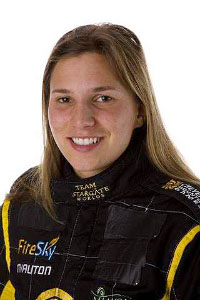 Michael Levitt/LAT PhotographicSimona De Silvestro will wheel the No. 78 Team Stargate Worlds car for HVM Racing full time in 2010.
Milka Duno reportedly has sponsorship for at least a partial Indy car season and is trying to find a team to field her entry. And owner/driver Sarah Fisher has expanded her 2010 program to include at least nine races.
Finally, Indy Lights race winner Ana Beatriz will make her IndyCar Series debut in her home race at Sao Paulo, Brazil for Dreyer & Reinbold Racing. Additional races are a possibility if 'Bia' turns in a good performance in Brazil.
From a competitive standpoint, De Silvestro is likely to make the biggest impact. Comparisons to Danica Patrick are obvious and have already started: Both drove single-seat formula cars in Europe prior to two seasons of Formula Atlantic. Patrick never won in Atlantics against a much stronger field than De Silvestro faced.
Katherine Legge also won Atlantic races and went on to compete in the Champ Car World Series and the DTM touring car championship.
Beatriz is the only female driver to date who has triumphed in Indy Lights competition.
De Silvestro tested a Dallara-Honda Indy car at Sebring International Raceway for HVM, and at the recent IndyCar Series open test at Barber Motorsports Park she lapped 0.3-second faster than Patrick on the second day.
"Racing in the IndyCar series, alongside the class of competition that I will be racing with, is a true honor," De Silvestro said.
HVM team principal Keith Wiggins has fielded cars in numerous formula car series around the world, including Formula One, and he believes De Silvestro can succeed in Indy cars.
"From the first day of the first test, we knew she could drive," Wiggins said. "The longer we worked with her, the more she impressed us. I think she has a great future in this series. She made a lot of history in the Atlantic Championship, and we expect her to make some waves in IndyCar now that she's here."
Patrick has occasionally struggled at road courses like Barber (she was 18th of 21 drivers in the Indy car open test) so those venues are where De Silvestro could earn some bragging rights. But she has zero oval racing experience, and as a smaller scale former Champ car transition team, HVM isn't fully up to speed on ovals yet either.
Fisher, 29, has done an impressive job of building her close-knit team in tough economic times. Thanks to increased support from sponsor Dollar General stores, her program has grown from three races in 2008 to six last year to nine in 2010, including two road races.
Sarah Fisher Racing will also field a second car for former Indy Lights champion Jay Howard for a five-race slate.
A new technical package for the Izod IndyCar Series has been a long time in coming, and now that details about four competing proposals for the future chassis formula are starting to be made public, it looks like open-wheel fans should prepare for conflict and controversy.
On Jan. 29, DeltaWing Racing Cars announced that it would reveal a concept to be considered for the 2012 IndyCar Series formula at the Chicago Auto Show on Feb. 10. In the weeks leading up to the unveiling, conjecture ran rampant about the DeltaWing car, which was believed to be quite radical under the technical direction of Target Chip Ganassi Racing engineer (and former Lola designer) Ben Bowlby.
 AP Photo/Jim PrischingIzod IndyCar Series drivers Scott Dixon, left, and Dario Franchitti appeared at the Chicago Auto Show on Feb. 10 to unveil the 2012 DeltaWing concept car.
A few days after DeltaWing scheduled its press conference but before the car was publicly shown, current IndyCar Series chassis supplier Dallara suddenly released artist's renditions of three future design proposals it submitted to the IRL. Two of the Dallara concepts were a fairly radical departure from the look of a current Indy car, while a third, more conservative design blended styling cues from Dallara's current Indy car with recent Lola and Reynard Champ Cars.
Perhaps prompted by the attention created by DeltaWing, former Champ Car chassis manufacturers Lola and Swift also quickly publicly confirmed that they submitted proposals to the IRL. Swift's presentation included three prospective designs; two of Swift's concepts were fairly standard-looking (though they employed retro-styling touches like partially exposed engines), while the other had swoopy, futuristic-looking enveloping bodywork. Swift's proposals include aerodynamic appendages below the rear wing called "mushroom busters" intended to clean up the turbulent wake for following cars, as well as some interesting, fan-friendly technical developments like LED displays built into the bodywork.
"We wanted to help communicate the car's critical information in real time to the fans, and to that end, we are pioneering a new lighting technology which we've dubbed 'SwiftLights,'" explained Swift's chief scientist, Mark Page. "SwiftLights will display car information like throttle, brake and fuel levels as well as race position. SwiftLights are lightweight, efficient, inexpensive, safe and extremely bright. TV-like sheets have also been demonstrated with this technology, offering amazing possibilities for team and series sponsors."
Lola was the last to reveal artwork of its potential designs, which bear a strong resemblance to Lola's final Champ Car chassis used from 2000 to 2006. Lola's chief selling point is a great deal of commonality between the cars used in the IndyCar Series and the Indy Lights feeder formula, including the use of the same basic nose box, fuel cell and tub, engineered for different engine installations. Two variations of Indy car bodywork would be available to provide visual differences between cars, and like Swift, Lola has also focused on cleaning up the aero turbulence to allow closer racing.
"We have worked closely and methodically to understand the needs of the IRL Board, the fans and the teams while remaining aligned and sensitive to the challenging commercial needs of all stakeholders," said Lola Cars managing director Robin Brundle. "For Lola it is also very important that the fans enjoy the cars and receive a great spectacle both trackside and on TV."
But in terms of shock value, nothing came close to the DeltaWing. Speculative comparisons to land-speed-record cars were on the mark; the DeltaWing features a long, slim fuselage that finally resolves into a fairly standard-looking open-wheel car cockpit. But there are no sidepods, bar-sculpted fairings fore and aft of the rear wheels. There's also no rear wing, but rather a tall fin like an aircraft.
The front end of the DeltaWing is even more unusual. Since the 1970s, designers have specified the widest possible front track to clear airflow to the sidepod-mounted radiators and the rear wing. The DeltaWing's front wheels are nearly together -- the front track measures 24 inches -- and while the rims are the standard IndyCar height of 15 inches, they're only 4 inches wide.
The DeltaWing, then, looks like a triangle -- hence the name. Bowlby said he didn't intend to essentially reinvent the wheel. But when he factored in all the performance, cost and safety parameters that the IRL was looking to meet, the DeltaWing was the result.
"We didn't set out to design what we ended up with," he said. "It wasn't like we had an idea as a starting point and tried to make it work. The shape was simply the outcome of addressing performance objectives. The breakthrough was when we realized we could achieve unbelievable vehicle dynamics if we went to a very narrow front track and a wide rear track with a very rearward weight distribution and aero distribution. Suddenly we kept the identity of the single-seater.
"Then we worked on how to still fair in the wheels for drag and safety reasons, because those were two important points, and still retain a true open-wheel feeling. If you completely cover the wheels, you end up with an ALMS sports car. It's not a fully exposed wheel, but as an interpretation it is perhaps the next step as the cars of the future become so driven by efficiency."
It's that tucked-in front end that is the most controversial aspect of the DeltaWing car. It's easy to envision it going around Indianapolis at 230 mph, but what about Iowa or Watkins Glen? Or the hairpin at Long Beach. Won't the front just wash out?
Au contraire, mon frere. Bowlby says that with 23 degrees of steering lock in both directions, the long DeltaWing car will get around the Long Beach hairpin just fine. He added that in computer simulations, the radical car is 1.5 seconds a lap faster around Mid-Ohio Sports Car Course than a current Indy car -- using a 300-horsepower engine.
"We discovered that our traction is better, relatively speaking, than the current Indy car, because of the weight on the rear of the car," Bowlby explained, citing the DeltaWing's 28:72 weight distribution. "And our braking performance is actually better. It's extraordinary. It's unique in this racing car that we have more than 50 percent of the braking force coming from behind the center of gravity.
"That gives you a very stable condition on corner entry. You have much less propensity to lock an inside front wheel because there isn't a lot of load distribution occurring at the front of the car. Suddenly we have a car that is out-accelerating and out-braking the current Indy car."
The biggest misconception about the project is that Bowlby and CEO Dan Partel don't want DeltaWing to become a racing car manufacturer. They want to essentially license their basic platform to the IndyCar Series for traditional manufacturers -- like Dallara, Lola and Swift -- to refine, build and market.
One issue DeltaWing faces is time. It is unlikely they could create a running prototype to test before August, and the clock is ticking on IRL officials to outline the 2012 engine and chassis specifications and select participating manufacturers. The concept requires on-track validation in terms of drivability, raceability and safety, and that is unlikely to happen in a timely enough fashion to satisfy IRL competition chief Brian Barnhart, who wants to pick a chassis supplier by May.
DeltaWing's other problem is perception. Once pictures of the prototype went public, the haters came out with a vengeance that in the past was reserved for the likes of CART team owners and IRL founder Tony George. Fan reaction was vehemently negative, suggesting that in the absence of a USAC/CART or CART/IRL war to debate, Indy car fans just need something to take sides and fight about.
There's no doubt that if the IndyCar Series wants to attract attention in its inevitable post-Danica era, adopting the DeltaWing platform would be one way to do it. Especially if the series' yet-to-be-determined new engine formula displays equally forward thinking.
But you have to wonder whether the concept can be sufficiently proven in time for a 2012 rollout. And maybe that's the solution: Adopt an evolutionary platform that achieves the IRL's current goals for three to four years as a bridge to the future, then aggressively encourage manufacturers to go radical for 2015 and beyond.
As such, it's highly unlikely that Barnhart and the IRL are going to give the DeltaWing concept serious consideration for the 2012 IndyCar Series formula. But that's not the point.
Chip Ganassi has financed the DeltaWing project to date. Ganassi is the closest thing to a visionary American open-wheel racing has had in the past two decades, and several team owners (including IRL founder/Vision Racing boss George) have endorsed the development of the DeltaWing platform. That in itself should send a powerful message to IRL management that business as usual isn't going to be good enough for Indy car racing to grow and thrive again.
The question is whether Barnhart and the rest of the management team at 16th Street and Georgetown Road in Indianapolis are paying attention. Because if they're not, there could be another revolt similar to USAC/CART or CART/IRL brewing that will shake Indy car racing to the core.
That's something the already beleaguered sport simply cannot afford.
John Force called his shot.
"They asked me today if I was passing the torch," he observed on Sunday morning's telecast, prior to elimination rounds at the 50th annual Kragen O'Reilly NHRA Winternationals at Auto Club Raceway in Pomona, Calif. "I told them 'Hell no!' Somebody will take it and then you earn it back. My job is to get it back.
"There's always a lot of other kids out here. But so is John Force. I will be back in 2010, and I will do some real damage."
The 14-time NHRA Funny Car champion proved good to his word by besting Ron Capps in the final to claim his first overall event win since he triumphed at Topeka, Kan., on June 1, 2008. It was the perfect way for Force to kick off his 25th anniversary season with sponsor Castrol Motor Oil, and it served notice that at age 60, the old man still has the bite to match his legendary bark.
"I don't know how I got around Ron Capps," Force exclaimed after his 4.124-second holeshot victory. "He's a great kid. I'm excited. This ain't just about winning a race, it's about coming back from the dead -- broken legs, broken arms, and I'm alive again."
Force was referring to the injuries he suffered in a devastating September 2007 accident at the Fall Nationals in Ennis, Texas. Although he posted that win at Topeka nine months later, Force finally admitted Sunday that he wasn't fully recovered until recently.
"My trainer told me if I kept working I could get my legs back," Force said in a release. "He told me I had to keep building my legs so I could push on that gas. My leg was shaking so bad last year holding the clutch and you can't drive like that. But I wasn't going to cry about it. I didn't want you all to know I was so screwed up.
"Over the winter I hit it harder, and all of a sudden I had strength to get through the day," he said. "It's awesome. I remember I got on the treadmill and I couldn't run for two minutes. Now I can go for an hour. Man, this is big for me."
Force's path to victory included a tense quarterfinal victory over his daughter, Ashley Force Hood, who herself had to deal with the stress of having her chute come unpacked prior to the run. After some confusion about whether the race would be waved off, she recovered well to post a 4.187-second pass (despite no burnout and a slow 0.178-second reaction), but her father beat her by clocking the fastest run of the finals with a 4.120-second effort.
"I'm just glad he ran a 12 because I really screwed up on my leaving," Force Hood remarked on the telecast. "After all that, the car goes down the track but the driver sucks and takes an hour to leave."
Force also had had to deal with significant changes at John Force Racing, including cutting back from four cars to three. Mike Neff, who was victorious at Pomona in November 2009 in his last start driving for JFR, now serves as co-crew chief with longtime Force ally Austin Coil.
"Mike Neff coming in to this team has been a great thing to bring some youth into our organization," Coil told a TV reporter. "John Medlen's first in-house chassis is obviously working just absolutely wonderful. The whole crew of guys we've got this year is just a big breath of fresh air from the past. I'm a very happy man."
"We have shuffled our team around," Force confirmed in a team release. "Austin Coil and Bernie Fedderly have teamed up with Mike Neff. All of them, together with Jimmy Prock, John Medlen, Guido [Dean Antonelli] and Ron Douglas, were in the think tank trying to figure me out. Just seeing the younger generation with the older generation works. My change worked."
Force revealed on the telecast that he also got a bit of race-day motivation from his wife, Laurie.
"I said to my wife this morning, 'Baby, it's getting tough,'" he recounted. "She said, 'I've never heard that out of you -- ever. It's Valentine's Day -- get out there and win that thing for me.'
"So Laurie, this one's for you!"
Although it was just the first round of 23, the Winternationals demonstrated that 2010 could be a vintage year for drag racing. Mike Edwards continued his mastery of the Pro Stock class, posting a relatively comfortable victory over Greg Anderson. And Larry Dixon and Al-Anabi Racing showed that they intend to end Tony Schumacher's streak of consecutive Top Fuel titles at six.
Dixon and Schumacher met in the semifinals at Pomona and produced the best race of the weekend, both posting identical 3.836-second, 317.05 mph runs, with Dixon emerging victorious thanks to his superior .068-second (versus .085-second) reaction time.
Dixon's 3.808-second/316.60 mph effort topped Doug Kalitta (3.848/310.05) in the final.
Over the past century, the Indianapolis 500 established the city of Indianapolis' identity to the sporting world. With a little help over the past 15 years, Indianapolis has been transformed into a major sports town.
Although the NBA's Pacers were established in 1967 (as an ABA franchise) and the NFL's Colts arrived in 1984, it wasn't until the mid-'90s that those teams truly achieved success and captivated the local fans.
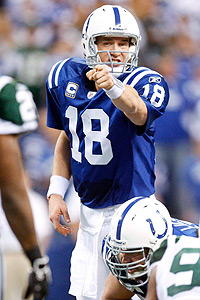 Andrew Mills/US PresswireCan Peyton Manning and the Colts add another Super Bowl championship in 2010?
In 1994-95, the Pacers had their breakout season, going 52-30 and reaching the NBA Eastern Conference finals. At about the same time, the Colts' first magical year came in 1995, when they went 13-3 and made it to within a Jim Harbaugh Hail Mary pass of the Super Bowl.
1994 also was the first year that Indianapolis Motor Speedway hosted the Brickyard 400 for NASCAR's Cup series, and the ending couldn't have been happier with adopted Hoosier Jeff Gordon scoring one of his earliest and most memorable NASCAR wins.
With all these additional choices competing for sports fans' attention and money, it was inevitable that Indianapolis' flagship event would suffer. Practice and qualifying crowds diminished, but the Speedway still packs in upward of 225,000 fans on Indianapolis 500 race day, and the party atmosphere promoted on Carb Day has lured the raunchy Snakepit set back to IMS.
The fact that the Indy 500 remained strong despite having serious local competition for arguably the first time in a century is a credit to Tony George's leadership of the Speedway over the past 20 years. During his tenure, George didn't accomplish all of his goals, but he did succeed in his main objective of maintaining the Indy 500's position as one of the world's top sporting events.
It's difficult to maintain that level of stability and excellence for 10 years, much less a hundred. But Indianapolis sports fans have been lucky enough to experience consistent success with the Pacers and, more recently, the Colts.
After their initial breakthrough in 1994-95, the Pacers made the NBA playoffs in 11 of their next 12 seasons, advancing to the NBA Finals in 1999-2000. But the franchise never really recovered from the infamous Brawl at The Palace in December 2004 and has tumbled back into pre-Reggie Miller era mediocrity. The current Pacers are 16-29 and at the bottom of the league in attendance, a far cry from the Pacer Pride of a decade ago.
The Colts lost their way in the late '90s until they drafted a guy named Peyton Manning, a franchise player if there ever was one. The Manning-led Colts went on to set an NFL record for wins in a decade with 115, won Super Bowl XLI and are set to make their second title game appearance in the past four years.
Speaking of Super Bowls, the 2012 edition of the league's championship game is set for Indianapolis' Lucas Oil Stadium -- assuming there is not a player lockout on the horizon. And Indianapolis was such a popular venue for the NCAA Final Four that it became a permanent part of the NCAA's host city rotation. In fact, the NCAA is now based in Indy.
Much of the non-NASCAR racing industry also calls the Indianapolis area home, including a passel of drag racing teams. Not surprising given that Indianapolis hosts the NHRA's U.S. Nationals.
As a whole, the sport of Indy car racing may not be in the best of shape. But the city of Indianapolis is doing just fine in sporting terms -- as is the cornerstone of that competitive heritage, the Indianapolis 500.
ABOUT THIS BLOG

John Oreovicz
John Oreovicz lives in the shadows of Turn 1 of the Indianapolis Motor Speedway.
His interest in racing was sparked by the battle between Niki Lauda and James Hunt for the 1976 Formula One World Championship, and he can remember watching the 1977 Long Beach Grand Prix and the 1979 Daytona 500 on the family RCA XL-100 television as if they happened yesterday.
These days, you're likely to find him at Pomona covering drag racing or Phoenix reporting on stock cars in addition to his usual role as one of the IndyCar Series' pressroom veterans.
With more than a decade writing for ESPN.com, his work has been published in more than a dozen countries around the world, and he co-authored "A Winning Adventure," a chronicle of Honda's successful CART Indy car engine program.
Contact him at indyoreo@earthlink.net.