Chase for the Sprint Cup

The Chase for the Sprint Cup is the postseason championship series used by NASCAR. The Chase began in 2004 as the Chase for the Championship and has been modified slightly several times since its creation. The Chase consists of 10 races that pit the top 12 drivers (based on points accumulated in the regular season) against one another, though non-Chase drivers still compete in the races. The winner is the driver with the most points at the end of the 10-race playoff.
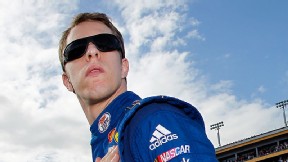
Brad Keselowski is the defending champion, winning his first Chase title in 2012.
NASCAR's top division, the Sprint Cup Series, hosts a regular season of 26 races in which the drivers accumulate points based on their finishes. 12 drivers at the end of the regular season are able to compete for the Sprint Cup championship -- the top 10 in the points standings and two wild cards. The wild card spots are award to the two drivers ranked 11th through 20th in the standings who have the most race wins in the first 26 races. The points are reset at the beginning of the Cup -- each driver receives a base of 2,000 points, plus 3 bonus points for each race won in the regular season. The two wild card entrants aren't eligible for the win bonus points entering the chase.
The Chase is scored using the same format as the regular season -- a driver is awarded 43 points for a win (42 points for second, 41 for third and so on), plus one bonus points for leading a single lap and one points for leading the most laps. The race winner also receives three additional bonus points. A 43rd (last) place finish is worth one point, so it is theoretically possible for a driver to make up as many as 47 points on another driver in a single race. All drivers participate in the Chase events, though only the top 12 who qualified for the postseason are eligible to earn Chase points.
The driver with the most points at the end of the Chase series is declared the champion.
The Chase for the Championship was created in January 2004 as a way to increase the excitement and opportunity for more drivers to win. When the changes were made, it was the first time in almost 30 years that the point system for NASCAR was altered. As originally set out, the Chase involved the top 10 drivers after the first 26 races of the Cup season (and any others within 400 points of the leader). The point totals were adjusted so that the first-place driver had 5,050 points, the second-place driver 5,045 and so on.
The new format was announced after an extremely controversial 2003 championship, when Matt Kenseth won the title despite winning only one race that year. He had finished in the top 10 in 25 of the 36 races, but many other drivers and critics were frustrated with the outcome, considering his lack of No. 1 finishes. Ryan Newman, on the other hand, finished in sixth place despite winning eight races, more than any other competitor. The point changes implemented in 2004 (increasing the number of points a winner receives compared with a runner-up) were considered a direct result of Kenseth's win, and the Chase format was more coincidentally planned for the next year -- though in the end, the two were inextricably linked.
In 2007, the format was changed again, slightly. The field was expanded from 10 drivers to 12, and race winners received an extra five points (earning 185 points for a win rather than 180). Drivers also were rewarded for winning races in the regular season, earning 10 points for every race they won in the first 26 meets and being seeded accordingly. The name also was changed from the Chase for the Nextel Cup to the Chase for the Sprint Cup after Sprint bought out Nextel.
Many of the Chase's toughest critics were appeased by the 2007 changes. Earlier, pundits had argued that resetting the point totals at the beginning of the Chase rendered the first 26 races of the year worthless -- an argument fixed by the 2007 adjustments.
Jimmie Johnson has won the most championships with five consecutive titles, from 2006 to 2010. He also has the largest number of wins in Chase races by a wide margin. Some critics have argued that because the races included in the Chase are some of Johnson's favorites, he has an unfair advantage. Kurt Busch won the inaugural Chase, and Tony Stewart won the second competition.
Through nine races, the 2010 Chase was the closest at the top. Four-time defending champion Jimmie Johnson got off to a slow start, falling 92 points behind leader Denny Hamlin after one race. However, over the next two races, he made up the difference and took an eight-point lead on Hamlin, with Kevin Harvick just 30 points back. The trio continued to separate themselves from the field, with Hamlin's win at Texas vaulting him back over Johnson and into the lead. Entering the final race of the season, Hamlin led Johnson by 15 points, but Johnson managed a second-place finish at the season finale and won by 39 points. Hamlin finished second (after a disappointing race that saw him 14th at Ford) and Harvick third, only two points behind Hamlin.
Many considered the 2010 Chase by far the best ever, with so many competitors realistically vying for the title by the final race. The 2010 running of the Chase also marked the first time the racer in second place before the final run came back to win the Sprint Cup title. Johnson became the first NASCAR driver to win five consecutive championships, and joined the Yankees, the Celtics and Canadiens as the only competitors to do it in any professional sport.
In 2011, NASCAR implemented a new points system and changed the qualifications for the final two spots in the Chase for the Sprint Cup. The points system was simplified, awarding 43 points to a winner and one point less for each spot behind, replacing the previous sliding scale. In addition, NASCAR changed the final two qualifiers from being the 11th and 12th drivers in the standings to two wild cards, given to the drivers ranked from 11th through 20th in the standings who have the most wins in the first 26 races.
The 2011 Chase turned into a two-man race between Carl Edwards and Tony Stewart. Edwards held a slight lead on Stewart heading into the final race, but Stewart won that race, leaving him in a tie with Edwards atop the points standings. Stewart was awarded the title, winning the tiebreaker for most wins.
The tracks and schedule the Cup series Chase uses today are largely identical to the schedule set in the opening event in 2004, though some races have been removed or added and a few have changed order in the schedule. In 2004, when the series began, the order was this:
New Hampshire Motor Speedway -- Loudon, N.H.
Dover International Speedway -- Dover, Del.
Talladega Superspeedway -- Talladega, Ala.
Kansas Speedway -- Kansas City, Kan.
Charlotte Motor Speedway -- Concord, N.C.
Martinsville Speedway -- Ridgeway, Va.
Atlanta Motor Speedway -- Hampton, Ga.
Phoenix International Raceway -- Avondale, Ariz.
Darlington Raceway -- Darlington, S.C.
Homestead-Miami Speedway -- Homestead, Fla.
In 2005, because of a lawsuit from the owners of Texas Motor Speedway that required NASCAR to host a second event at the track, the speedway in Fort Worth was added and Darlington Raceway -- previously the second-to-last event -- was removed from the order. That schedule remained the same until 2009.
In that year, the Atlanta Motor Speedway was removed from the final 10 events and the Talladega Superspeedway was moved to a later date in the competition. The Auto Club Speedway in Fontana, Calif., was added to replace the race in Atlanta.
In 2011, the Chicagoland Speedway opened the Cup playoff series, making it the first year since the Chase was created that the Sylvania 300 was not the first event. The Auto Club Speedway was removed from the Sprint Cup Chase to make room for Chicagoland. In 2012, the races at Talladega and Kansas were flipped on the schedule.
2012 schedule:
Sept. 16 - Chicagoland Speedway -- Joliet, Ill.
Sept. 23 - New Hampshire Motor Speedway -- Loudon, N.H.
Sept. 30 - Dover International Speedway -- Dover, Del.
Oct. 7 - Talladega Superspeedway -- Talladega, Ala.
Oct. 13 - Charlotte Motor Speedway -- Concord, N.C.
Oct. 21 - Kansas Speedway -- Kansas City, Kan.
Oct. 28 - Martinsville Speedway -- Ridgeway, Va.
Nov. 4 - Texas Motor Speedway -- Fort Worth, Texas
Nov. 11 - Phoenix International Raceway -- Avondale, Ariz.
Nov. 18 - Homestead-Miami Speedway -- Homestead, Fla.
TOP STORY
Bringing It Home
Brad Keselowski won his first Sprint Cup title before the end of Sunday's finale when Jimmie Johnson was forced out of the race with mechanical problems. Story » Standings »
2012 CHASE FOR THE SPRINT CUP
 First Race: Sept. 16 at Chicago
Last Race: Nov. 18 at Homestead
Races: 10
Drivers: 12
Defending Champion: Brad Keselowski
PAST CHASE CHAMPIONS
Sprint Cup
| Year | Driver | Manufacturer | Wins |
|---|---|---|---|
| 2012 | Brad Keselowski | Dodge | 5 |
| 2011 | Tony Stewart | Chevy | 5 |
| 2010 | Jimmie Johnson | Chevy | 6 |
| 2009 | Jimmie Johnson | Chevy | 7 |
| 2008 | Jimmie Johnson | Chevy | 7 |
| Year | Driver | Manufacturer | Wins |
|---|---|---|---|
| 2007 | Jimmie Johnson | Chevy | 10 |
| 2006 | Jimmie Johnson | Chevy | 5 |
| 2005 | Tony Stewart | Chevy | 5 |
| 2004 | Kurt Busch | Ford | 3 |
2012 CHASE FOR THE CUP SCHEDULE
| Date | Race | TV |
|---|---|---|
| 9/16 2:00 PM ET | Sprint Cup at Chicago |  |
| 9/23 2:00 PM ET | Sprint Cup at New Hampshire | |
| 9/30 2:00 PM ET | Sprint Cup at Dover | |
| 10/7 2:00 PM ET | Sprint Cup at Talladega | |
| 10/13 7:30 PM ET | Sprint Cup at Charlotte |  |
| 10/21 2:00 PM ET | Sprint Cup at Kansas | |
| 10/28 2:00 PM ET | Sprint Cup at Martinsville | |
| 11/4 3:00 PM ET | Sprint Cup at Texas | |
| 11/11 3:00 PM ET | Sprint Cup at Phoenix | |
| 11/18 3:00 PM ET | Sprint Cup at Homestead-Miami | |