

If you follow the U.S. men's national team, here's a good sanity check: Imagine going back in time -- say, 15 years -- and telling your past self about the current situation.
"Yeah, so there's this guy who came up through the FC Dallas academy, moved to Schalke when he was a kid, started for them as an 18-year-old when they finished second in the Bundesliga behind Bayern Munich, and then moved to Juventus. He has played more Serie A matches for Juve than anyone else in the seven seasons since he joined the team."
"And he just did this news conference where he said, 'Guys from here being talked about going to Manchester United' was 'inevitable.' Oh, and this is important: he was saying that because Manchester United just poached the USMNT manager in the middle of the Premier League season."
Think about all the assumptions your 15-years-younger self would be making, whenever they had regained consciousness after suffering the double-whammy of learning that time travel exists and that the USMNT was one step below Manchester United in the global pecking order.
... Schalke are one of the best development clubs in the world, and Juventus are one of the best clubs in the world, so one of the best soccer players in the world plays for the USMNT now? And then, well, the USMNT coach is now coaching Manchester United, which might be the best club in the world. If my math is right, then there was a World Cup a couple of months ago -- in summer 2026 -- so ... wait ... did the U.S. just win the World Cup?
At this point, you'd disappear back to the present, allowing yourself to dream of a more hopeful future -- rather than explaining what happened to the Italian economy in the aughts, or what went down at Manchester United after Sir Alex Ferguson left, or what the USMNT's score against Belgium was.
But even with the relative changes in station over the past decade-plus, it's still a surreal thing to say today: Manchester United just hired away the USMNT manager. And, as Weston McKennie suggested, this always happens: Transfer rumors connect the manager of a new club with a smattering of players from the manager's old team.
All of which brings us here: Would any of Mauricio Pochettino's former players actually make Manchester United better? And even if they would, should United sign any of them?
What do Manchester United need?
There are three clear, interrelated issues with the way United's team plays and the way United's team was built.
The first: They're old. In fact, they're as old as Arsenal.
Now, you might be saying, "But Arsenal are the best team in the league!" But, well, Arsenal are the best team in the league, in part, because they're old. After multiple seasons of signing exclusively young players, they've spent the past two years adding established players who are late in their prime to the roster. They are trying to win as much as possible right now, and so their average age, weighted by minutes played, is 27.2 -- tied for third oldest in the league.
Although they finished third last season, United were clearly not a title contender coming into the Premier League season -- and, well, they're currently in 19th place. After Sunday's embarrassing loss to Liverpool, prediction markets now give them a 19% chance of being relegated. Once again, this team should be building for future title contention -- not contention to win right now.
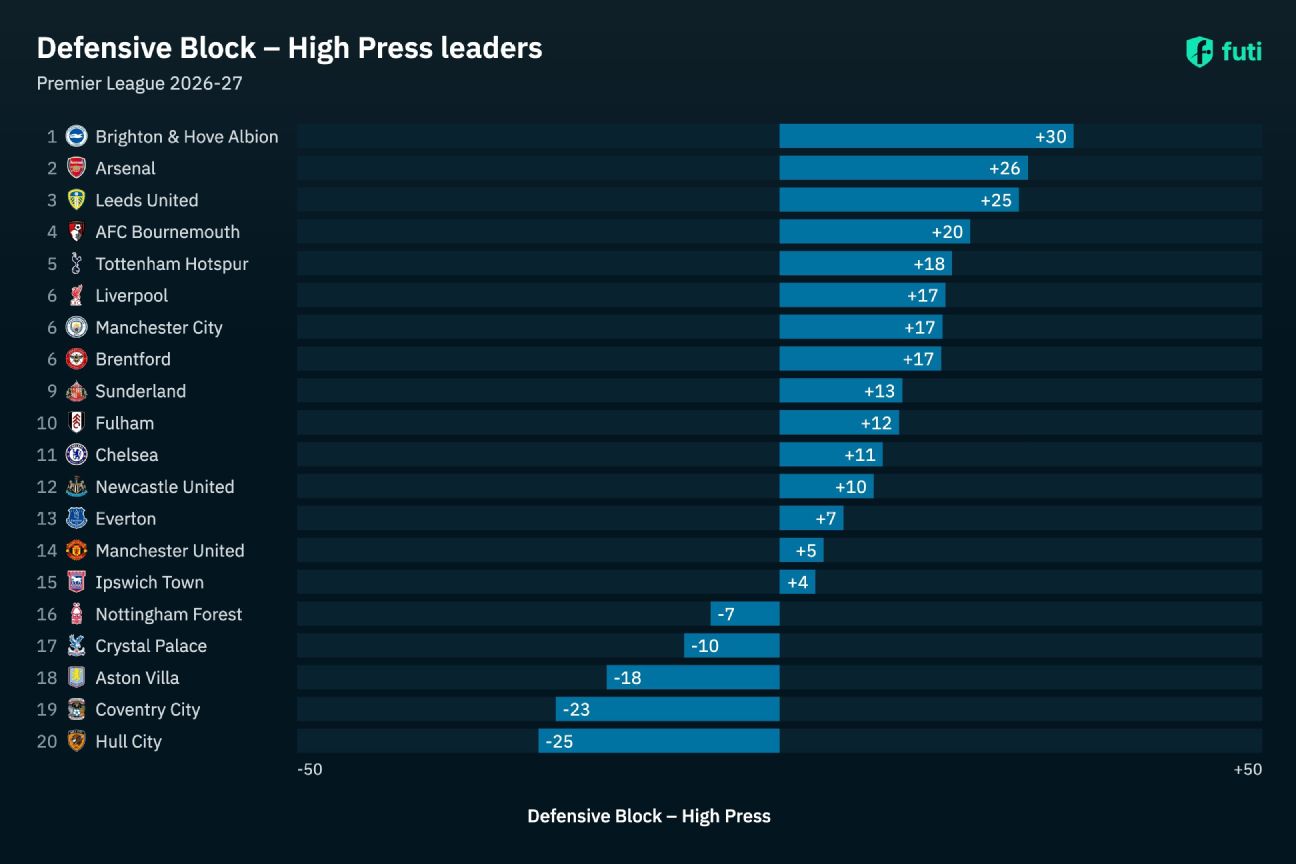
Perhaps connected to that is the team's inability or unwillingness to press. The stats app Futi measures team's tendencies across a variety of stylistic markers. One of which is: "Stay compact to deny space or press to win the ball during the opponent's buildup?" Here's where United landed on that spectrum before Pochettino took over:
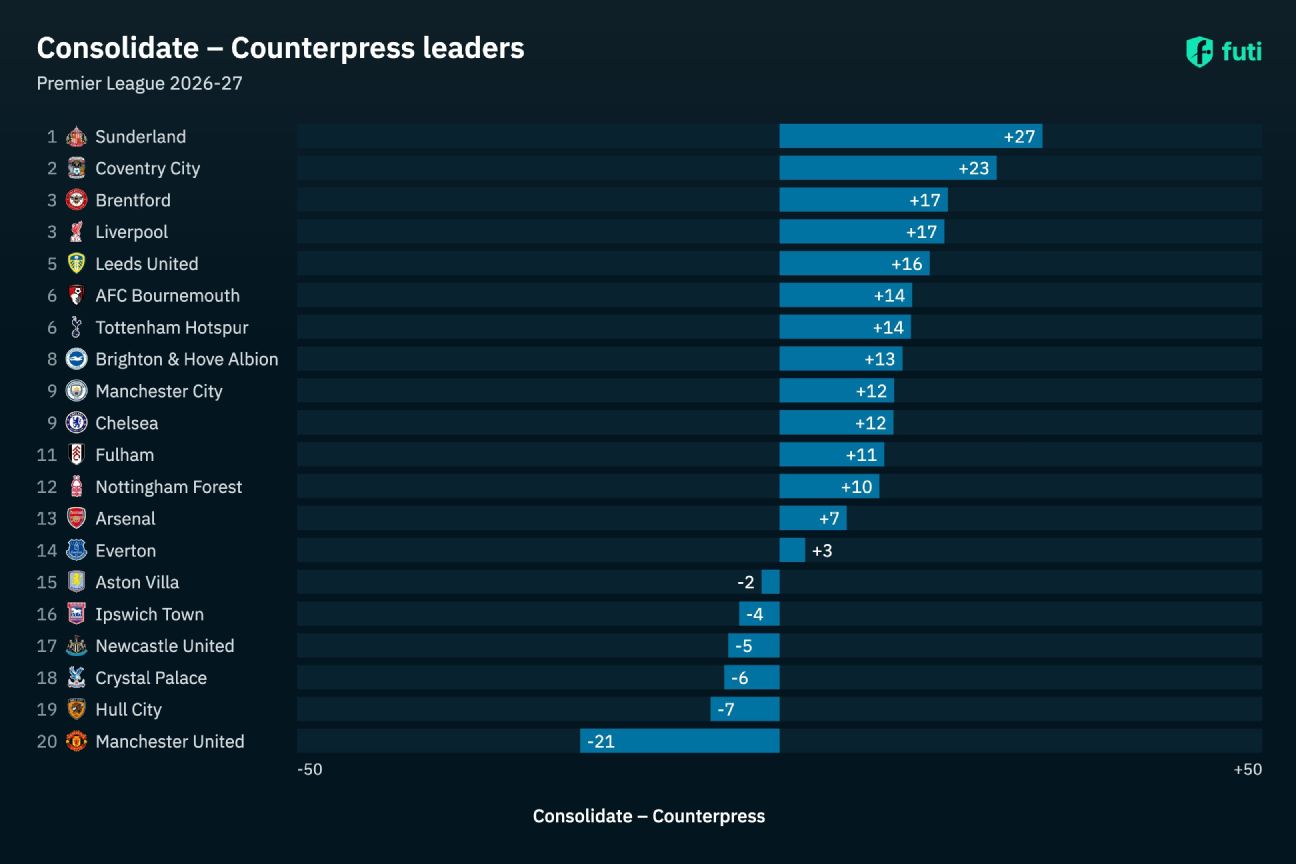
It's even worse when you look at what they do soon after possession is turned over: "Press aggressively to win back lost balls or fall back to recover defensive structure?"
While the league has moved toward a much more aggressive stance in these situations, United have gone in the opposite direction:
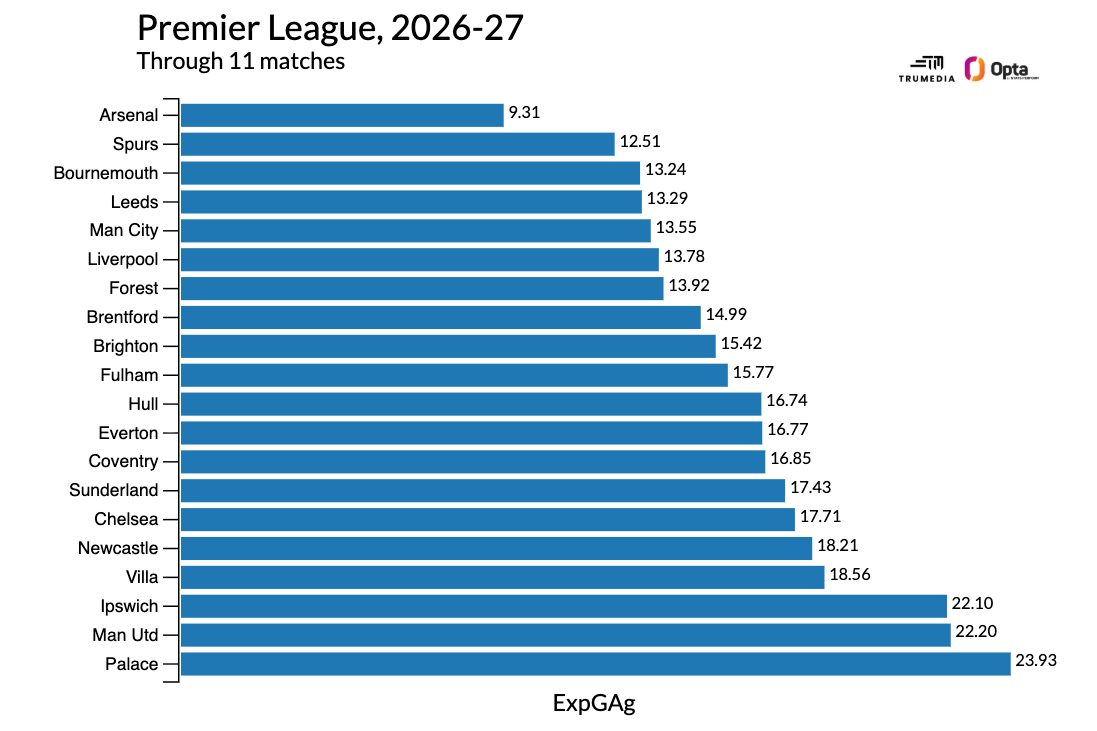
And it hasn't helped the defense in any way.
Only one team has conceded more expected goals than United this season:
We know that Pochettino wants his teams to press, and we know that pressing tends to favor younger, more energetic, and more mobile players. We also know that Pochettino's USMNT ticked both of these boxes at the World Cup: They were one of the more aggressive pressing teams in the tournament, and -- despite the presence of 39-year-old Tim Ream -- the ninth-youngest team in the field, weighted by minutes played.
Would any USMNT players make Man United better?
Given everything we've just gone over -- or, you know, what you might've watched Sunday -- the obvious place to start is in the back.
Man United goalkeeper Senne Lammens is young and roughly a league-average Premier League starter, and goalkeeper might be the weakest position in the USMNT pool. No Americans would be an upgrade here.
At the back, United's four most-used players this season are Diogo Dalot at right back, Luke Shaw at left back, and Harry Maguire and Lisandro Martínez at center back. Shaw is 31, Maguire 33, Martinez 28 -- and they're all out of contract at the end of this season. Plus, a large chunk of the defensive issues can probably be directed here.
These players are all on the older side, and none of them are above-average or even average ground-covering athletes. It's really hard for a team to press without rangy defenders covering behind the press, but none of these defenders have excelled in the more passive defensive structure. Otherwise, well, United wouldn't give up so many great chances.
Pochettino seemed aware of this, as he benched Maguire for the Liverpool match and played a back three with the theoretically more mobile Leny Yoro and Matthijs De Ligt alongside Martinez. We just needed eight minutes of game time at Anfield to see that this probably isn't the solution.
Two obvious American candidates for these positions are already playing in the Premier League: Crystal Palace center back Chris Richards and Fulham left back Antonee Robinson. And there are two obvious problems with each option.
While he's used to a back three, Richards has played in much deeper defensive systems in the Premier League, and it's unclear how good Richards actually is. Futi's rating system -- which looks at how much a player increases his team's chances of scoring and decreases its chances of conceding -- sees him as a league-average player. And he's currently the senior center back on the only team with a worse defense than United.
Robinson, meanwhile, has been one of the better left backs in the Premier League over the past three or four years. Especially with Shaw's injury problems, he could provide immediate value. But while he's younger than Shaw, he's not that much younger. Robinson is 29; United don't need more 29-year-olds.
At right back, Dalot is 27, and his contract expires at the end of next season. I think he gets a bad rap; he's fine. You can win with him as a starter; you will not win if he is one of your best and most consistent starters, which has been the case at United over the past half-decade.
Alex Freeman is the standout option here. As the flex centerback/fullback that Pochettino seems to want in one of his fullback spots, Freeman was one of the breakout stars of the World Cup. He's an uber-athlete whose on-ball skill seems to improve every time he plays for the U.S., and Pochettino loves him.
As Poch said after the World Cup win over Australia: "Alex Freeman has the potential to be one of the best players in his position in the world."
At just 22, Freeman would also make Manchester United younger. He's the kind of player United need to be signing, but we also shouldn't get carried away. He has been in and out of the lineup for Villarreal this season. The betting-market-implied power ratings at PitchRank still see United as a slightly better team than Villarreal. You wouldn't be signing Freeman to make United better right now.
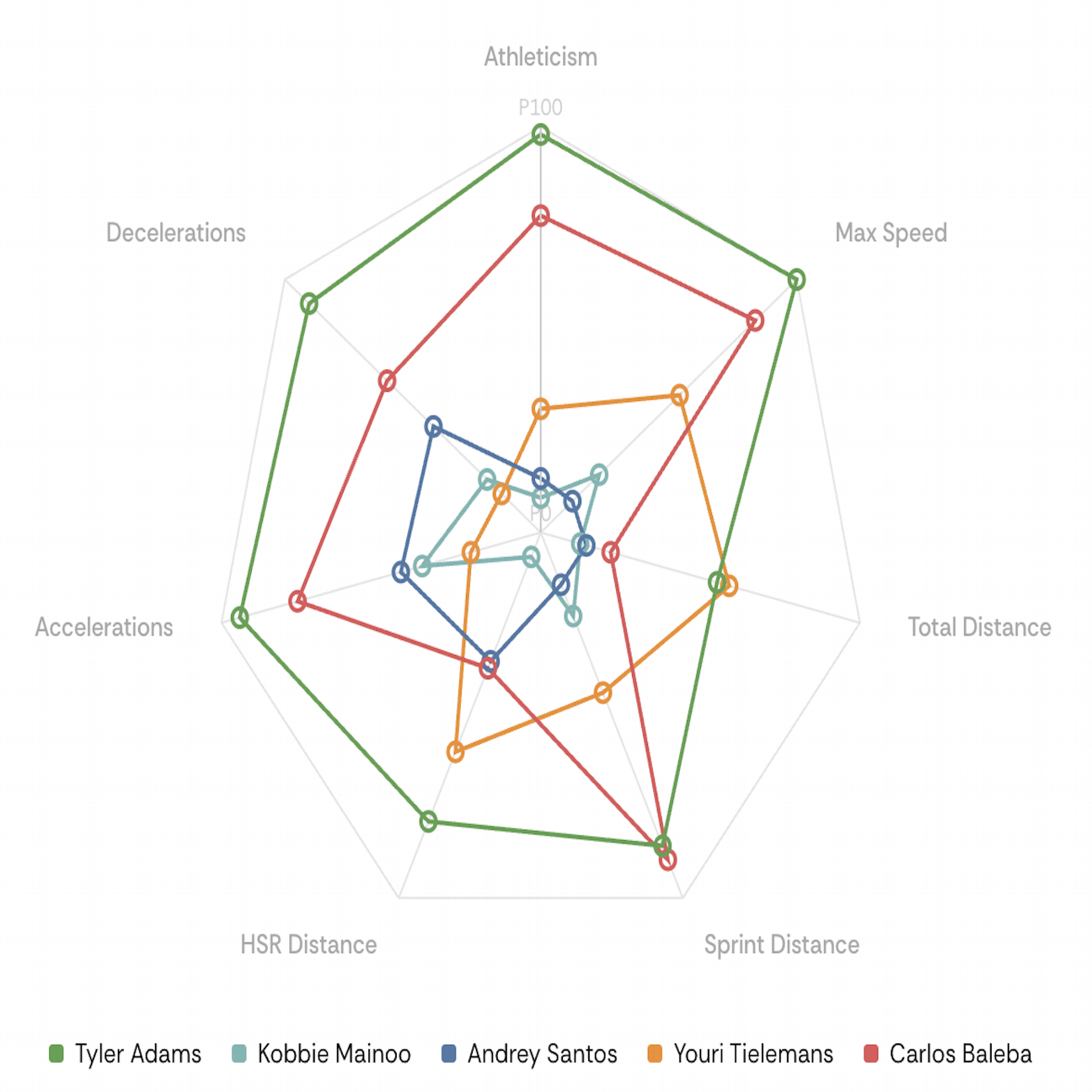
United got younger in the midfield this season, but the first-choice pairing of Kobbie Mainoo and Youri Tielemans is one of the least athletic in a league in which midfield play has become a rock fight combined with a 90-minute beep test. Twenty-two-year-old summer signing Andrey Santos doesn't move the needle on the physical side, and while the other 22-year-old summer signing, Carlos Baleba, does, it's still unclear whether he has the on-ball chops to hang on a team that's going to have the ball as much as United will.
Tyler Adams is playing almost every minute of every game for Bournemouth, who those market-implied ratings see as a top-15 team in the world. He's also one of the more athletic midfielders in the league. Here's how he compares to United's midfielders across a number of physical metrics from Gradient Sports. "HSR" represents "high-speed runs" or runs at a slightly lower speed than a sprint, and the outer edge of the graphic represents the 100th percentile:
The problem, of course, is that United have already invested a ton of money in midfield, and Adams turns 28 in February.
Further upfield, in attacking midfield, both Malik Tillman and Weston McKennie would add more athleticism, and they'd certainly improve United's ability to press:
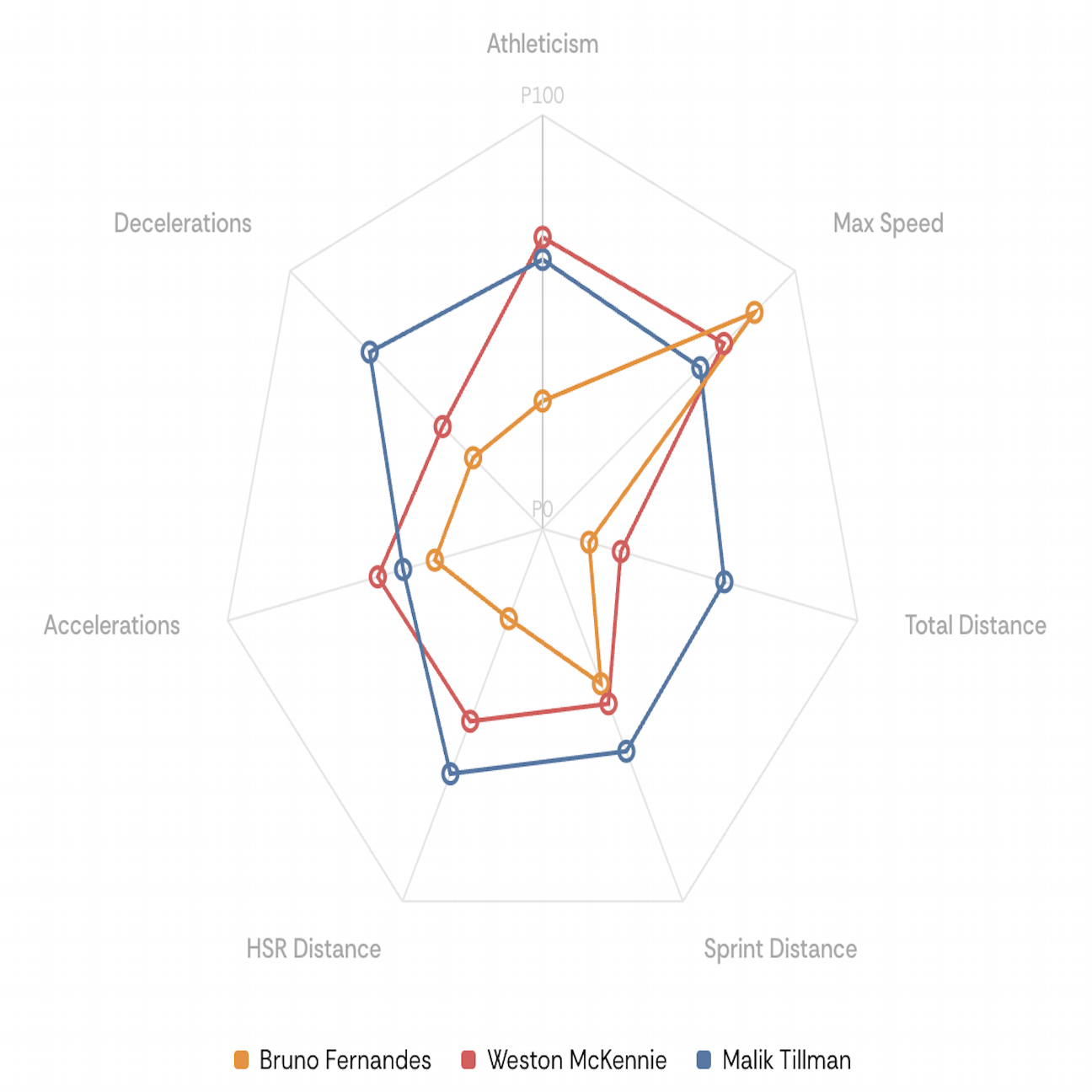
Bruno Fernandes's contract is up after this season, and he's 32. If he stays, maybe the 24-year-old Tillman could come into the midfield and Bruno could bump up to the front three. Leverkusen, too, are rated ahead of United in those market-derived rankings.
But for as good as he looked at the World Cup, Tillman still hasn't locked down a consistent first-choice role since moving to the Bundesliga in summer 2025. It would be absurd to ask him to replace one of the best creative players in Premier League history. McKennie, meanwhile, is 28 years old.
Up top, we know that Folarin Balogun is available -- after the last-second failure of his previously agreed-upon move from AS Monaco to Everton over the summer. At 25, he also fits right on the edge of the age range United should be looking for. He has been productive in Ligue 1 and the Champions League whenever he has been on the field. And he would finally give United an attacker who wouldn't consistently settle for low-quality shots.
But Balogun isn't a standout presser -- he will press, but he's not adding value in that area -- and he has mostly thrived in transition-heavy attacks. United's attacking struggles have come with breaking down more set defenses. And the attack really isn't the major issue this season; only City, Brighton, Bournemouth and Liverpool have created more expected goals (xG) through 11 games.
Christian Pulisic is on fire with AC Milan, and he's good enough to play significant minutes for this United side. But they already have Matheus Cunha and Bryan Mbeumo; they don't need a third winger in his late 20s. Plus, Pulisic just signed a new, five-year deal with Milan, so his transfer fee would be especially expensive.
United are a mess, and there's at least an argument that they're in a real relegation fight right now, so they need to stop thinking about age curves and future value. They just need to bring in players who can contribute right now and make sure the unthinkable doesn't happen. And the USMNT player pool does have a bunch of players who fit that mold.
While no transfers are without risks, the likes of Richards, Adams, McKennie and Pulisic could all probably give United useful minutes as soon as they joined the club.
But those, too, are the kinds of moves that make a season like this one more likely to happen again in the future. You'd be making an already-old team even older and filling it with players who are only likely to decline.
The USMNT pool also offers tons of young talent, as we've seen with Pochettino's last few matches in charge. But that's a group of players with lots of potential. Some of them might one day be good enough to compete at the top of the Premier League, but these are mostly teenagers and guys who just entered into their 20s.
Unfortunately for Pochettino, his old team just doesn't have a lot of what his new team needs: players who can contribute today, tomorrow and a couple of years down the road.