 AP Photo/David RamosMark Webber, above, trails F1 leader Jenson Button by 17 points after Sunday's Spanish GP win.
Mark Webber earned arguably the most valuable win thus far this Formula One season. Entering the Spanish Grand Prix 32 points behind leader Jenson Button, Webber needed a strong finish, and he got it. Thanks to a dominating victory, Webber cut his points deficit by nearly half, and now finds himself fourth in the driver standings.
His teammate Sebastian Vettel again had to battle mechanical concerns, this time fighting front brakes that were about to give out. Unlike previous races in 2010, Vettel managed to battle through the issue and finish on the podium, thanks in part to a stunning accident by Lewis Hamilton in the closing laps. For Hamilton, it was sheer bad luck, and relatively costly, as he lost 10 points to Button in the standings.
Webber's win highlights a trend we'll likely see in the upcoming two races: winning from the pole. After all, Spain, Monaco and Turkey rank first, second and third, respectively, in regard to the highest percentage of drivers who have won from the pole since 2004.
Catalunya has seen the pole sitter take the race win every year since 2001, while the man on the pole at Monaco has won five of the past six events. Drivers starting outside the top three at Monte Carlo should be concerned, as the last man to win this famed event from outside the first three starting positions was Olivier Panis in 1996. He started from 14th in a race in which Michael Schumacher hit the barrier on the first lap and only seven cars ended up classified.
Highest winning percentage from pole (2010 venues since 2004)
Spain -- 100 percent
*Monaco -- 83.3 percent
*Turkey -- 80 percent
*Next two races on the schedule.
This year's edition could easily see an unlikely winner, similar to Jarno Trulli's victory in 2004. With all 24 cars scheduled to participate at the same time in Q1, it will be a hectic qualifying session, and if the top-level drivers are constantly in traffic, they could find themselves failing to make it to Q2 or Q3. From that point forward, it will be extremely difficult for quicker cars in the race to get by the leaders on the incredibly twisty and narrow circuit. It's somewhat ironic, as the most prestigious and difficult track on the schedule likely provides the most hope for a podium finish from mid-range teams.
If Red Bull can claim its sixth straight pole to begin the season, it would be the first occurrence that a single team took the first six poles of the year since McLaren in 1998, when the duo of Mika Hakkinen and David Coulthard claimed the first nine of that year.
As the teams quickly shuffle to Monaco for Thursday's practice sessions, eyes again will be on Michael Schumacher. Although he has not won this race since 2001, his five victories in Monte Carlo are tied for second-most with Mr. Monaco, Graham Hill, and one shy of Ayrton Senna's record six wins. Schumacher is coming off of his best finish of the season (fourth), and his new, longer wheelbase should help him at a high-downforce track like Monaco.
Fernando Alonso is the only other active driver to have won this race at least twice, and a third victory would mean he would join Stirling Moss and Jackie Stewart as the only drivers to win at Monaco three times.
Most wins at Grand Prix of Monaco
Ayrton Senna -- Six
Michael Schumacher -- Five
Graham Hill -- Five
Alain Prost -- Four
The strongest team could be McLaren, as the constructor has won three of the past five Grand Prix of Monaco events. But it likely will be an uphill battle for the McLaren outfit, which leads the constructors' championship. Over the past eight years at Monaco, only once has the leading constructor entering the race had both its entries finish among the top five (Brawn GP managed the feat last year). Just twice in that span has a driver from that constructor won, and in five of those eight years, the second finisher checked in at eighth or worse.
It will be interesting to see how defending Monaco winner Jenson Button fares; so far this year he seems to be either winning or not even in the mix up front.
Sauber is one of those teams that has made big changes over the past few weeks, and driver Pedro de la Rosa is confident the Ferrari-powered outfit can compete.
"For the Spanish Grand Prix, we will also have a new aero package in place," he told reporters. "I'm sure at the end of the race we will either be close to or in the points."
Think about that statement for a second. It is a bold one.
Over the past two grand prix events, Sauber drivers have combined to tally 15 total laps, and in the first four races this season, they have one finish. In fact, Sauber is the only team that also competed in 2009 that has not collected a single point this year, and it can be argued that the team has thus far been the worst of the 12 in competition. A team that is also in contention for that dubious honor, HRT, can at least claim a race where both Karun Chandhok and Bruno Senna crossed the finish line (Malaysia). There are a few bright spots for Sauber, however. Kamui Kobayashi did qualify ninth on the grid in Malaysia, while de la Rosa's only finish of the season (Australia) was just five seconds behind the final point earner.
A few drivers must have had this race on their radar early in the season. Obviously, Fernando Alonso would love to win again in his home country. Alonso was victorious at Catalunya with Renault in 2006 -- by nearly 20 seconds over his closest competitor. He is a strong favorite to win again this year. A victory would catapult him to first or second in the standings. His Ferrari teammate, Felipe Massa, likely has been ready for this race since the conclusion of last year's. Massa and Ferrari were at the end of an embarrassing miscalculation in which the Brazilian had to slow toward the end of the race due to a very low fuel level. As a result, that allowed Alonso to catch and overtake Massa in the closing laps, with Massa winding up sixth.
Rubens Barrichello set the fastest lap of the Barcelona race last year and dominated the early stages, but had his hands tied after having to pit three times compared to teammate Jenson Button, who pitted only twice en route to the win. Barrichello likely will have his sights set on points this year, however, as he is with a Williams team that has not won since 2004, the longest spell in the team's history.
Speaking of fastest laps, the notable award continues to yield little in regards to early-season wins. Just like each of the past two seasons, the driver who notched the quickest lap of the race has gone on to win that race just once in the first four events (Alonso at Bahrain). Only once in the past six seasons has the fastest lap of the race translated into a win more than one time in the first four events; that was back in 2007, when three of the first four races saw the driver with the fastest lap also cross the line first. Spain likely will not alter that trend, as just two of the past five winners at Catalunya have also posted the quickest lap of the grand prix. As always, speed is nothing without good strategy and sound reliability.
The Circuit de Catalunya brings with it several challenges. It is really the first track on the schedule this season with even mild elevation changes, and is comprised of a number of high-speed corners, including the third turn. Teams find themselves making choices between speed and grip, and while the front stretch is very long, the rest of the track requires a setup that favors high downforce. It is essentially a nice transition track in regards to downforce, as the next race on the calendar, Monaco, requires incredible amounts of grip.
When team setups are just right at Catalunya, however, it is very evident, as the last four years have indicated. Since 2006, the podium each year has featured two drivers from the same team, meaning that race setups are especially crucial here, and if a competitive team nails it, both of its drivers likely will be on those top three steps.
Teams with two drivers on podium, last four seasons at Catalunya
Year -- Team -- Finish
2009 -- Brawn -- 1-2
2008 -- Ferrari -- 1-2
2007 -- McLaren -- 2-3
2006 -- Renault -- 1-3
As the calendar shifts to May, Formula One endures its first three-week break of the season.
It's a nice opportunity for teams to make changes to the car before Spain, provided they can get back to their shops in a timely fashion. Force India was one of those teams that still had a majority of its members stranded in Shanghai several days after the race due to travel restrictions from the volcanic eruption in Iceland, but with the lengthy break, it likely will not have any long term ramifications.
Mercedes is one major team that is looking to make adjustments for Barcelona.
Michael Schumacher's car has undergone changes to its weight distribution in an effort to increase front downforce. The decrease in front tire width is a key to this change, as the old tires Schumacher was used to prior to his retirement three years ago provided more weight and downforce at the front of the car.
Red Bull meanwhile is seeking to alter downforce at the rear. The team is working on its own version of the F-Duct, which of course is a scary premise for the competition, as it could mean that the RB6 is about to become even faster on the straights.
Indeed, Europe is the time on the schedule for the strong runners to showcase what they have.
 PHILIPPE LOPEZ/AFP/Getty ImagesLewis Hamilton usually heats up with the weather and the European start of the season.
The necessary improvements have hopefully been made at this point, and teams will generally have to succeed or fail by their alterations.
Fernando Alonso recently put it best to reporters: "The championship always starts in the first race, but it's true that it's just a race to confirm the good feelings you've had during testing. It's also true that in Europe it is time to show who is going to fight for the title and who isn't."
With nine of the next 10 races held in Europe, including Istanbul which is just on the border of Europe and Asia, the heart of the schedule is clearly on the horizon. So who might we see at the top of the driver standings at the end of the European swing? It could very well be the 2008 F1 champion.
Over the past two seasons, Lewis Hamilton has the most podium finishes on the upcoming nine European circuits. Delving deeper, Hamilton has found the podium nine times in those seventeen races, and his four wins in that span are the most of any active driver.
Most podium finishes the last two seasons on upcoming nine European tracks (active drivers)
Driver -- Podiums -- Victories
Lewis Hamilton -- 9 -- 4
Rubens Barrichello -- 6 -- 2
Felipe Massa -- 6 -- 3
Jenson Button -- 4 -- 3
Sebastian Vettel -- 4 -- 2
Mark Webber -- 4 -- 0
A notable name not on this list is of course is Alonso. Over the past two seasons, Alonso failed to record a single podium finish on a European track with Renault. He is in much-improved equipment this season with Ferrari, so he is a name that also must be factored in.
Still, the case for Hamilton over the summer months looks quite strong.
The early summertime in the Northern Hemisphere means that Monaco is close on the schedule as well.
Alongside that race are the other two members of the triple crown of motorsports, the Indianapolis 500 and the 24 Hours of Le Mans.
While modern racing dictates that drivers really do not tackle more than one of these races in the same year, it was commonplace to attempt two or all three within the timeframe of just a month or two only a few decades ago. Graham Hill, the only driver to ever win all three races, drove in all three events in 1966 and he is just one example from the 1950s, 60s and 70s.
In 1966, Hill competed in the Monaco Grand Prix on May 22, finishing third. Hill won the Indianapolis 500 after starting 15th a week later. At Le Mans on the 18th and 19th of June that same year, he co-piloted the number seven Ford GT40 Mk II but failed to finish. Hill would later win that race in 1972 while driving alongside Henri Pescarolo. Having won five times at Monaco, Hill is certainly one of the best representatives of all-around driving skill that motorsports has to offer.
There are modern exceptions of course, such as Sebastien Bourdais. Last season, Bourdais competed for Toro Rosso at Monaco and then finished second overall for Peugeot at Le Mans less than a month later.
It's an example of drivers still attempting two of the races in the same season, and it is, of course, rare. Could you imagine if Fernando Alonso or Lewis Hamilton were to attempt all three in the same year? It will never happen today, but it's fun to think about.
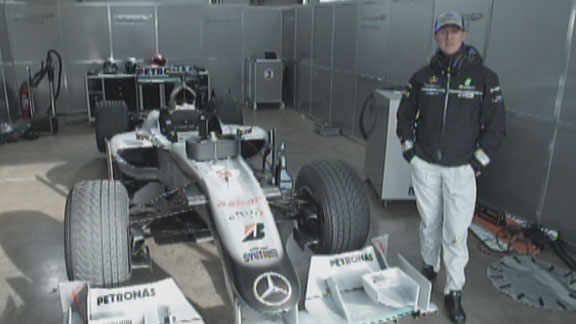
If you have not yet viewed the latest Formula One driver standings, who would you guess is second behind Jenson Button?
Lewis Hamilton, Fernando Alonso and Sebastian Vettel are all worthy choices, but it is actually Nico Rosberg who claims the second spot, albeit by slim margins.
 AP Photo/Ahn Young-JoonMercedes GP crew members embrace Nico Rosberg after the German finished third in Sunday's Chinese Grand Prix.
The man who entered this year in Michael Schumacher's shadow is now forming one of his own, with impressive, consistently high finishes this season. Rosberg has two consecutive podium finishes and has not finished worse than fifth in four events. In the Chinese Grand Prix on Sunday, he ran the fifth-fastest lap and orchestrated a sound race all around, spending less than 50 seconds in the pits on the day despite the changing weather conditions.
All the more impressive when you factor in that Alonso, Felipe Massa, Schumacher, Vettel, Hamilton and Mark Webber each pitted at least four times. Those numerous visits to pit lane by his rivals no doubt aided Rosberg's quest, but it also indicates a strong strategy by the No. 4 team.
If Rosberg continues to be a legitimate title contender, we may see Schumacher take on more of a role as a test driver during races for Mercedes GP, pitting frequently to take on different tire compounds to find the fastest setup. It would be a rather unimaginable scenario for the seven-time world champion, but one that appears more realistic with each day.
Rosberg's best career position in points:
Year -- Position -- Last race (order on calendar)
• 2010 -- Second -- China (fourth)
• 2010 -- Fifth -- Malaysia (third)
• 2010 -- Fifth -- Australia (second)
• 2009 -- Fifth -- Spain (11th)
• 2009 -- Fifth -- Hungary (10th)
*Does not include first race of season.
The McLarens again proved very quick, and had Hamilton had another lap or so he likely would have passed Button for the win. Button, however, drove a sound race in the wet conditions, and despite a late mistake or two showed he can compete against a teammate who is historically very good in the rain.
The 1-2 finish helped McLaren establish a lead in the constructors' title as well, although the team was certainly not without its share of controversy in both pit lane (Hamilton and Vettel) and on the track (Button slowing severely as the field was about to return to green-flag conditions).
F1 boss Bernie Ecclestone did not seem too concerned, telling other teams to "stop complaining and get on with the racing." The racing was indeed on, and for the first third of the race, constant visits to pit lane left the viewer guessing as to who would emerge as the midrace leader.
Vitaly Petrov was equally impressive, not only earning his first race completion but his first points as well. Despite a midrace spin, Petrov bounced back, finishing seventh. It was just two places shy of teammate Robert Kubica, who, according to his postrace comments, could have finished even better.
"The critical moment of my race was when the safety car came out, which ended my hopes of a podium, because I lost the big lead I had to the cars behind me," Kubica said. "So although I'm happy to finish fifth, I still feel a bit frustrated to have missed a podium."
Nevertheless, it was an impressive showing from Renault, the strongest team outside the top four squads.
It was not a day to remember for others. The points leader entering the race, Massa, found himself pitting four times and battling Schumacher for ninth late in the race. He is now nearly 20 points shy of points leader Button.
The Asia swing is over for now, and F1 will not return until Singapore in late September. In three weeks Formula One will be at Catalunya, a track that has hosted F1 races since 1991. This will be the start of 10 consecutive races in either Europe (including Turkey) or North America, and of course includes some of the most prestigious events on the calendar: Monaco, Montreal, Silverstone, Spa and Monza.
As for Catalunya, Alonso will be seeking his second career victory at his home track. It will no doubt be his month, as he has two more wins than any other driver in May since 2005:
Most wins in May since 2005
• Fernando Alonso: four
• Jenson Button: two
• Felipe Massa: two
• Kimi Raikkonen: two
Alonso's pairing with Ferrari is also a fantastic omen for Barcelona, as the constructor has six wins at the circuit since 2000, three times more than any other team. If Alonso wins, he would be the fourth driver in that span to win for the prancing horse.
Just three races down, and this already has been a wild season in Formula One.
Even with the revamped points system, four drivers are within four points of leader Felipe Massa, and six drivers within nine. Last season, one driver was within 10 points of Jenson Button through three races, and that was with a points system that did not strongly reward race wins and therefore made it difficult for one driver to pull away from the field. Then, a win earned a driver two more points than the runner-up. This year, the second-place driver earns 72 percent of the points compared to the winner, rather than the previous 80.
 AP Photo/Lee Jin-manSebastian Vettel's victory in the Malaysian Grand Prix on April 4 was finger-lickin' good.
With that in mind, the winner at China this weekend will really have to earn it. As the inaugural winner Rubens Barrichello said, "Shanghai is a really interesting circuit. It has a good combination of corners and that really long straight at the end of the lap, which is perfect for overtaking. To hook up a quick lap, the car requires more aero strength, rather than mechanical, but an exact blend of the two, which is always quite difficult to achieve. Together with the fact that the lap is also quite long with lots of different variables, setting up the car perfectly is hard work."
The long straights and reliance on strong aerodynamics again will favor Red Bull, McLaren and Ferrari. Mercedes, as Nico Rosberg has said, is not quite in that group.
Shanghai is nearly the identical length of Sepang, with one additional turn. Both also have several passing opportunities on the long straights. With each race consisting of 56 laps, tire strategy likely will be similar, as well.
The tracks each carry significant weather concerns with them, as rain marred both events last season and seems to have the ability to strike at any time.
Despite their similarities, having both been designed by Hermann Tilke, the two tracks do not typically yield the same results. Since China joined the F1 calendar in 2004, only once has a driver won at both China and Malaysia in the same season (Fernando Alonso in 2005).
Last year's event was the first time that Shanghai appeared in the beginning of the season rather than the end, so perhaps defending race winner Sebastian Vettel will have better fortunes than past drivers.
Vettel's win over a week ago continued to showcase the youth movement in Formula One. His victory at Malaysia was the sixth win of his career, all before the age of 23. That's the most wins by a driver before turning 23 in F1 history, two more than the previous record set by Lewis Hamilton. Before Hamilton and Vettel, only one driver in Formula One had ever won more than one race before turning 23 (Bruce McLaren).
Most all-time Formula One wins before age 23:
Driver -- Wins -- Span
• Sebastian Vettel -- Six -- 2008-2010
• Lewis Hamilton -- Four -- 2007
• Bruce McLaren -- Two -- 1959-1960
Hamilton is of course connected to Bruce McLaren through the squad he drives for, as McLaren founded the team back in the 1960s. Before starting his own team, McLaren stormed into F1 by winning the 1959 season finale at Sebring and the 1960 opener in Buenos Aires, both while just 22 years old.
F1 is set up now more than ever to provide seats for young drivers. In the first four or five decades of the sport, few drivers were afforded the opportunity to compete in F1 before the age of 24. Indeed, former champions Jackie Stewart, Keke Rosberg and Graham Hill are just a few examples of the many drivers who started their F1 careers at or beyond the age of 25.
Sure, there were young drivers who got their chance in F1 in the first few decades of the sport, but nothing like today. This season alone, there are five drivers on the grid who are under the age of 24. Toro Rosso's Jaime Alguersuari and Sebastien Buemi are just 20 and 21, respectively.
With the emphasis put on the GP2 series, champions of the prime feeder series have gotten immediate chances to compete in F1. Nico Hulkenberg was last year's GP2 champion and he now finds himself competing for Williams. Timo Glock was signed by Toyota the year after his 2007 title, while Hamilton and Nico Rosberg each joined F1 teams the year after claiming the GP2 crown.
The past few seasons have begun a new era of sorts, and it makes the comeback of 41-year-old Michael Schumacher all the more intriguing.
It was only a matter of time until Sebastian Vettel took home a win this season. Despite not starting on the pole for the first time this year, Vettel made up for it prior to the first turn in the Malaysian Grand Prix, jetting past Nico Rosberg and teammate Mark Webber to take the lead.
 AP Photo/Lee Jin-man Malaysia winner Sebastian Vettel has led more than 50 percent of the laps turned so far in 2010.
What's truly scary about Vettel is that despite his Red Bull Renault's mechanical problems in the first two races, he's just two points shy of leader Felipe Massa. The young German has now led well over 50 percent of the laps turned this season as well.
Vettel will almost certainly score a top-5 finish at China on April 18; he won the event last year in wet conditions and is historically good at backing up race wins. In five career races following a victory, Vettel has not won but has never finished worse than fifth. Indeed, his third-place average finish in the next event following a victory is certainly on par with other F1 superstars since 2008, the season of his first win.
The best average finish in races following a win since 2008 (minimum three wins, active drivers only):
• Fernando Alonso -- 3.0
• Jenson Button -- 3.0
• Sebastian Vettel -- 3.4
• Lewis Hamilton -- 5.7
• Felipe Massa -- 6.8
Granted, it is a small sample size, but it should not take away from Vettel's ability to defend a race win.
As impressive as Vettel's run was at Malaysia, Hamilton's performance was arguably as good or a close second. After starting 20th on the grid following McLaren's disastrous qualifying effort, Hamilton sliced through the field on the opening laps, placing himself in 10th within five laps.
Teammate Jenson Button and the Ferrari duo also started the race around Hamilton, but were nowhere near as quick in relation to him in the opening laps. The feat is even more impressive when you consider that Hamilton was running on hard tires, not the softer options like many others.
If you had not seen the race and viewed only lap-by-lap positions, you might have thought the race was run in the rain, as few are better than Hamilton in those conditions and it read much as if he was easily overtaking drivers who weren't as confident in the wet. But, alas, there was no rain and Hamilton performed admirably on a dry track.
Elsewhere Sunday, reliability issues with Ferrari's engines were brought into the spotlight. Fernando Alonso's blown engine with a lap remaining added to the list; both Ferrari-powered Saubers saw their engines fail. Pedro de la Rosa failed to make the start, and teammate Kamui Kobayashi failed to make it 10 laps into the race before his engine let go. Recall that Ferrari had changed engines prior to the season opener at Bahrain. It should be noted that both Toro Rosso cars, also powered by Ferrari, seemed to have no engine issues.
After a fairly processional Bahrain, the past two events have certainly provided thrills. Three teams have won the first three races, the first such occurrence since 1990. That season was a memorable one, as Ayrton Senna was able to best former teammate and bitter rival Alain Prost in the world championship standings, in Prost's first year after departing McLaren. Although that season had variety at the start, with Ferrari, McLaren and Williams sharing the first three race wins, only one other team was able to score a victory the rest of the season (Benetton in the final two races).
The most consecutive races won by a different team to start a season (since 1975):
Year -- Races -- Teams
• 1983 -- Five -- Brabham, McLaren, Renault, Ferrari, Williams
• 2010 -- Three -- Ferrari, McLaren, Red Bull
• 1990 -- Three -- McLaren, Ferrari, Williams
• 1986 -- Three -- Williams, Lotus, McLaren
• 1975 -- Three -- McLaren, Brabham, Tyrrell
Spanning to 1975, there have been just five occasions when three teams won the opening three races, and McLaren has been involved in all of them.
Michael Schumacher's comeback has gotten off to a rocky start, but few expected him to be competing for race wins this early in the season. While there's no reason to think that Schumacher cannot or will not find more success down the road, he must be frustrated with the difficulties encountered thus far.
Said Schumacher after Malaysia, "It was a shame that I could not finish the race, but unfortunately the wheel nut on the left rear wheel was lost. ... I would have obviously wanted to finish the race, and I think it could have worked out quite reasonably well. But in the end that is motor racing, I remember that very well. It makes no sense to get angry about it -- you have to accept it as part of the game and look ahead."
Schumacher has remained calm while weathering the early storm, despite his 10th-place position in the points. It's rather unfamiliar territory for him, as he hasn't been in a similar position since his first season with Ferrari in 1996, when he was battling an unreliable car (two retirements in the first three races).
While he struggled out of the gate in the first three competitions of several more recent seasons, those were with a strong Ferrari squad, and Schumacher was able to quickly bounce back. Teammate Rosberg has shown that Mercedes has a pretty high potential this season, however, so only time will tell.
The curious case of Jenson Button continues to grow. Obviously a very talented driver, the man from Great Britain apparently just needed a chance in good equipment to be successful in Formula One.
Consider that in the first 155 races of his career, Button had one win and finished on the podium 15 times in nine seasons. Since his move to Brawn GP at the start of last season -- and Mercedes' subsequent buyout of Brawn -- Button has eight wins, a world championship, as well as 10 podiums in 19 events. His latest victory came Sunday in the Australian Grand Prix.
 Paul Gilham/Getty ImagesJenson Button had just one win and 15 podium visits in 155 races before his breakout season in 2009.
The cars can be as strong as possible, but it still takes an excellent driver to get the most out of them. Button has certainly done that over the past two years, after previously driving for teams such as Honda, which provided very little chance for a good race finish.
Button's skill was combined with good fortune Sunday when his fears of the setting sun creating dangerous racing were unfounded due to constant cloud cover. His early pit strategy to switch off of wets also paid off considerably, although his off-track excursion on the out lap was harrowing. Nevertheless, Button was clearly the man to beat after Sebastian Vettel again was felled by mechanical gremlins, this time with his brakes.
Because of his misfortune, Vettel made history in Australia. The 22-year-old German became the first driver since 2000 to claim the first two pole positions of the season yet come away with no race wins to show for it. Mika Hakkinen suffered the same misfortune that season after coming off consecutive world championships.
Going back a bit further, it gets considerably more serious, as it also happened to Ayrton Senna in the first two races of 1994, just prior to his death at Imola in the third event of the season. Before that, it hadn't happened since 1976 and 1977, when the eccentric James Hunt managed the feat in consecutive years. Hunt went on to win the 1976 world championship by the narrowest of margins.
The past five instances when a driver won the first two poles of the season and failed to win either race:
• 2010 -- Sebastian Vettel• 2000 -- Mika Hakkinen
• 1994 -- Ayrton Senna
• 1977 -- James Hunt
• 1976 -- James Hunt
A few other drivers had some notable performances at Albert Park, good and bad:
Robert Kubica took Renault to a runner-up finish; he now has two podiums in his past four races overall. Vitantonio Liuzzi of Force India again collected points, finishing seventh. Last race it was Fernando Alonso who had the fantastic start. This time, it was teammate Felipe Massa who started strong, collecting three places before the first turn. By doing so, he avoided the collision between Button, Alonso and Michael Schumacher. Schumacher's front wing was damaged, and an early pit stop to replace the wing set the tone early for his disappointing day.
This weekend, Formula One is off to Malaysia, looking to continue the thrilling racing that ensued at Australia. Traditionally the second event of the season, the weather over Sepang last year caused significant problems, as the race was halted after just 31 laps due to torrential rain, with Button being declared the winner.
On the calendar since 1999, Sepang provides a challenging 15 turns with two massive straights separated by a hairpin leading to the finish. The circuit was designed by Hermann Tilke, who has a significant influence on the current F1 calendar. He's also behind the designs of such tracks as Bahrain, Shanghai, Valencia and the Yas Marina circuit that debuted last season. While the courses are undoubtedly stunning, a common criticism is that they often produce less than thrilling racing with limited overtaking.
Malaysia has a chance to continue where Australia left off, however, as the long straights as well as the considerable width of the track make for numerous passing opportunities.
In recent years, the course has not been kind to Massa, who seems to succeed most anywhere. In seven career visits to Sepang, Massa has never finished better than fifth, collecting no more than four points in any event. On five occasions, he earned a single point or fewer. If any, this looks like the season to change his fortunes.
Australia brings with it a set of new challenges this week, in part because Albert Park is so strikingly different from Bahrain.
Not only is the circuit half a world away from Bahrain, it's about a kilometer shorter as well. And much of the course is constructed off of public roads, similar to Circuit de la Sarthe, which hosts the 24 Hours of Le Mans annually. Driver sight lines are much more open in Australia, whereas in the desert, there are very few available driver references in regards to braking points.
Slower cars will be in trouble here, as the quicker teams will likely put them a lap down considerably earlier in the race. What was alarming about the Grand Prix of Bahrain was that there were only five cars -- aside from the top four strongest teams -- that finished on the lead lap. Bahrain is the second-longest course on the schedule, so it will be much easier for the leader to put slower cars a lap down on the shorter tracks.
Albert Park is likely the track that Michael Schumacher most wanted to see early on in his return.
He has four race wins at this venue, while no other active driver has more than one. During his dominant run between 2000 and 2004, Schumacher won there four times. But times have changed, and Australia has yielded to variety recently, starting with David Coulthard's victory at Albert Park in 2003, the event has produced seven different winners in a row, tied for the longest active streak of any venue on the 2010 calendar.
That streak could continue this year, as Ferrari pilot Felipe Massa and Red Bull driver Sebastian Vettel have not been a part of that wins list.
Most consecutive different race winners (active streaks)
Track -- different winners
Australia -- 7
Great Britain -- 7
China -- 6
Italy -- 5
Canada -- 5
Essentially, tab the polesitter as the race winner, as this race has recently played out like an event at Monaco. For three years in a row and five of the past six seasons overall, the pole winner has gone on to win the event. Fernando Alonso in 2006 is the only exception during that span, as he started third. Coulthard has the distinction of the worst starting position by a winner at Albert Park; he started 11th after running nearly two seconds off the pace in qualifying in 2003. It was the 13th and final win of his Grand Prix career.
The city of Melbourne provides a striking background for this beautiful circuit, which has a unique mix of fast and slow corners. One of those slower corners is the first turn, which has created some harrowing accidents over the years.
The most notable took place at the start in 2002, when Ralf Schumacher went airborne after running into the back of Rubens Barrichello's Ferrari heading into the first bend. The accident took an astounding eight cars out of the race.
Just last season, several cars touched heading into that same turn on the opening lap. It's a tricky corner, especially at the start of a race, and it seems as though so many tracks now have that quick right-to-left hander at the end of the front straight.
True to form, last year was not without its controversy as well. Lewis Hamilton and McLaren were disqualified following the race for misleading officials regarding his overtaking of Jarno Trulli during a yellow-flag period.
Certainly not what the team needed to start the season, already fighting the faster competition that made use of an enhanced double diffuser. This season, the playing field appears to be considerably more even up front, and therefore, Hamilton has real hopes of repeating his 2008 winning drive at Albert Park.
Formula One suffered a bit of irony in the season opener at Bahrain.
It was clear early on in the race that passing was going to come at even more of a premium than usual despite F1's intention to create more overtaking by altering some key rules in the offseason.
The primary rule change, a refueling ban, was at the heart of the changes. Michael Schumacher, who ran in sixth place for most of the race, voiced his displeasure with the new race rules, as did many other drivers. Who can blame them, as there seemed to be only a handful of notable passes, none of which presented much excitement: Lewis Hamilton besting Nico Rosberg during pit stops, Fernando Alonso getting by teammate Felipe Massa in the first turn of the opening lap, and the Ferrari duo overtaking Sebastian Vettel's ailing Red Bull Renault on the front straight at the conclusion of Lap 34.
The perceived lack of passing on the track should not come as a big surprise, though. In recent years, teams have had varying levels of fuel at the start of the race in comparison to rival teams because of race strategy. That led to cars with significant weight differences at the start, which in turn created more passing because the front-runners were not all running the same pace. Altering the cars via a uniform fuel level therefore likely will not increase passing but almost certainly will decrease it.
Despite the criticisms, nothing should be taken away from Alonso's win. His first victory with Ferrari was also the 22nd of his career, tying him for 10th on the all-time wins list with Damon Hill. Remarkably, Alonso has the chance to finish this season in the top five of that list; with five more wins this season, he would tie Jackie Stewart for fifth. The win bodes extremely well for Alonso if recent history has anything to say about it, as the past four season-opening winners have also won the championship that season.
In fact, since 1990, there have only been four seasons in which the opening-round winner has not gone on to win the title (2005, 2003, 1999, 1997). Extend that a race further, and only once in those remaining four seasons did the eventual champion not win in the second race (Schumacher in 2003). Clearly, the beginning of the F1 season is an incredibly accurate fortune-teller, and the upcoming race at Australia likely will tell even more of that story.
F1 season-opening winner, past five seasons
Year -- Driver -- Final points finish
2010 -- Fernando Alonso -- ?
2009 -- Jenson Button -- First
2008 -- Lewis Hamilton -- First
2007 -- Kimi Raikkonen -- First
2006 -- Fernando Alonso -- First
What likely needs no further clearing up is the strength of the four teams at the top. As expected, Ferrari, Red Bull, McLaren and Mercedes were considerably stronger than the rest of the field. Those four teams occupied the first eight places on the starting grid and the first eight finishing positions. Only five other cars finished on the lead lap. It appears there are more legitimate title contenders than ever, yet also a greater distance between the top teams and everyone else.
Ferrari's 1-2 finish was impressive, but had Vettel not run into trouble, it could have been an exciting final few laps. If Vettel's early pace was indicative of his season to come, he could be in line for an even better year than in 2009. As for Ferrari, the Prancing Horse matched its win total from all of last season and occupied the top two spots on the podium for the first time since Magny-Cours in 2008. That streak of 27 races without a 1-2 finish was the longest such drought for Ferrari since a considerably longer one from late 1990 through the middle of 1998. Further back in the field, Schumacher's return to Formula One was relatively positive with his sixth-place finish, although his goal for Australia most certainly will be to finish ahead of teammate Rosberg, who was fifth.
It's going to be very difficult for the action on the circuit in 2010 to equal the chaos that was the Formula One offseason.
In the span of just around four months, we saw the all-time winningest F1 driver announce his historic comeback, the reigning F1 champ leave his post to join another team, a former world champion -- Kimi Raikkonen -- leave the sport altogether, a points system modified and then tweaked again, an in-race refueling ban announced, the addition of several newcomers (as well as the subtraction of USF1) and 16 drivers debuting with a new team for 2010.
Let's start with Jenson Button.
The 2009 F1 champion left Brawn GP to join McLaren and 2008 champion Lewis Hamilton. It's certainly not the first time a driver has left his team for another squad immediately following a championship season.
Since 1980, the defending champion has left his team following the season eight different times, including Button. Alain Prost left Williams in 1993 but retired, while Nigel Mansell departed for CART following his 1992 championship. Fernando Alonso was the most recent to do it, finishing a single point behind champion Kimi Raikkonen in 2007 after leaving Renault following his title-winning season of 2006.
Other drivers have had varying success; Damon Hill struggled with a bad Arrows team in 1997, finishing outside the top 10 while collecting just seven points. Schumacher departed Benetton following his second straight title in 1995, joining a beleaguered Ferrari squad. Schumacher battled opponents as well as his car throughout 1996, finishing third in the standings while collecting three race wins.
Alain Prost and Nelson Piquet both made the move in the late 1980s; Prost finished second in his first season with Ferrari in 1990, while Piquet checked in sixth in 1988 with Lotus after leaving Williams. If Button wants to win the title this season, he's clearly got some history to battle with.
 AP Photo/Lefteris PitarakisTyhe past two world champions are on one team, with 2008 champ Lewis Hamilton, left, welcoming 2009 victor Jenson Button on board.
Schumacher's return to F1, while not shocking after his attempted comeback last season, certainly raised eyebrows throughout the F1 community.
Following several weeks of preseason testing, Ferrari, Red Bull and McLaren appeared to lead the way, with Schumacher's Mercedes squad (formerly Brawn GP) in the mix as well, if not just a tick slower. Schumacher will have to battle not only a three-year absence from the sport, but numerous rule changes and new competitors, as well.
A revised points system was implemented to accommodate the additions of Hispania, Lotus and Virgin (also with the expectation of USF1's arrival, but that has since fallen through). Mid-race refueling has also been banned, meaning fuel tanks are now much larger and the car has a longer wheelbase and more weight. Also consider the radical design changes the cars underwent prior to the 2009 season, eliminating many of the aerodynamic properties Schumacher previously knew.
Young superstars Lewis Hamilton and Sebastian Vettel have also joined the series since Schumacher retired following the 2006 season.
Even the opening-round venue is not the same as last year.
The 2009 schedule had Australia host the first race of the season, while this year, the venue has been switched to Bahrain. A regular on the schedule since 2004, Bahrain's layout for the F1 race this year has been altered to include the extended backstretch, meaning it is now the second-longest circuit on the schedule behind Spa.
That's great news for Red Bull driver Vettel, who scored two wins and three podiums on the four longest circuits of last season. Keeping with that theme, as Vettel is one of the popular selections to win the championship this season, the winner at Bahrain has won the title in the same season four times out of six.
Felipe Massa is a rare exception; he won the 2008 race at Bahrain, but finished second by a single point to Hamilton in the championship. Keeping with the common theme, Massa too made headlines this offseason with his comeback from injury along with the fact he has a new teammate in two-time champion Alonso at Ferrari.
This season looks to be incredibly balanced at the top, and it's anybody's guess as to who takes home the first race, much less the title.
ABOUT THIS BLOG

Tom McKean
Tom McKean is a studio researcher for ESPN, frequently working on shows such as SportsCenter and NASCAR Now. He can be contacted at Thomas.McKean@ESPN.com. Follow Tom on Twitter @Tom_McKean.