

By the time Florentino Pérez took to the stage at the Eurobuilding hotel, just north of the Bernabéu, it was almost 1 a.m. in the Spanish capital. As the crowd chanted "Presidente! Presidente!" Pérez waved, and began his victory speech. "Good evening everyone," he said. "This has been a great day for Real Madrid."
Moments earlier, and not far away, Pérez's rival for the club's presidency, Enrique Riquelme, had stepped out of his election headquarters to admit defeat. Riquelme was still talking, magnanimously congratulating his opponent, when Pérez began to speak. Breaking news coverage abruptly cut from one to the other, favouring the victor.
After two weeks of accusations and denials, blockbuster signings promised and publicity stunts staged, Madrid's first contested presidential elections since 2006 were over. Pérez was the winner, both candidates accepted, although the official results wouldn't be confirmed until an hour later: Pérez had taken 65% of the vote, and Riquelme 35%.
- Should Mourinho's return as Real Madrid coach really be a surprise?
- Like Figo and Beckham, Haaland promise was a classic election move
- Real Madrid unveil new home kit for quest to end major trophy drought
Madrid's members had waited 20 years for the chance to vote. From early on Sunday, fans lined up to do so, arriving by car, train, or specially organised fleets of buses at the club's Valdebebas training ground. The basketball pavilion had been transformed into a 60-table polling station, where voting was divided by seniority: the longest-serving members voted at table 1; the youngest, at table 60, across the hall.
By the afternoon, temperatures were climbing over 86 degrees Fahrenheit. There had been warnings of transport chaos, thanks to Madrid's first Papal visit in 15 years, but still, fans came in their thousands, to be part of history. In club's last five electoral cycles -- 2009, 2013, 2017, 2021 and 2025 -- Pérez had faced no opposition, and there was no vote. This time it was different. Pérez, 79, faced a challenger: renewable energy magnate Riquelme, 37.
Two successful businessmen, from different generations, with opposing visions for Real Madrid's future. After casting his vote just before 11 a.m. Riquelme, Madrid's socio number 41,736, spoke to reporters outside. "Twenty years later, we can vote," he said. "And these aren't normal elections. This is a referendum."
Riquelme had said Pérez wants to "privatize" the member-owned club. Pérez had responded by accusing Riquelme of "telling lies," of being the face of "a campaign in the shadows" to discredit him. Riquelme had promised to sign Erling Haaland and Rodri, and persuade Jürgen Klopp to join as coach. Pérez had announced José Mourinho, Ibrahima Konaté, Denzel Dumfries, and vowed to bid over €150 million on an unnamed "Galáctico" signing.
With so much at stake, it was no surprise that members wanted to ensure their voices were heard. When polls opened at 9 a.m., hundreds were already waiting outside. When polls closed at 8 p.m., 33,555 votes had been validated, making up around 45% of Madrid's 75,000 members.
Minutes after voting stopped, several Spanish media outlets released exit polls which proved to be accurate: Pérez would win, by around 2:1. Almost five hours later, the two candidates accepted that outcome. The count had taken so long -- in part due to some postal votes being contested, and struck off -- that Riquelme was forced to abandon the drive-in theater venue he'd chosen for election night, due to a midnight curfew.
The result was widely expected; the margin was more surprising. When Pérez chose to call voluntary elections last month -- he'd only been re-elected last year, and could have waited until 2029 -- he might have expected an overwhelming victory, or even to face no opposition at all, despite two seasons without a major trophy. Instead, the extent of fan division has been exposed.
The question now is how Pérez chooses to govern over the next four years, and when he pushes ahead with his most contentious proposal: a plan to sell 5% of the member-owned club to an external investor.
Success and stars
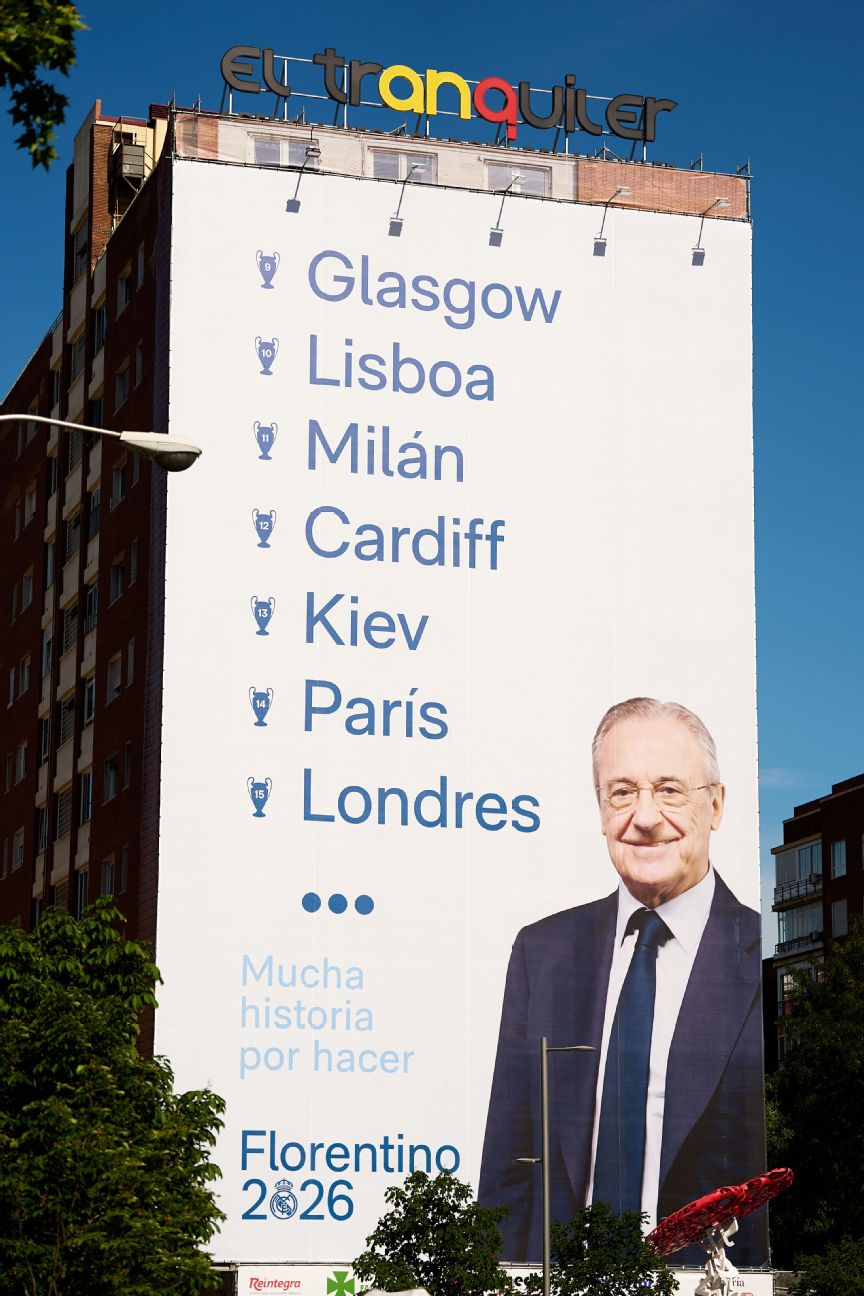
Pérez's achievements, and greatest electoral strengths, were summarised in giant billboards, displayed on the side of prominent Madrid buildings during the campaign. One of them listed the cities where the team have won the Champions League under Pérez's leadership: Glasgow [in 2002], Lisbon [in 2014], Milan [in 2016], Cardiff [in 2017], Kiev [in 2018], Paris [in 2022] and London [in 2024]. Madrid have won a record 15 European Cups. Pérez has been in office for seven of them.
Whatever you might think about the relative merits of some of those sides and their victories, the collective weight of silverware is undeniable. Anyone who doubts it can go and see those trophies lined up in the Bernabéu museum.
A second billboard named the stars Pérez has signed during his two spells in the presidency, from 2000 to 2006, and from 2009 until the present day. "Figo, Zidane, Ronaldo, Beckham ..." the list begins, ending with current stars Jude Bellingham and Kylian Mbappé, and one word: "Continuará." To be continued.
"New stars will arrive for next season," Pérez told fans at a meeting in Toledo last week, before deals for Konaté and Dumfries, plus the mystery €150 million man, had been announced. "That's how it's always been with me. The best players will always play here."
The teams might not always have worked -- Pérez quit in 2006 when the previous star-led Galáctico project failed, and it's still unclear whether the current side led by Mbappé, Bellingham and Vinícius Júnior will truly gel -- but the names are box office. In an attention economy, they resonate.
Off-pitch issues
Besides the trophies and star names, Pérez's legacy stands in steel and concrete, towering on the east side of the Castellana, and spreading out to the north-east, near Barajas Airport: the revamped Bernabéu stadium and the club's training ground, Real Madrid City. Work at Valdebebas began under Pérez in 2004, and it continues to grow. Pérez now wants to add a profitable, Silicon Valley-style tech hub on vacant land next door. Back in the centre of town, the costly and controversial Bernabéu redevelopment is only just complete, barring the stadium's VIP 'Sky Bar' delayed by a legal dispute, and surrounding transport links. But Pérez has delivered both, transforming the club's infrastructure.
It's a long list of achievements, unattainable for the vast majority of sports executives. But Pérez's global reputation as one of football's most effective administrators has also suffered. Part of that is down to Madrid's underperformance on the pitch: two seasons without a major trophy, with two coaches -- Xabi Alonso and Álvaro Arbeloa -- being hired and fired in the last year, and Mourinho a nostalgic pick to be next in line.
Far greater has been the off-field, reputational hit from high-profile failures. Pérez was the most vocal, visible advocate for the breakaway European Super League, starting with his ad hoc opening sales pitch for the project, delivered unscripted live on late-night TV. When Madrid were eventually left alone as the Super League's sole member, they were forced to seek a belated rapprochement with UEFA earlier this year. Meanwhile, long-term, draining battles with Spanish football's institutions -- with Spain's football federation over refereeing and LaLiga over TV rights -- have dragged on for years, with no sign of resolution.
"Real Madrid protest about absolutely everything," Villarreal CEO Fernando Roig Negueroles said, memorably, last year, before the reconciliation with UEFA. "I agree with them about a lot of things. But they lose legitimacy because they oppose anything that's proposed ... They're losing influence at a European level."
Even Pérez's flagship Bernabéu project has been hit by noise complaints over concerts at the venue, which have been on hold since 2024. Pérez told the El País newspaper during the previous election campaign that Madrid's town hall would rubber stamp "special rules" to allow concerts to return, while insisting that they were more valuable in terms of prestige rather than income.
Pérez's handling of the election campaign in its early stages fed further concerns on competence, starting with the chaotic news conference in which he announced the news, complete with a heated back-and-forth with a journalist, and extended pauses in which Pérez looked through messages on his phone.
Ultimately, though, the issue that dominated the election, and will continue to provoke debate in the coming weeks and months -- beyond Mourinho headlines, and moves in the transfer market -- is Pérez's bid to change Madrid's ownership structure.
Move toward legacy
Pérez first trailed the idea in a speech to members in 2024, calling it a bland-sounding "corporate reorganization proposal." A year later, he expanded on the concept.
"We'll call a referendum so all members can vote [on it]," Pérez said on Nov. 23, 2025. "We'll continue being a members' club, but we'd create a subsidiary, with the members as owners. We'd conserve absolute control, but allow something like 5% for a partner, who was willing to invest a significant amount for a symbolic participation. Governance would always belong to the members."
During the election campaign, Pérez's repetition of these ideas was nothing new, but Riquelme, sensing a weakness, chose to seize on the idea as his "red line."
"After 20 years of [Pérez] management, without any kind of opposition, they think the club belongs to them," he told ESPN. "And it doesn't. It belongs to the members ... They want to 'privatize' the club. We need to know: who has the financial interests in the club being privatized? Who's so close to president Pérez, to take him down the road of the Super League, the privatization, the concerts? Who benefits, really?"
The renewed focus on a proposed sale forced Pérez to articulate his proposal further, denying that it meant "privatization," while leaving some key questions unanswered.
"Nothing [would change]," he said in a campaign video. "The club would still belong to its members, it would have its president, its board, its assembly of delegates, chosen every four years. Everything that's important about the club will continue as it has been until now.
"The club would create a company, belonging 100% to the club, where we manage the football and basketball activities, with the aim that if we want to know the club's true value, we can let someone in. If we want to welcome an investor, with a maximum of 5%, to value the club, that global brand, will not run the club. They won't participate in any of the decisions ... It isn't privatization, it's quite the opposite, it's giving the financial ownership of the club to the members."
It's still unclear why an investor would accept investing a huge sum -- hundreds of millions of euros -- without gaining any measure of control. And many details still need to be set out, including the legal mechanisms involved, the scope of the authorization required from members, and what the financial implications would be for them, if their membership becomes a taxable asset.
"They're going to open up the statutes to the sale of the club," Riquelme told Cadena SER, suggesting that such a move would represent a first step down a slippery slope.
Pérez has a track record of looking to steamroll opposition, rather than seeking to compromise. But the ownership issue could prove difficult to navigate. Only four Spanish clubs are member-run: Madrid, Barcelona, Athletic Club and Osasuna. The rest were forced to become limited companies in 1990, by legislation meant to better control their finances. The status is precious, and Riquelme has hinted that he may choose to use his newfound position as de facto opposition leader to mobilise resistance.
A fundamental change in the club's structure would, in theory, require another referendum, with an absolute majority -- approval from over half of all members -- needed to pass. Sunday's results suggest that would be extremely difficult to achieve.
"We should be united," Pérez said on Sunday night. "We're driven by our passion for Real Madrid. We've got a lot of history left to make."
The extent of that unity will be determined by results on the pitch. Plans for a referendum on the ownership issue have already been postponed over the last six months. Success for Mourinho's team would create a favourable environment for Pérez's plans. A third season without a major trophy would make that environment toxic.