Five years after embracing road racing, the Izod IndyCar Series prides itself on being America's most diverse form of auto racing, thanks to its mix of oval speedways, street courses and natural terrain road circuits.
 Matthew Stockman/Getty ImagesIowa Speedway is the only short track on the 2010 IndyCar schedule, but that could change in 2011.
Most participants in the series are happy with the near 50-50 balance between oval and road racing. But the oval portion of the schedule isn't as diverse as it used to be. Iowa Speedway, which hosts the Iowa Corn 250 on Sunday, is the only remaining short oval in Indy car racing. In fact, other than the 2.5-mile long Indianapolis Motor Speedway, each of the other six oval tracks used by the IndyCar Series is a 1.5-mile speedway -- though in all fairness, only two of those tracks (Kansas Speedway and Chicagoland Speedway) are design clones.
One could argue that Iowa is a short oval in distance (0.875 miles) only, because it races like a superspeedway. Conceived by NASCAR star Rusty Wallace as a super-sized Richmond International Raceway (which measures 0.75 miles), Iowa is wide and steeply banked for a short oval. And in a modern Indy car, with just 650 horsepower and a lot of down force, it's easy to drive flat out. Too easy.
Part of what made tracks like the Milwaukee Mile and Phoenix International Raceway great for Indy cars is that they forced the drivers to balance throttle and steering inputs. By the 1990s, Phoenix was virtually flat out for CART Indy cars, with just a confidence lift needed for Turn 1. But Milwaukee still featured a considerable speed difference between straights and corners, making it much more of a driver's track.
Another short oval that was starting to build a reputation for quality Indy car races was New Hampshire International Speedway. The inaugural CART race at New Hampshire was one of the finest races I've ever witnessed, with Nigel Mansell going from third to first in the last 20 laps by passing Team Penske's Emerson Fittipaldi and Paul Tracy.
Chip Ganassi envisioned a "Super Milwaukee" when he constructed Chicago Motor Speedway in 1999, but the paper-clip track configuration coupled with CART's unsuitable short oval aero package at the time produced terrible racing. The inaugural IndyCar Series event at Iowa was also judged poorly, but racing has improved in the past two years and it's still too early to say whether, like CMS, the track is unsuitable for Indy cars.
The great news for short track enthusiasts is that New Hampshire and Milwaukee are back on the IndyCar Series' wish list. A year ago, NHIS expressed considerable interest in hosting an Indy car event but was rebuffed by Indy Racing League management. With Randy Bernard installed as IRL CEO, the IndyCar Series sanctioning body is being much more receptive toward NHIS, and Bernard is also working hard to re-establish Milwaukee on the IndyCar schedule, even if it means the IRL promoting the race itself.
The IndyCar Series will likely announce its 2011 schedule around Aug. 1, and I expect considerable change. The return of additional short ovals would be a step in the right direction.
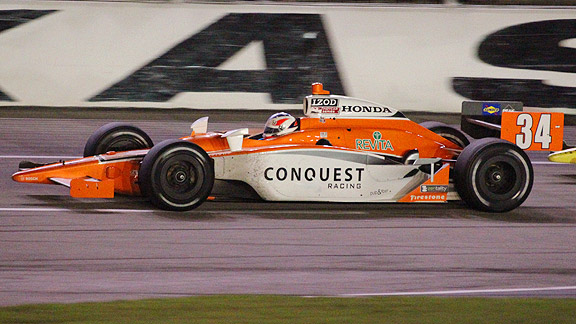 Courtesy IZOD IndyCar SeriesThe "Honda" lettering on the IndyCar air intake -- and the engine that goes underneath it -- appears likely to stick around for 2012 and beyond.
The IZOD IndyCar Series' announcement of its engine formula tentatively set for 2012 and beyond was short on details. But the news that the IndyCar Series will allow engines featuring up to six cylinders and 2.4 liters of displacement is positive on a number of fronts.
First and foremost, the allowance of V-6 architecture is almost certain to keep Honda involved in Indy car racing. Honda Performance Development president Erik Berkman has made no secret of the fact that HPD preferred a V-6 over an inline 4-cylinder layout because it would allow the company to design a basic engine that could be adapted to IndyCar or ACO/American Le Mans Series specification.
By not dictating a V-6, the IndyCar Series has left the door open to 4-cylinder designs, in particular the "Global Racing Engine" concept being developed by the FIA to power everything from World Rally to Formula One cars. Equivalency formulas are nothing new to the Indy Racing League -- the IndyCar Series' first season featured CART-specification, pure racing 2.6-liter V-8 turbo engines pitted against production-based 3.8-liter Menard/Buick V-6 turbos.
The IRL achieved satisfactory parity with its 1996 equivalency formula, but its ancestor, the United States Auto Club, was less successful with its engine regulations in the 1970s. The key going forward for the IndyCar Series is getting the equivalency formula right -- and having a trusted technical engine adviser on staff to maintain a level playing field to the satisfaction of all competing manufacturers.
That, after all, is the reason the IRL is allowing the introduction of a 4-cylinder engine, as long as it meets the performance guidelines of 550-700 horsepower.
"We will require reference engines as a benchmark in performance while looking at sonic air restrictors, fuel flow restrictions and more as key criteria for competition," said IRL competition president Brian Barnhart.
HPD's Berkman certainly endorses the idea of an "Engine Czar" for the IndyCar Series. Two members of the seven-man ICONIC committee advising IRL CEO Randy Bernard have particularly strong engine knowledge: Pi Electronics founder (and former Jaguar F1 team principal) Tony Purnell and Speedway Engine Development founder Rick Long. Other potential candidates include former Champ Car race director Tony Cotman and IRL senior technical director Les MacTaggart.
"The people we work with -- Brian and Les -- the capabilities are fine," Berkman said. "But as it relates to engines, it would be nice if the league could add that position to have a true engine expert on staff. It couldn't hurt and I think it could only help.
"If there is competition, once we start going to war with one another -- and I say war in a good way -- war without cost escalation. Let's find a way to tie our hands behind our back, close our wallets, cut up our credit cards and figure out a way to compete with our brains instead of our wallets. And I believe it can be done."
Honda and any competing manufacturers coming into the IndyCar Series will all want to supply the top teams, and Berkman hopes league officials will be able to devise an equitable engine supply process.
 AP Photo/Darron CummingsIRL competition president Brian Barnhart will have his work cut out for him trying to keep engine suppliers on a level playing field with each other.
"Each manufacturer will want equal representation, an equal chance to win, and the competition needs to be controlled by clever rules that prevents us from a cost escalation," Berkman said. "Manufacturers would all sign on the dotted line, not a gentleman's agreement, but a contractual agreement that says we won't money launder and give teams money to hire drivers -- all the things that can be done to try and skew the table to get your engine [in a particular car]. It would be the league's responsibility to distribute the engines. In other words, we wouldn't go out and line up our customers."
Berkman also advocates a NASCAR-like philosophy of using occasional rule changes to allow manufacturers that are lagging the opportunity to make approved improvements. Again from a manufacturer perspective, cost stabilization is the key.
"If we have competition and I bring in a design change every week and try to bury you, you've got to counter and now we've got an escalation," Berkman said. "The league can save us a lot of money by not allowing change very often. Since they want close racing, if there is a disparity in performance, let this guy [Manufacturer No. 2] catch up. Don't penalize this guy [Manufacturer No. 1]. Let him [No. 2] catch up. Freeze him [No. 1] until they [No. 2] get caught up, and then open the window.
"If I could only make design changes twice a year, I might be working every day to prepare for when the window opened up and I could throw the bomb," he continued. "But so would the other guy. We would be working and spending our money, but we wouldn't be building engines and spares and qualifying engines and all the tricks and then tearing them down next week and retrofitting them with all the latest bits, with the huge amount of waste and cost associated with that. All the manufacturers are saying 'this is what we have to do.'"
It's almost certain that Honda will continue in the IndyCar Series in 2012 or beyond, and Berkman and other company officials have repeatedly said that they hope for competition. "Competition" is also the message the IndyCar Series is sending out, and it will be interesting to see if any other manufacturers step up to the challenge of racing Honda in a category it dominated even before it was the exclusive engine supplier.
INDIANAPOLIS -- By modern standards, they drew a nice crowd at Indianapolis Motor Speedway for the opening day of practice for the 2010 Indianapolis 500.
I was out there with them, walking the grounds of the Speedway and soaking it all in -- literally, when the rain later came -- with my almost-4-year-old son. We parked in the infield media lot, but that was as close as I got to being a member of the working press on Saturday.
It was a great day for an emerging young car enthusiast, from the parade of shiny Camaro pace cars to the Indy cars screaming at 230 mph.
The first person we recognized while walking near the Garage Area was none other than Tony George, who was delighted that we had just purchased chocolate chip cookies from the nearby Clabber Girl stand. (spectacular cookies, by the way).
We sat in the pit lane grandstands right above the Target cars (Patrick's favorites), and moved on to watch from the Turn 1 infield.
Then we walked down Hulman Boulevard toward Turn 3 before doubling back to get ice cream and check out another grandstand vantage point.
Patrick wondered why Dario Franchitti and Scott Dixon just sat in their cars in the pits for a long time, but when they were finally released, Dixon was over 225 mph in just three laps. Franchitti and Helio Castroneves both topped 226 mph, with defending race winner Castroneves' 226.603 leading all challengers.
At $5 admission, any practice day at the Speedway remains one of sport's great bargains, and opening day drew a diverse, family-oriented audience. There's plenty to see and do at the track, and although courtesy transportation trams are provided, there's plenty of walking, too.
Spending the day at IMS with my son brought back memories of my earliest days at the famous track, starting when I was about 10 years old. But I can't talk about any of that right now. I've got a young race fan asking whether we can go out to the Speedway again today. How can I refuse?
One of the first major things newly appointed Indy Racing League CEO Randy Bernard did upon joining was to form a committee to recommend a future chassis and engine formula for the Izod IndyCar Series.
With the unveiling of the Delta Wing concept car, as well as renderings of potential designs from four other manufacturers, the public focus has been on the new chassis. But the IRL intends to introduce new engine specifications, as well, and designing and developing an engine is a more time-consuming process than creating a new chassis. With high hopes for a 2012 introduction, the seven-man ICONIC (Innovative, Competitive, Open-Wheel, New, Industry-Relevant, Cost-Effective) committee certainly has a lot on its plate.
Although little official information has emerged with regard to the future engine formula, it is clear that even the basic format of the engine is still very much in question. Three brands from the Volkswagen Group (Volkswagen, Audi and Porsche) have indicated potential interest in participating in the IndyCar Series if the IRL adopts a modular inline 4-cylinder "Global Racing Engine" (GRE) layout similar to the one being worked on by the FIA (Federation Internationale de l'Automobile, the sanctioning body for Formula One and for the World Rally and World Touring Car championships). Meanwhile, Honda, which has been the exclusive engine supplier for the IRL since 2006, is strongly in favor of V-6 architecture.
 Honda Performance DevelopmentThe IndyCar Series engines built at the Honda Performance Development shop have been practically bulletproof, but will Honda remain a supplier for the next generation of Indy cars?
Given the amount of talk circulating about fuel efficiency and relevance to production cars and technology, Honda has been perceived as out of step with regard to the engine formula of the future. At Long Beach, Honda Performance Development president Erik Berkman explained Honda's rationale to ESPN.com.
What it boils down to is that HPD (as well as Honda corporate in Japan) has not gotten on board with the FIA GRE concept. Instead, HPD has aligned itself with the ACO (Automobile Club de l'Ouest), which sanctions the 24 Hours of Le Mans and, indirectly, the American Le Mans Series, which HPD has participated in using the Acura brand for the past four years.
"We don't have a GRE design -- we have not put one ounce of engineering effort into designing a GRE," Berkman said. "For us to start on a GRE and have it ready for 2012, I don't know that that's possible, though I don't want to underestimate the power of Honda or HPD. In the old days, we would just call Japan and they would make it happen. But we [HPD] are standing on our own two feet now. So it is important to know which way we're going so I can put my energy into that direction.
"We have not wanted to take the time, energy, bandwidth and start delving deeply into GRE because it was going to distract us from what we thought we had an agreement in principle with the [IRL] to do," he added. "I'm not saying the league's rule package that we've been proposing and dialoguing on is exactly ACO-compliant spec, but it's close enough that we can find a way to connect the dots between an Indy car, top-level bespoke engine and the pinnacle P1 [Le Mans and ALMS] class, should we ever want to go back, with architecture that connects. We've definitely connected the dots between an Indy Lights-level spec and a P2-class spec with a mass production-based V-6 engine -- think Odyssey, Ridgeline, Accord, Acura TL. That's already under development, and someday we'll roll it out and show you guys what it is."
The advent of the Delta Wing car, which is projected to require only 300-325 horsepower to achieve 220 mph on superspeedways, has complicated the issue. The IRL's original stipulation was for the future engine to produce 550-750 horsepower, with output adjusted via turbocharger boost to tailor the cars for road racing or ovals.
"Once the Delta Wing came out, we asked the league which way they were leaning," Berkman said. "We told them our strong advocacy is for a bespoke, custom-designed jewel of a race engine using all of the technology that we can bring to bear so it meets the three tenets that we set at the first roundtable. We said it had to be socially or environmentally responsible; there's got to be production linkage; and it's got to be cost-controlled. We have to bring the costs down for the competitors and for all the stakeholders.
"With the engine design we've conceived, it's not easy to scale it down below 550 horsepower. If all we need to make is 300 or 325 like Ben's [as in Ben Bowlby, Delta Wing designer] talking about, it needs to be a different engine. I've got a 1.5-liter Honda Fit engine, and I could probably put a turbo on that and make the power that Ben needs, but not the power that Dallara, Swift or Lola needs. None of those manufacturers have provided us with drag targets, much less any simulations they have done about why they think their targets are achievable."
“” -- HPD president Erik Berkman
We're standing still, marking time. We've told the league that June 1 is a hard date for us, as an engineering company, to get to our objectives for 2012.
Berkman's main concern at this point is the lack of progress made in the past year by the IRL in terms of finalizing the 2012 engine formula.
"At the end of 2008, the process had broken down and we were also into a serious recession and everybody was stalled for making commitments, including Honda, for 2011, which up until that point was our goal," Berkman said. "Now that was off the table and 2012 was the earliest we could consider something new. And frankly, the first half of '09, there was radio silence. It was all about 'Are we going to survive?' We put on a pretty good show in the first half of '09, but there were real pains in the economy.
"We've been continuing to march along a path, but we are now at a point where we've stopped marching," Berkman continued. "We're standing still, marking time. We've told the league that June 1 is a hard date for us, as an engineering company, to get to our objectives for 2012. It should have been April 1. But we respect and appreciate that Randy needs these two months to be able to do his process. It's a complicated and important thing to decide, but now's the time. Everybody can't be happy because everyone can't win, but hopefully he can strike the right balance."
The next 60 days should be extremely interesting as the ICONIC committee makes its final decision on the IndyCar Series' engine and chassis formula for 2012 and beyond. Given that Honda has pretty much carried the engineering (and marketing) load for the IRL for the past five years, it seems unlikely that the league will do anything to upset such a strong and loyal partner.
In that regard, the ICONIC committee's decision appears to boil down to this: Delta Wing versus Honda. Choosing the Delta Wing -- which has strong support from a group of team owners who believe the sport needs a radical shake-up -- would force Honda to either go back to the drawing board or pull out of Indy car racing. That wouldn't be a total shock; Honda pulled out of the CART-sanctioned Indy car series at the end of 2002 after losing faith in CART's ability to fairly manage competition between engine manufacturers.
For the time being, Berkman and HPD remain committed to their V-6 and have little doubt they can produce an engine that meets all of the IRL's pre-Delta Wing objectives in time to supply part or all of the 2012 IndyCar Series field.
"We haven't built any prototypes or ordered any tooling," Berkman said. "We've started the design process, and we're ready to pull the trigger on building and actually making something and start proving it out.
"But for me, it's getting a little uncomfortable from a timing perspective."
More than a few people in the Izod IndyCar Series lament the loss of the event in Surfers Paradise, Australia that featured America's top open-wheel series from 1991 to 2008. Now a handful of Indy car drivers from present and past alike are getting the chance to return and race down under.
After a failed one-year experiment in which Gold Coast organizers attempted to replace Indy cars with the now-bankrupt A1GP open-wheel series, the Surfers weekend has been rebooted and rebranded as the Armor All Gold Coast 600, an endurance race for the Australian V8 Supercar championship on Oct. 24.
 AP Photo/Mark BakerThe last time the IndyCar Series raced at Surfers Paradise, in October 2008, Ryan Briscoe hoisted the trophy.
The twist: the inclusion of 18 international drivers, including current IndyCar Series stars Scott Dixon, Dario Franchitti, Ryan Briscoe, Will Power and Alex Tagliani. Five other drivers who raced Indy cars at Surfers also will compete, topped by series champions Sebastien Bourdais and Jacques Villeneuve and 1997 Surfers CART race winner Scott Pruett.
"There are so many of us who seriously missed not racing on the Gold Coast last year, and it's great news that the event has survived last year's drama and will move forward with this unique format," Power said.
Each of the international stars has been paired with one of the 18 V8 Supercar teams that compete in the series' endurance races. They'll race on a shortened version of the legendary Surfers Paradise street course. Other changes include a new family-friendly focus that includes an average 20 percent reduction in ticket prices and the addition to what is being billed as "a massive three-day music extravaganza featuring some of the world's biggest acts."
The Australian race was perhaps the most popular in the series among Indy car drivers, who appreciated the warm welcome from the local fans and the impressive promotion of the event. V8 Supercars were added to the Indy car bill in 1997, and over the next decade, grew into the role of co-headliners.
"The Gold Coast event is one of the most special in world motorsports and to have the chance to go back down there and race -- in no less than a V8 Supercar -- is going to be something pretty special," said Franchitti, who won the 1999 CART race at Surfers. "When I was first contacted about the idea, I thought it was fantastic, and when the opportunity came up to join James [Courtney] at Dick Johnson Racing, it was the icing on the cake.
"I have always been a fan of V8 Supercars, and I've been bugging a few friends in Australia for a drive at Bathurst for a few years, but dates have never fallen in my favor," Franchitti added. "To win at Surfers Paradise in both a Champ Car and V8 Supercar would be something pretty special."
Australian stars Briscoe and Power and Australia-born New Zealander Dixon are excited for the opportunity to compete at home after spending most of their careers racing in Europe or America.
"I'd say 90 percent -- no, 110 percent -- of the drivers always loved that race," said Dixon, who will team with the Kelly brothers (Todd and Rick) in a Jack Daniel's Racing Holden Commodore. "It was the best race that we went to and everybody looked forward to it. Everybody would fly in a week before the race. A lot of the races here in America you fly in the Thursday night before it starts on Friday.
"It's a shame that we're not back there in the IndyCar [Series], but to obviously go back in a V8 is going to be even cooler."
"My parents are happy because they don't have to pay for an international airfare," joked Briscoe, who will compete for Toll Holden Racing. "I guess I am the defending international champion after winning the final IndyCar race in 2008, and I would like to keep that record intact.
"It will be a lot of fun racing all the other international drivers that don't race V8 Supercars for a living," he said. "There will be a lot of talent, but also a lot of inexperience in those cars. It's a daunting track with fast sections and close walls so there could be a bit of carnage along the way."
Jamie Whincup is dominating the V8 Supercar Series this year, with six wins in eight sprint races. After winning his first two titles driving a Ford, Whincup's team, Triple Eight Racing, has switched allegiance to rival manufacturer Holden this year.
The V8 Supercar championship consists of 15 race weekends, including four multi-driver endurance events. The most prestigious and popular event in Australian motorsport is the Supercheap Auto Bathurst 1000, staged at the Mount Panorama road course on Oct. 10.
You can refute the argument that drivers play only a small part in winning races in the Izod IndyCar Series with two words:
The 30-year-old from Sheffield, England, won last year's IndyCar race at Watkins Glen for perennial tailender Dale Coyne Racing. And he did it with speed and savvy, not through a lucky full-course caution or Hail Mary fuel strategy.
 AP Photo/Jae C. HongJustin Wilson, right, shared the Toyota Grand Prix of Long Beach podium with winner Ryan Hunter-Reay, center, and third-place finisher Will Power.
Wilson switched to Dreyer & Reinbold Racing this year and finished second in two of the first four races of the 2010 season, regularly beating the heavy favorites from Team Penske and Target Chip Ganassi Racing.
"It was fun to pass Will [Power, the championship leader of Team Penske] after all the success he's had this year," Wilson said after his second-place run in the Toyota Grand Prix of Long Beach. "That made me feel good, and I think it was just a very positive day for everyone at Dreyer & Reinbold. We've worked really hard, and we keep making improvements."
After helping to transform Coyne's team from a field filler into a winner, Wilson was expected to stay on with DCR in 2010. But key engineering departures and Coyne's desire to lock Wilson into a multiyear deal caused J-Wil to look elsewhere.
He landed with Dreyer & Reinbold, the team established by Indianapolis car dealer Dennis Reinbold and former IRL driver Robbie Buhl in 2000. And although D&R has vaulted from the midfield to the front at the four road races to start the IndyCar Series season, Coyne has dropped to the very back with drivers Milka Duno and Alex Lloyd.
"When I went to the [D&R] workshop for the first time about four months ago, I saw everything they were working on and all the potential there," Wilson said. "It's a great team, and everything is coming together. A little bit of continuity is going to go a long way because I think we have all the right parts and all the right pieces to the puzzle -- the personnel and the work that they do. It's just going to take a little bit of time for us all to get used to each other.
"We go through the weekend and develop the car and think, 'If only we could start the weekend like this!' That's where the continuity is really going to come in."
Buhl won Dreyer & Reinbold's first IndyCar Series race, but Wilson's pair of seconds matched the closest the team has come to returning to Victory Circle. After running a rotation system of drivers last year that included Duno and Tomas Scheckter, D&R is sticking to a core two-driver lineup of Wilson and fellow Briton Mike Conway, who is in his second year of racing Indy cars.
Conway shined in practice and qualifying at Barber Motorsports Park, where he lined up on the outside of the front row. He finished ninth in the race, two positions behind Wilson, and has finished in the top 10 in three of four starts this year.
Wilson managed to come home second at Long Beach despite losing a front wing when his car was clipped by backmarker Lloyd.
"I had the door slammed in my face," Wilson said. "I made a move to back out of it, but the guy came right across the apex and clipped the curb even. I was pretty frustrated by what I thought was poor racing, and we lost the front nose. Everyone on the crew did a great job switching out the nose, and we did our pit stop at the same time. Then it was tight until the end on fuel, but we managed to make it and actually ran out of fuel on the in-lap.
"All weekend I said the Z-Line Designs car has been really quick. We had the potential to win this race. Today we were in the battle and unfortunately we didn't get first, but it was a good day."
Wilson, an acknowledged road-course ace, will begin his acid test at Kansas Speedway when the IndyCar Series transitions into a series of oval races. He says he's ready for the challenge.
"I'm really looking forward to the ovals," Wilson said. "I think we have an opportunity to be close to the front -- maybe not challenging for the win, but I think we can be much further up. I have a lot of confidence. I know what I want from the car and how to get it.
"I'm looking forward to learning from Dreyer & Reinbold. They've done a lot of oval racing, and my engineer [Matt Curry] is more in tune with the oval racing. That's where his background is, and I think the two of us make a good combination. A lot to learn, but I'm looking forward to it."
 AP PhotoCrew members try to stop Parnelli Jones' race car after it lost its brakes during the 1962 Indy 500.
LONG BEACH, Calif. -- Parnelli Jones' record of six Indy car and four NASCAR wins doesn't reflect his contemporary status in the sport.
He was the man many of his rivals feared most.
"As far as I'm concerned, Parnelli Jones was the greatest driver of his era," said Mario Andretti. "He had aggressiveness and also a finesse that no one else possessed. And he won with everything he put his hands on, including off-road."
Jones packed a lot into what was basically a 10-year top-line racing career, as well as the years he later spent as a team owner and prominent Firestone tire dealer. He was honored for those achievements Thursday night in Long Beach at the second annual Road Racing Drivers Club dinner to benefit Jeremy Shaw's Team USA scholarship.
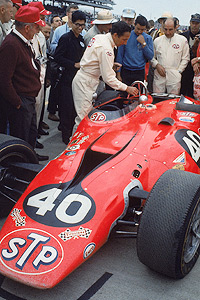 AP PhotoParnelli Jones' turbine-powered STP Granatelli broke down with three laps remaining in the 1967 Indianapolis 500.
A who's who of drivers ranging from young champions (and Team USA scholarship winners) Connor Daly and JR Hildebrand to Indy winners Danny Sullivan and Rick Mears turned out to pay respects to a man racing insiders consider one of the all-time greats.
RRDC president Bobby Rahal served as the evening's emcee, joined by special guests Dario Franchitti and Robin Miller for a Q&A session that touched on the many phases of Jones' diverse career, which included victories in the Pikes Peak Hill Climb and the Trans Am sports car championship.
"It's an honor to be here honoring Parnelli tonight," Franchitti said. "Not only is he a man who could drive anything quickly -- and I really mean anything -- I went 'round the museum last night and some of the stuff he's driven ... wow!
"Possibly one of the toughest guys ever in racing," Franchitti added. "He could completely kick the ass of anyone I've ever met. He looks like he's made out of granite. I'm glad I didn't have to race against him because he would have definitely kicked my ass!"
Vel's Parnelli Jones Racing originated the three-car superteam concept by fielding Andretti alongside Joe Leonard and Al Unser in 1972-73. Unser won the 1970 USA championship and the 1970 and '71 Indianapolis 500 for the team, while Leonard was USAC champion in 1971 and '72. Unser and Andretti also won Formula 5000 championship races for VPJR.
"That worked pretty well," Jones said. "We won 53 Indy car races, and it was great until Roger Penske came along."
The only forms of racing Jones missed out on were Le Mans prototypes and Formula One.
"I drove Lotus Indy cars for Colin Chapman, and he talked to me about Formula One," Jones said. "No respect to Jim Clark, but I felt Chapman wanted me to be No. 2 to Jimmy, and I wasn't a No. 2 to anybody.
"Ford offered me the chance to run at Le Mans, but I was having problems finishing shorter races -- like 500 miles -- so I thought I had better work on that instead."
A day earlier, Franchitti spent the evening in Torrance viewing Jones' private collection of cars. In partnership with Vel Miletich, Parnelli was a successful racing car constructor from 1971-80, including trail-blazing Indy car designs like the failed 1972 dihedral wing car.
USF1 talked a lot of smack about building a Formula One car in America, but Jones and Miletich actually did it in Torrance. Vel's Parnelli Jones Racing competed in F1 from 1974-76, with Mario Andretti scoring several top-five finishes.
The team then revolutionized Indy car racing by transforming the VPJ4 F1 car into the VPJ6 Indy car by engineering a 2.65-liter turbocharged version of the 3-liter Cosworth DFV F1 engine. By the late '70s, the turbo Cosworth DFX rendered all other Indy engines obsolete.
Franchitti was especially excited by Jones' Lotus 34 Indy car, the very car he drove to victory at the Milwaukee Mile and Clark put on pole for the 1964 Indianapolis 500.
"Parnelli is the first person that ever let me sit in one of Jim Clark's cars, and they had to drag me out of it," Franchitti said. "It was quite something."
LEEDS, Ala. -- The Izod IndyCar Series would greatly benefit if two of Andretti Autosport's drivers could find a way to win a race.
One of them looks like he is ready to deliver.
While Danica Patrick struggled to a 19th-place finish in the inaugural Indy Grand Prix of Alabama, her AA teammate Marco Andretti led 58 of 90 laps at Barber Motorsports Park. And while the 23-year-old Pennsylvanian ultimately finished only fifth after making a late splash-and-go pit stop, he served notice -- and not for the first time in 2010 -- that his next IndyCar race win is going to happen sooner rather than later.
 AP Photo/Steve NesiusMarco Andretti led 58 of 90 laps at Barber Motorsports Park on Sunday, but he had to settle for fifth after a late stop for fuel.
He's in his fifth year of racing Indy cars, but Sunday at Barber was perhaps Marco's most impressive performance to date. It certainly drew words of praise from his competitors.
"I thought he drove a great race and did a bloody good job," observed defending series champion Dario Franchitti.
"On a track where it's so difficult to pass, he did a great job -- a hell of a job," chipped in Scott Dixon.
After some of the challenging time he's encountered since claiming his first (and only) IndyCar win at Infineon Raceway back in August 2006, leading a ton of laps and notching a fifth-place finish could have seemed like a victory for Andretti, his father, team owner Michael Andretti, and strategist Kyle Moyer. Marco was still pretty glum in the aftermath, but he wasn't pouting or complaining.
"We have to be happy to put this thing in the top five after our disaster on road courses last year," Andretti said. "We'll just keep marching forward. The four of us are working together to improve these race cars. We're still a little bit off as far as pace goes. Here I was looking a bit stronger than maybe anywhere else just because it's tough to overtake. So it was easier for me to control the race.
"The good thing was when we needed to push, we could," he continued. "The car was giving it to me. We were just kind of conserving the front tires and conserving fuel. I'm yet to doubt myself. We need to just keep working on the car to make it easier on us."
Andretti certainly caught Castroneves by surprise when he barged past on a Lap 17 restart. But following instead of leading caused Team Penske to change Helio's strategy and ultimately won him the race.
"Marco did a good job in passing me," Castroneves said. "In fact, he kind of like pushed me away. And he was driving like he was more patient this time. His driving reminded me of his father, Michael Andretti. He did a hell of a job.
"I felt like I had a better car than Marco, but unfortunately, I just couldn't pass him. And I was just patient and waiting for an opportunity, and, well, I guess we were able to be smart enough to save a lot of fuel."
Andretti eventually started saving fuel, but it was too late to allow him to commit to a two-pit-stop strategy. Moyer accepted the responsibility for not recognizing early enough that Barber was developing into a fuel race.
"We were good enough to win," Moyer said. "But that one you can blame on me. We should have been saving fuel after we stayed out on the first yellow. Everybody else did and we didn't. That's my mistake. He was doing exactly what he was told.
"We should have won this one."
Once again showing signs he is maturing, Andretti refused to blame Moyer -- or anyone else at Andretti Autosport.
"Each time, Helio just went longer than me and longer than me, and that was the difference after the last stop," Marco explained. "We fell a bit short. It would have been close with that last yellow, so I'm a little disappointed."
In 2009, the Andretti Autosport team suffered through its least competitive championship campaign in its eight years in the IndyCar Series. Based on circumstantial evidence from the first three races of 2010, it looks like the team is on the way back. Andretti has been consistently the quickest of the AA foursome; Tony Kanaan scored his first podium of the season, and Ryan Hunter-Reay had a second-place run in the season opener at Brazil.
The only AA driver not regularly running near the front is Patrick, who has struggled mightily in the sequence of road races that open this year's IndyCar title tilt.
Moyer, who has held key management roles with Andretti Autosport and its former iterations since the team started out at Forsythe/Green Racing in 1994, is convinced that AA in general -- and Marco in particular -- is ready to mix it up with the dominant Penske and Ganassi teams.
"The one good thing about this is the team is working together well and Marco is driving great," Moyer said. "We saw that last race and we saw it again today.
"Now it's just time for us to get our stuff together and get something happening."
The Izod IndyCar Series had gained some leadership and direction in terms of determining its new engine and chassis formula for the future. But the decision remains controversial.
Spurred by the unveiling of the radical Delta Wing concept, there's been a lot of recent talk about the new chassis. But things have gone quiet on the engine front.
 AP Photo/Jim PrischingIndyCar Series stars Scott Dixon, left, and Dario Franchitti were on hand for the unveiling of the 2012 Delta Wing concept car Feb. 10 in Chicago.
That is, until Roger Penske, the most successful team owner in Indy car racing history, stepped into the fray when he met with reporters at the Honda Grand Prix of St. Petersburg.
Citing cost concerns for the teams, Penske advocated introducing the new engine formula first and retrofitting it into the current Dallara chassis, which has been the default chassis of the IndyCar Series since 2003.
"Let's make each step one at a time rather than two steps at once," Penske commented. "I'm all about saving costs right now for all of the teams. I'm not sure if we change cars right now we are going to put 50,000 more people in the stands."
He added: "I don't think it changed NASCAR when we went from the old car to the [Car of Tomorrow], so we just have to look at it. Our team has probably got to have seven or eight cars, so you're talking $2-3 million, plus all your parts. I think they've got to consider that."
Indy Racing League CEO Randy Bernard has met with Penske, and he seems to be leaning toward delaying the introduction of a new technical package until 2013. It's a tricky situation to balance for Bernard:
On the one hand, public perception is that the IndyCar Series badly needs a new design to replace the aged and unpopular Dallara. On the other hand, in the current economic climate, can competitors -- even well-funded ones like Team Penske and Target Chip Ganassi Racing -- afford to make a major equipment change?
One point that shoots down Penske's argument is that the new engine formula is expected to lower engine costs, whether it is the turbocharged V-6 favored by current IndyCar supplier Honda or an inline-4 being pushed by alternate manufacturers.
Bernard is counting in particular on Gil de Ferran, who has been nominated as the team owner representative for the seven-member advisory committee chaired by retired US Air Force General William Looney.
"I think it's very important for Gil to do a team owner survey to see exactly what is important to the team owners," Bernard told reporters at St. Petersburg. "Can they afford, in this economic situation right now, to move into a new car in 2012? Do they like leasing their engines rather than owning their engines? Questions like that.
"I don't want to just shoot from the hip. We could have announced a car last week, and that would have created negative vibes among our fan base and our team owners and sponsors. We need a new car for perception, but if you look at how close some of these races are, the fans love the closeness of these races. We've got something working for us and we have momentum. We have more cars now than we have in the past four years.
"This is one chance that IndyCar can continue to build momentum by making sure this process is well done and well thought out," Bernard concluded. "If the advisory committee comes back and says we need to wait until 2013, we need to think about that."
While the chassis will provide the visual identity for the Indy car of the future, the engine is probably a more important element. Once again, a number of factors need to be considered. Obviously there is the basic format. What kind of fuel should the new powerplant use? How much relevance to street car engine technology should be part of the package?
My own transportation during the St. Petersburg race week was a 2010 Ford Fusion Hybrid, a vehicle I was highly impressed by after driving it. The car's transition from electric to gasoline power was seamless and unobtrusive, performance was on par with a V-6 Fusion, and I averaged 35.5 miles per gallon in more than 300 miles of varied driving. The standard V-6 Fusion probably would have returned mileage in the low to mid-20s.
You could argue that relevance to street car technology is much more important to stock car racing. Of course, NASCAR is legendary in its refusal to adopt modern technology; its spec cars still feature carburetors some 55 years after fuel injection was introduced into Formula One, and the design of basic components such as the live rear axle date to the early '60s.
Formula car racing, on the other hand, has always been about new and advanced technology -- which often carries a higher price tag. But it also provides open-wheel racing with a bit of cache for serious gearheads who love to watch the development of the latest and greatest technology. It also offers car manufacturers an avenue to filter racing technology into their road cars and genuinely prove the adage "Race on Sunday, sell on Monday."
These are the questions the IndyCar technical advisory committee -- and ultimately Randy Bernard -- must grapple with. And with a decision on Indy car racing's future technical direction expected by June 1, time is running short.
For the last several years, the Indianapolis 500 has scrambled to come up with 33 starters. Shoot, there were times when it appeared the Memorial Day Classic would struggle just to put together 33 entries.
That doesn't appear to be the case in 2010, another sign that the IZOD IndyCar Series is picking up momentum. Twenty-four cars started the first two races of the season in Brazil and St. Petersburg; there are already eight additional entries confirmed for the Indy 500, and there could be as many as 10 more when the shortened practice and qualifying format takes the green flag May 15.
In addition to the 24 cars that competed in St. Petersburg, seven teams have already revealed extra Indy entries (de Ferran/Luczo Dragon Racing -- Davey Hamilton; Bryan Herta Autosport -- Sebastian Saveedra; Sarah Fisher Racing -- Jay Howard; Sam Schmidt Motorsports in association with Ganassi Racing -- Townsend Bell; Andretti Autosport - John Andretti; Conquest Racing -- Bernard Baguette; and FAZZT Race Team -- Bruno Junqueira; KV Racing Technology -- Paul Tracy).
 Jonathan Ferrey/Getty ImagesHe's back? Yes, Paul Tracy is expected to race in the Indy 500.
Of that group, the Junqueira/FAZZT link-up is the most compelling story. Last year, the vagaries of Indy's complicated qualifying system led to Junqueira qualifying Conquest's second entry after Alex Tagliani was bumped out of the field. Citing commercial reasons, Conquest then nominated Tagliani to race the car that Junqueira had qualified after only 13 practice laps.
Junqueira was rightfully crushed, but fate has a funny way of working things out. Tagliani now drives for the newly formed FAZZT team, and when it was realized that FAZZT had the budget to run a second car at Indy, there was no hesitation about whom to hire.
"Because we have enough sponsorship to run a second car at Indianapolis, we felt it important to give that chance to Bruno," Tagliani said in a team statement. "Last year with Bruno as the second driver in the team I was at, he let his spot in the field go after I had a mishap in qualifying. And it turned out, I had a pretty good race at the Indy 500 so it is a nice way to say 'thank you' to Bruno for what he did for me last year."
Junqueira has had a roller-coaster career at Indianapolis Motor Speedway; he qualified on pole position for the 2002 event but suffered the worst accident of his career in the 2005 race, breaking his back after being put into the wall by A.J. Foyt IV.
Junqueira has notched two top-5 finishes at the Speedway, and the 33-year old Brazilian is delighted he will be back in the mix at IMS.
"To win at Indianapolis has always been a dream of mine," Junqueira said. "I've had some very competitive opportunities at Indianapolis, and I hope that in 2010 I am able to complete my dream of a win at Indianapolis since I have been so close in the past. The FAZZT team will give me the resources and support to compete in a car that has the capabilities of winning at the Indianapolis 500."
The John Andretti/Andretti Autosport pairing is the latest chapter in the long Andretti family saga at Indianapolis. Mario Andretti's victory in the 1969 Indy 500 remains the family's only triumph at Indianapolis; Mario's son, Andretti Autosport owner Michael Andretti, and Michael's son Marco Andretti have both led the race and finished second.
John Andretti is the son of Mario Andretti's twin brother, Aldo, and is Michael's cousin. He has made 10 Indianapolis 500 starts with a best finish of fifth in 1991.
For the second year in a row, John Andretti's Indy effort is in conjunction with NASCAR team Richard Petty Motorsports and sponsored by Window World. The car will carry the iconic Petty Blue/DayGlo red colors and the number 43.
"It would be difficult to script a scenario any better than the one we have here," John Andretti said. "The relationship I have with Richard, the respect I have for Michael and his team, the partnership I enjoy with Window World, and all of it focused on the Indianapolis 500 -- it's really a perfect situation.
"I can't wait to get in the car and get to work. May can't get here soon enough."
"I have a lot of respect for John's talent -- I always have," Michael Andretti added. "I really think he will fit in very well at Andretti Autosport and can be a factor during the month of May."
Still to be confirmed, but expected, are additional entries from Newman/Haas/Lanigan Racing with driver Graham Rahal, A.J. Foyt Racing (Foyt IV), Dreyer & Reinbold Racing (Ana Beatriz), and Vision Racing (Ed Carpenter). Other teams that are likely to post entries include Hemelgarn Racing (with driver Buddy Lazier), Panther Racing, Team 3G and Rahal Letterman Racing.
The combination of more cars, less practice time and fewer qualifying days should make for the most exciting Month of May during the Indy Racing League era (1996-present). There promises to be significant excitement on Bump Day, and the 94th running of the Indianapolis 500 should also boast the strongest field in the modern era.
All in all, this is a month of May for Indy car racing fans to really look forward to.
ABOUT THIS BLOG

John Oreovicz
John Oreovicz lives in the shadows of Turn 1 of the Indianapolis Motor Speedway.
His interest in racing was sparked by the battle between Niki Lauda and James Hunt for the 1976 Formula One World Championship, and he can remember watching the 1977 Long Beach Grand Prix and the 1979 Daytona 500 on the family RCA XL-100 television as if they happened yesterday.
These days, you're likely to find him at Pomona covering drag racing or Phoenix reporting on stock cars in addition to his usual role as one of the IndyCar Series' pressroom veterans.
With more than a decade writing for ESPN.com, his work has been published in more than a dozen countries around the world, and he co-authored "A Winning Adventure," a chronicle of Honda's successful CART Indy car engine program.
Contact him at indyoreo@earthlink.net.