CONCORD, N.C. -- It was barely Nov. 21, 2011, 2:30 in the morning on a Monday in North Carolina, and Steve Addington's mind and heart were racing. He was lying in bed, restless.
The NASCAR season had been over for six hours.
The transmission on the car Addington built to race in the NASCAR season finale, the No. 22 Penske Racing Dodge, had come apart early in the running. When it did, a piece from the drive shaft opened a softball-sized hole in the grill of Tony Stewart's Chevrolet.
At the time, that development didn't seem to bode well for Stewart's run at a third career championship -- and lying there in the dark, Addington felt it might not bode well for his future. Because at the very moment that universal joint pierced Stewart's grill, Stewart effectively became Addington's boss.
Or so Addington still hoped.
"This is a funny business -- you never know what's going to happen the next day," Addington said. "We almost cost Tony a championship, so I'm thinking, 'What's he thinking? He's just won a championship and going to change [his] mind.' I couldn't sleep."
Despite Stewart's unprecedented success during the 2011 Chase for the Sprint Cup -- five wins in a 10-race stretch and a dramatic third career title -- he decided to part ways with the man that directed his team to that championship, crew chief Darian Grubb.
And he did it in favor of Addington.
 Jerry Markland/Getty Images Friends Steve Addington and Greg Zippadelli have the task of getting Tony Stewart a fourth Sprint Cup championship.
Stewart reassured Addington throughout the Chase that he was the man in 2012. But as the weeks passed and the wins piled up for Stewart and Grubb, Addington couldn't help but wonder if Stewart might change his mind.
Then his phone buzzed. It was Stewart with a simple yet profound message: "No pressure, bud."
"I'm not going to tell you what I replied," Addington chuckled.
Given the unique dynamics surrounding his introduction to Stewart Haas Racing, one might infer that Addington enters 2012 feeling substantial pressure. He says that he doesn't. As if the Grubb variable isn't reason enough, there's also the prospect of Greg Zipadelli peering over his shoulder.
Zipadelli, the newly minted SHR competition director, crew chiefed Stewart to a pair of NASCAR championships. Yes, Addington and Zipadelli are close friends, but what if the No. 14 team starts especially slow? What then?
"Not at all," he said. "I've got a lot of respect for Zippy. I'm going to feel good with him back there, giving his support. He knows Tony very well, and when you need to crack the whip and when not to. Tony told me I'd have to jerk him back in line when he's out of line, and that's what he wants out of me. That's when I'm going to lean on Zippy, to help me figure out what that point is."
Addington's accustomed to working with fiery drivers, of course. His past two jobs were with Kyle Busch and Kurt Busch, respectively, so his disposition is fitting for Stewart. He hopes his track record is what got him the job.
"I hope the wins got me the job," said Addington, who led the Busch brothers to 16 combined victories. "I wouldn't be here if I didn't think we could go out and win a championship. A lot of people will look at it like, 'You're the only thing that's changed on that race team.' And that's true. But I feel good about it.
"I'm confident enough in my position and experience in races to give him what he needs. Yes, we can go win a championship."
More often than not over the past several years, when I picked up the phone to call Jay Frye the voice on the other end was exhausted, frustrated and borderline disgusted. For 15 years Frye had run a race team at the Sprint Cup level. There was MB2. Then Ginn. Then Team Red Bull.
And when the doors effectively closed on Red Bull after the 2011 season finale, there was little more left than "now what?"
 Geoff Burke/NASCAR/Getty ImagesJay Frye on joining Hendrick Motorsports: "Everything I learned in this sport -- and much of what I've learned about life, in general -- came from Rick Hendrick."
He tried to piece together an opportunity with the remaining parts and people from Team Red Bull, but no true investor properly engaged. As we've seen all too often recently, you can't race without money. A pile of it. During that same time he sought advice from an old mentor, Rick Hendrick, on multiple occasions. Those conversations spawned a new partnership between old friends.
Frye joined the Hendrick juggernaut recently in an executive role, focused mostly it seems on business development. He has no title and doesn't know exactly what his responsibility is yet. Not that he especially cares.
"Rick is a mentor. If I need advice I go to him, always," Frye said. "When this whole thing went down I met with them about other things, and basically outright told them I'd sure like to be here. I didn't know what they had, but whatever it was I'd do it. They basically came up with some ideas on what I could do to help. And that's how we came up with this role. I'm honored and flattered.
"Their sponsors don't leave and their people don't leave. There's a reason for that. They do it right. I'll contribute however I can. They don't need me."
For Frye, the move to Hendrick is a homecoming of sorts. In the early '90s, when Frye managed the NASCAR account for Valvoline, his office was at Hendrick Motorsports. He dropped a ceiling in an old barn up on the hill, in which legendary crew chief Harry Hyde used to restore old Volkswagens. They called it the "Bug Barn" for a reason.
"Everything I learned in this sport -- and much of what I've learned about life, in general -- came from Rick Hendrick," Frye said. "I was never more proud than I was of that office in the barn. That was a great experience for me. I have huge respect and admiration for Rick."
The respect is mutual.
"Jay is one of the most well-connected people in the sport, and he's going to be a great resource to help develop strong partnerships," Marshall Carlson, Hendrick Motorsports president, said in a statement. "We've known him for a long time, so there's an immense level of trust and respect between us. The opportunity to work with Jay again and have the benefit of his experience is something we're excited about."
What's left of Team Red Bull is still on the market. Investors still call Frye about Red Bull. He directs them to the corporate folks in Austria trying to sell the team. Frye says there is a fantastic opportunity sitting right there in plain view for the right investor.
"Up until the last couple of weeks there was something new happening every day, people calling all the time," he said. "I'm not directly involved so I don't know exactly what's going on. There's a very good facility with great cars ready to go, and if you hire some people over the next couple weeks you can go race immediately. There are great people on the street, great drivers, looking for work. You could put a great team together in a week. Red Bull has great people from Austria still trying to make things happen. I wish them the best."
Above all, Frye is relaxed. For the first time in more than a decade it's not his responsibility to keep mouths fed. I could sense it in his voice.
"It was 11 years with MB2 and four years with Red Bull, and it was a huge responsibility that I took very seriously every single day," Frye said. "I took it very seriously that no one would ever miss a paycheck. Part of our success was our survival. I'm very proud of that."
KANSAS CITY, Kan. -- As far as I'm concerned, it's high time Kyle Busch grabbed a shotgun and took off after Richard Childress. On a hunting trip.
Go to Montana with him. Or Wyoming. Or some remote land maps don't chronicle and nobody's ever seen outside of Childress, Dale Earnhardt and the locals.
That's the only way this feud will truly be quelled. They need to hash it out over cold beers and wet fishing line. With that comes honesty. And, ultimately, laughter.
On Saturday, witnesses said Childress removed his wristwatch, snatched up Busch in a headlock and went to beatin' on his head with his fist. There is neither footage nor photographs of the incident, at least that I am aware of. But I imagine it looked something like Nolan Ryan versus Robin Ventura.
 John Harrelson/Getty ImagesRichard Childress leaves the NASCAR hauler after meeting with officials prior to Sunday's Cup race at Kansas Speedway.
Whether it looked like it or not, we'll likely never know. But we do know this: The message was the same. Don't tread on me, young buck. This is my territory, and I'll see to it myself that you respect that territory.
As it pertains to racing, Busch did nothing wrong during -- or after -- Saturday's Truck series race at Kansas Speedway. Yes, he raced inexperienced drivers very hard -- too hard if you ask around the Cup garage. But this is Kyle Busch. If it has wheels, he's going to drive it like Junior Johnson running from the revenuers on the backroads of Wilkes County at dusk. We know that. It's not surprising.
During the race, Busch leaned on and crowded some kids who aren't prepared to be leaned on or crowded, including Joey Coulter, driver of Childress' No. 22 Chevrolet. He tapped Coulter after the checkers. That is driver code for, 'Hey, brother, I see you. I'm right here. And I don't like what you did to me.' It happens every weekend at every racetrack in this land.
The difference is this isn't Sprint Cup.
Coulter has eight Truck series starts to his name. He's learning on the fly. And he was racing the best of the best for a top-5 position. Welcome to the big show, kid. Coulter said after the race his truck began to handle differently than he expected. It got tight, so the front end wouldn't turn, and he pushed up into Busch's truck. Coulter ultimately prevailed in the drag race to the checkers, finishing fifth to Busch's sixth.
No matter the reasoning, Busch was none too pleased with the outcome and showed it with the love tap.
And that set Childress off. He would not be denied. He would prove to Busch once and for all that damaging his cars for no good reason would no longer be tolerated. This goes way back, even before Darlington or Dover. Multiple sources inside Richard Childress Racing tell me that there was a time years back, when Busch and RCR's drivers were wrecking far too many cars unnecessarily. That equals countless man hours to fix them. And that equals money spent.
So Childress confronted Busch, and told him if it continued he'd settle the situation himself. Saturday, it seems, he lived up to his word.
Childress hasn't commented on the matter, and Busch has said little more than yes, it happened, and that he'll support whatever action NASCAR deems appropriate. At this time he doesn't plan legal action outside of NASCAR's decision.
NASCAR said Sunday that Childress' actions were "unacceptable" for a team owner and "will not be tolerated." The sanctioning body will announce its findings this week, and I'll be very surprised if they suspend Childress. I base that opinion on his stature in the sport and the lofty respect NASCAR officials have for him. I could be wrong, but I expect he'll be fined monetarily, and that will be that.
What he did wasn't right. It's the old-school approach. It's the way it used to be handled. It's not how it should have been handled this time.
They should grab a couple of shotguns instead. And go hunting together.
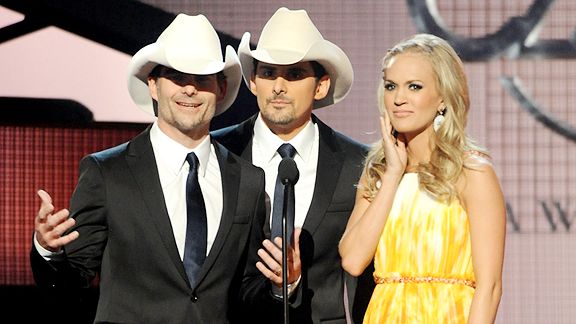 Rick Diamond/Getty ImagesCould Jeff Gordon, left, possibly be Brad Paisley's long-lost twin brother? Even Carrie Underwood did a double take at the 2010 CMA Awards.
Family, faith and Virginia Tech football not withstanding, my life's greatest passions are NASCAR racing and country music, and for the very same reason: Both are authentically southern and fundamentally rooted in an outlaw past.
Anyway (David Pearson shout-out), those passions collided at Charlotte Motor Speedway on Saturday. Brad Paisley showed up at the Sprint All-Star Race to hang out with a couple old buddies, Rick Hendrick and Jeff Gordon, and debut the video for his excellent new single, "Old Alabama."
It was the perfect scenario. Paisley already was planning to attend the race as a fan, then found out the track had a television screen on the backstretch big enough for the astronauts to watch from Endeavour. Why not debut a video on it?
So there he was, parked on site in the Nationwide garage, seated in the heavenly shadow cast by his blue and white tour bus.
Most folks in the racing industry are aware of my country music fandom. Including the Hendrick Motorsports folks. So they arranged for me to sit for a time in Paisley's shade to chat about the video, which includes a slew of Hendrick's classic cars and stars Gordon, naturally, as Paisley's buddy.
 Hendrick MotorsportsReal-life pals Jeff Gordon and Brad Paisley play good buddies in the country music video "Old Alabama."
It was 4 p.m. And it was at least 8,000 degrees. In 2010, Paisley released a song called "Water." I thought I'd make a quip about the heat and how badly I could use some water. But then I realized that wouldn't be funny. So I didn't.
When I sat, I shared with him that I'm probably the biggest country music fan on Earth.
"Oh, wow, good," he said. "I'm glad to know that person exists."
Zing.
Paisley and Gordon may as well be twins. During the 2010 CMA Awards show that he co-hosted with Carrie Underwood, Paisley had the idea that he and Gordon should wear identical suits, and Gordon should walk onstage wearing his hat. Gordon played along, and the two took a photograph together beforehand.
"I went, 'Oh my God, that's me,'" Paisley chuckled. "He walked out with Carrie and started presenting. The trick was we didn't have him speak. When he talks, he sounds like Jeff Gordon. There's only one voice like that. We don't sound alike. But it was absolutely hysterical. He could have stood there the whole time.
"We have a common friend in John Lasseter [CCO] at Pixar, and have gotten to know each other through them. All it takes is one other family that you hang out with, and next thing you know you're all around together. I think the world of Jeff. He's a good guy."
So when the time came to write the video plan for "Old Alabama," Paisley had another idea for Gordon.
"This song is all about driving and listening to music in a nice car, so we did a NASCAR take on it," he said.
They shot the video on the Hendrick Motorsports campus, where Rick Hendrick opened the doors to his classic car collection.
"Rick's been so generous," Paisley said. "He let us use all these old cars and his facility. We couldn't have done this without him. We had '57, '59, '63, '65 Corvettes. You've got these backdrops that look like they're part of a set, but they're not. They're part of his facility. If we'd have had to pay for this stuff, it would have been a million-dollar video."
Paisley describes the production as "a buddy flick," in which he and Gordon cruise around the CMS backroads, then take a seat on the hood of an old car to watch a movie on a drive-in screen while they reminisce.
 Kevin Kane/WireImageBrad Paisley rocked the house during a prerace concert at the 2011 Daytona 500 in February.
"We drove the 24 car around on the road out here," Paisley laughed. "We didn't make it street-legal. We just drove the thing. That's the beauty of videos -- they'll close down roads for you. People were freaking out, man. Imagine that car going by you -- Jeff himself was out there driving his race car on the roads. People saw him go by, and were like, 'What? He didn't even take time to switch vehicles before driving home from work?'"
As the video concludes, Johnny Law shows up and asks which one of them is Gordon.
Gordon points at Paisley.
Paisley gets the ticket.
That's how the video ends. But, in fact, it is only the beginning. Both gentlemen are quite philanthropic, and the video project offers an opportunity for more giving.
"We're using this video as an excuse to give some tickets away," Paisley said. "We're pairing up to give away tickets to the races to my fans, and tickets to my concerts to his [fans], and combining our charities here and there. We've only begun that process.
"Now we've got this video common-thread, in addition to it looking like my father made his way back to California or wherever. ... I don't think my dad was in California ..."
Zing.
"Anyway, it's a chance for both of us to do good that way. And it'll be a great use of a famous friendship."
The past year has been huge for Paisley. He was integral in helping buoy Nashville emotionally following the flood last spring, then helping rebuild it physically in the aftermath. Then, in November he achieved one of country music's highest, rarest honors: Entertainer of the Year.
"It's our Cup championship," he said. "Even though we don't necessarily earn it in points. It's a voted-on thing, so it's subjective. But it's a feeling of history in a way that only a few moments have matched. Like The [Grand Ole] Opry -- that's the gift that keeps on giving. When you get that, you can play there the rest of your life. That's better than the Hall of Fame, in my opinion, because the Hall of Fame is like, 'Nice job, you're done. I hope you had a good time because it's over.'
"Although, they put in George Strait recently and he's nowhere close to done. But the Opry is an award that's like the keys to the city. And Entertainer feels just as big, because it's achieved. Kenny Chesney called me and said, 'Enjoy this. They don't give these away. These are earned and you did a great, great job. Congratulations.'"
NASCAR is an obvious fit for Paisley. NASCAR people are his people. We're country and proud of it. And as a fan, one thing I really appreciate about him is, like us, he pays particularly genuine homage to the pioneers who built his platform.
"It was easy to cross right into [NASCAR] as a fan, because it's so much my world," he said. "Other than that it's a lot of the same types of people. I never feel out of place at races. I feel right at home."
It was sometime around midnight on Thursday, April 28, and Danielle Frye, former NASCAR publicist and wife of Red Bull Racing general manager Jay Frye, couldn't sleep. So she went to the couch and turned on the television.
Channel-by-channel, horrific images of the tornadoes that decimated the Southeast the previous day filled the screen. Among the areas affected was her hometown, tiny Pell City, Ala., located in the shadow of Talladega Superspeedway.
Fourteen people were killed in St. Claire County, which houses Pell City, and as Frye watched the devastation she was moved to help her own. So she grabbed her laptop and over the next 90 minutes sent and string of emails to her husband.
They were blessed. They had the platform to make a difference. They had to do something.
In the morning, Jay Frye went to work. His first call was to an old friend, Marshall Carlson, general manager at Hendrick Motorsports. Carlson didn't hesitate, and in fact raised the ante.
If you're sending a transporter full of supplies, he said, we are, too.
 Danielle Frye, Special to ESPN.comPallets of food and other goods await distribution to the tornado-ravaged South.
 Next up was a call to J.D. Gibbs. Then Ty Norris at Michael Waltrip Racing. Then Richard Childress Racing. No one hesitated.
"This was obviously a very personal cause for Danielle and a general humanitarian cause for the nation," Norris said. "When Jay and Danielle asked MWR to participate, we reacted as quickly as we could to participate. There are so many families who need people who care, and the families of Alabama found that in Jay and Danielle, who didn't just say they felt bad about the situation but they did something positive about it."
MRN Radio mentioned the initiative, and when the Jeff Gordon Foundation got wind of it, they, too, joined in. Gordon's foundation is specifically tailored to assist children battling cancer, but in this instance, Frye said, an exception was made. An online donation was organized. In three days, Danielle Frye said, JGF raised more than $6,000, all of which went towards assisting children affected by the tornado.
Over the following days two transporters were packed far past legal capacity with supplies and sent south to St. Claire County. HMS worked with the Charlotte Pepsi bottler to provide a palate of soda and water. Red Bull donated palates of product and water, as well. Frye estimates some 70,000 pounds of goods were on those trucks. The Red Bull Racing transporter alone, she said, was 6,000 pounds overweight.
"Fortunately, the weigh stations understood," she said with a laugh.
Upon arrival, the transporters were met by the St. Clair County Sheriff's Department and escorted by deputies into town. There, the Alabama National Guard waited to help unload supplies. In order to deliver the goods, volunteers were forced to float the supplies on Humvees.
The devastation was unspeakable.
"It was so sad," Danielle Frye said. "I try to tell people, it's not like it was a low-income or underfunded area. These are people that have things. And now they have nothing. Nothing.
"Think about everything you've used this morning. Those people don't have any of that right now. There are babies that need formula. There are kids that are separated from their families or lost their families completely."
She pauses briefly. Then starts again.
 Danielle Frye for ESPN.comMen and women of the Alabama National Guard stand proudly behind Dale Earnhardt Jr.'s National Guard car as they work to distribute relief to the tornado-ravaged South.
(Disclaimer: This is one of the saddest things I've ever heard.)
"There's one story about a little boy in St. Clair County that the EMTs found wandering the street, and he was carrying his 3-year-old brother," she said. "He stopped the medic and said, 'Would you sit with us for a few minutes until our parents come back? We can't find them, and they would never leave us. My brother is asleep right now, but I'm kind of scared.'
"Come to find out, his 3-year-old brother was dead. He wouldn't leave his brother. That breaks my heart. Those stories are all over. That is everywhere."
She told the story of a farm not too far from the racetrack, where 100 horses were found in a nearby lake. She recalled seeing cows grazing on insulation in a remote field.
"The saddest thing for me, there was a house where the only thing left was a carport," Frye said. "There was a tire swing on a tree, and the entire tree was gone except one limb with the tire swing on it.
"And that's just one small area. The larger cities got all the attention, and rightfully so. But there were smaller communities that weren't getting what they needed. That's where our initiative went. I was familiar with the people and the area."
The Hendrick transporter carried on it one of Dale Earnhardt Jr.'s No. 88 cars. The National Guard volunteers were so excited to take photographs with it that they tried to climb up into the area that housed the car. Eventually, the car was lowered and removed so they might all have that opportunity.
"It was the least we could do," Frye said.
As we speak, Frye is driving north from downtown Charlotte with a car load of supplies. Next week, another smaller truck full of goods is headed to Alabama.
"You want to take the hurt away," she said. "You want to help them. When your own people are in need, and you know where the stuff is going and how it's impacting them, you need to step up. That's what we're trying to do."
 Courtesy Taylor StrategyMatthew Hansen was proud to see his and his brother's names all over Richmond.
I was very late. I had a date in Victory Lane at Richmond International Raceway with Matthew Hansen, the Marine for whom the Sprint Cup race later that evening was named, and I was double-booked. So I quickly wrapped up an interview with NASCAR president Mike Helton about NASCAR's new foundation initiative, NASCAR Unites, and hustled across the garage.
Hansen waited. He was there at the track with some folks from Crown Royal, and I wanted to hear the story he was there to tell. It was a story about brotherly love, and about a tribute to a hero. It was a sobering reminder of sacrifice. It was an alarming wake-up call.
When I arrived he was cutting up over in the far corner with some of the boys on Matt Kenseth's pit crew. He respected them, and would later tell me that the intricate choreography of pit stops at NASCAR's highest level was his favorite thing about the sport.
He wore a tight polo shirt and khaki pants. He was tall and lean with flat-top hair and a no-nonsense attitude. He made me feel ridiculous -- stupid, really -- for generalizing all men and women in uniform as soldiers. He was a Marine, and made it abundantly clear that Marines don't appreciate being called soldiers. I corrected myself with an apology that I won't soon forget, and settled in for the particulars on he was here.
I appreciate my wife more than anyone. But if she is 1A on that list, the men and women fighting for my freedom are 1B. Their sacrifice, collective and individual, is remarkable and truly indescribable for those of us who've not lived it. We try to grasp it, but most of us take it for granted every day. We shouldn't.
That's why I sought to chat with Matthew Hansen. He went to war for us. And his twin brother, Daniel, died for us. Daniel was killed by a roadside bomb in Afghanistan on Valentine's Day 2009, and when Matthew won Crown Royal's "Your Name Here," contest at Richmond, he honored his brother by including him in the race name.
"We used to always tell everyone we were best friends and worst enemies," Matthew Hansen said, peering off into the distance through dark sunglasses. "If you've ever had someone you competed with, that's who he was for me. It was that competition that made us so good.
"Even though we had different jobs, we got promoted at almost the same time, only months apart. As soon as one would get promoted, we'd call the other and give him a hard time. We were what made each other strive to be better. But at the same time we were each other's biggest fans, too."
Both brothers joined the Marine Corps in 2002. Matthew spent the better part of four years in the Middle East, in Kuwait and Iraq. When he returned in 2008 he enrolled in drill instructor school, and during training suffered a knee injury that required surgery.
Daniel, meanwhile, was a member of President George W. Bush's personal security staff for several years before being reassigned to Camp Pendleton to serve on Lieutenant General Richard F. Natonski's security team. He then joined another security detachment and deployed to Iraq. During this deployment the brothers saw one another several times, which Matthew fondly recalls today. Upon return to the United States, Daniel moved to explosive ordnance disposal, for which he underwent a year's worth of difficult schooling. He then joined a unit in Okinawa, Japan, and following several more months of explosives training, he deployed to Afghanistan.
"He loved his job, and one day it just didn't work out, and he was killed in an explosion during a foot patrol," Matthew said. "Combat happens."
The news of his brother's death was devastating for Matthew.
"It was not good, to say the least," Matthew said. "I didn't react well at all. It was easily the worst day of my life.
"My only thought was I wanted to get out there. At that time I was undeployable. I'd had surgery on my knee. I was trying to heal up. It hurt me a lot not to be out there with him, let alone lose him. I can't stress enough how much he loved what he did. He loved being a Marine. What more can you ask for in life, really?"
The opportunity to honor Daniel at Richmond was humbling for Matthew. But he feels he has unfinished business overseas. Once his knee was repaired he re-enlisted for the Marine Corps, and immediately requested orders back to the Fleet Marine Force. He currently serves with VMM 561 Pale Horse, in Marine Corps Air Station Miramar in California.
"This is great," he said. "To have him honored and tell everyone his story is really amazing. But I can't wait to be back out in the action."
We should all appreciate that attitude.
Kevin Harvick versus Kyle Busch isn't over. Trust me. Even if NASCAR slaps them both with a penalty and even if both drivers say all the right things, their general intolerance for one another goes way back and won't wane anytime soon.
I'm not saying they'll intentionally dump one another every weekend. Not even. But drivers' memories are everlasting -- every wreck, every perceived injustice. And forgiveness is fleeting. I had that very conversation with a former Sprint Cup champion last fall in Fontana, Calif. When I asked, he laughed.
"Oh, hell yes, we remember everything -- forever," he said. "Anybody who tells you different is lying."
For that, we fans are the winners. It adds to the weekly grind an intriguing layer that is both captivating and, if you ask me, sorely needed.
I expect NASCAR to penalize both Harvick and Busch in some fashion, probably probation and a monetary fine. But if they do so it will be because the fracas occurred on pit road, where innocent bystanders could have been injured. Not because they don't like each other.
If this had happened in Turn 3 at Darlington, we'd move on down the road to Dover. But it was on pit road, and a car went careering into the pit wall with no driver aboard. That doesn't sit well in Daytona.
Harvick and Busch are the perfect candidates to resurrect the old-fashioned NASCAR rivalry. Both have a serpent's tongue and a laser wit and a general intolerance for one another. It's DW versus Dale circa 2011.
And while those characteristics add drama, none of them is as important as their respective on-track success. Both are championship-caliber drivers on elite teams. Both are weekly contenders. They run closely together every single race. Neither is apt to take much flack. And these days neither has to race as if the food on his table depended on his success. But both do so.
No matter how fans may perceive either one of them generally, most everyone appreciates their hard-charging approaches. I know I do.
Think for a moment about sports' great rivalries: Duke versus North Carolina, Yankees versus Red Sox, Michigan versus Ohio State, Lakers versus Celtics, Packers versus Bears, and so on. Why are those rivalries great? Because the teams are almost always competitive.
I grew up in Virginia. In my mind, Redskins versus Cowboys is the greatest rivalry ever. But even that has lost some luster through the years because the Redskins haven't been the Redskins since Joe Gibbs hung up the whistle the first time around.
Great rivalries engage the national audience. I'm neither a Yankees nor Red Sox fan, but I watch every game they play against one another because the general hatred is palpable and fantastic to experience.
And they're almost always in a battle for the pennant. I'd bet Harvick and Busch will both be in NASCAR's pennant race come November.
It's not over.
Jerry Caldwell welcomes the unenviable task of following a legend, albeit the legend from whom he learned most everything he knows about auto racing -- how to appreciate it and, certainly, how to promote it.
Caldwell is charged with making his mentor proud, by way of upholding the lofty standards he inherited in a sport that demands excellence of its leaders. Caldwell, a member of the Bristol Motor Speedway staff since 1997, was named the track's general manager late last year, following the death of former GM Jeff Byrd, to cancer. During Byrd's tenure -- he had held the position since 1996 -- Bristol became the sport's most coveted ticket.
"I'm humbled by it, blessed by it, honored by it," said Caldwell, 35. "I'm not Jeff, can't be him. I learned from him, but I need to put my own approach on things. He taught me to treat people the way you want to be treated. I think if you do that, you can't go wrong.
"If you can focus on those things in life, I think you'll end up being successful."
That's the cornerstone of Byrd's legacy at Bristol -- always side with the fan. It was his mission to produce a culture focused on assisting the paying customer.
"If at all possible, don't tell them no," Caldwell said.
More often than not, Caldwell and Byrd had the same goals, but typically chose different routes to arrive there. As a result, he said, day-to-day operations at Bristol haven't changed much. Byrd assembled a like-minded staff at BMS, one that shared his philosophy.
"It's really learning from the best in the business, learning from Jeff Byrd," Caldwell said. "There's no one else you'd rather learn from. There are other great ones, but Jeff Byrd is one of the best. A lot of times, in making a decision, I'm thinking, 'What would Jeff do?'
"He'd tell you over and over, 'We're Bristol, we're special, we're the most sought-after ticket in NASCAR, the best show on the circuit. We promise fans the most in the sport, and we must deliver on that. We work for the race fans.' Growing up here, that's what's drilled into your head."
Caldwell is excited as his first race weekend as GM approaches. It is the 50th anniversary of racing in Thunder Valley, and the folks in East Tennessee couldn't ask for a better scenario.
Trevor Bayne, the fresh-faced, gregarious, just-happy-to-be-here kid who won the Daytona 500, also happens to be local. He's a southern boy, grew up 90 minutes west of Bristol, in Knoxville. His victory, of course, returned the Wood Brothers to Victory Lane -- and to relevance.
NASCAR is a sport that celebrates history. It is wonderful to experience moments when historical appreciation collides with present-day significance. Follow up Bayne's victory with his hero, Jeff Gordon, snapping a two-year winless drought, and mix in a Carl Edwards' Vegas triumph, and Bristol is the epicenter of NASCAR's perfect storm.
Overall ticket sales at Bristol are slightly behind 2010 numbers, Caldwell said, mostly renewals. But since Jan. 1, he said, year-over-year sales are up. August sales, he said, are "very, very strong."
"I'm really encouraged," Caldwell said. "I'm excited about what's going on in our sport. I love it. We couldn't ask for a better scenario. What better place to have some of the scenarios we've seen so far play out? We're Bristol. It's a good position to be in."
Throughout Sunday morning, Feb. 20, the Daytona Beach air was electric, buzzing with an anticipation not felt, at least to that degree, in years. Many felt it, mentioned it. The grandstand was packed and the prerace entertainment decidedly Southern.
There was a palpable optimism, a sense that 2011 could be a cornerstone chapter in NASCAR's comeback story.
As Martina McBride completed a hair-raising National Anthem -- sung how it's supposed to be sung -- I began to make my way to the No. 29 team's pit stall. On the third lap of the Daytona 500, there would be a silent tribute, three fingers raised by every attendee in honor of Dale Earnhardt. I wanted to be with his team during that emotional moment.
The 29 pit was down toward Turn 1, and the walkway to get there was packed with people. I knew I'd never reach my destination in time if I didn't take an alternate route. So I grabbed my buddy, ESPN the Magazine senior writer Ryan McGee, hopped the pit wall and took off down pit road. It was empty, save for a few crew members sweeping their pit stalls and the team of NASCAR officials who work pit road every weekend.
As I walked I offered well wishes to many but stopped to shake just one hand, Leonard Wood's. I grew up in Virginia. My father's mother was born and raised on a farm in Stuart, just around the corner from the Wood brothers' homestead. I know what Wood and his family mean to folks back home. For decades they've proved small-town boys can make it big. There is a strange hope in that -- that people just like you can do amazing things.
Suddenly, a hair-raising realization hit me. The cars were rolling off. This was the Daytona 500. This was the moment I'd spent months waiting for and a lifetime dreaming of. And here I strolled, on the racetrack -- on the racetrack -- with the cars as they sped off into battle.
I can't lie. I was wide-eyed, humbled and plumb tickled, and I could tell McGee was, too. Like me, he completely understood and respected how impossibly rare and special this moment was. We hustled to the 29 pit and giggled all over ourselves, making sure we took copious mental notes of the experience to share with our children someday.
Several hours later 20-year-old Trevor Bayne was parked in Victory Lane and square in the American mainstream consciousness, a captivating, gracious and gregarious young man who achieved the impossible. He is the type of kid every father prays his daughter brings home, chivalrous, selfless and refreshingly unaware of what he'd just done.
It was an achievement that reminded us of heroes lost.
There is hope in that and it subsequently gave hope to NASCAR racing. But how do we follow that up? How do we harness that momentum and push it forward?
Easy. With a good ol' classic American comeback story, a redemption piece, one born from a once-hated silver spoon now humanized by an unforeseen topple from the pinnacle.
Jeff Gordon's win at Phoenix was the perfect way to continue the momentum from Bayne's Daytona 500 triumph. It was unexpected yet historic, and it wasn't handed to him. Gordon went and took it. That was the true beauty in it. For the first time in a long time, he hunted down his prey and completed the kill.
In recent years, as Gordon's nearly decade-long dominance of the sport became a distant memory, fans who once utterly loathed him suddenly had empathy for his struggle. Near miss upon near miss led many to consider him washed-up, done, shelved. He even began to question whether he'd lost the fire.
But Sunday, on the very same track that three seasons ago saw him equal his greatest and most respected rival, Dale Earnhardt, in career victories, he moved into a tie with legendary Cale Yarborough for fifth all time on the wins list. Two more and he'll own sole possession of third.
As I sat and watched Gordon and his boys spray champagne Sunday, I happened to look at his race car. It looked like a race car is supposed to look. It had an air dam on the front and a spoiler on the back. No wings. No spice rack. And there was confetti all over it. It looked like a big red Christmas gift.
And for NASCAR and many of its fans, that's exactly what it was.
After I interviewed Gordon about his win, I happened upon a longtime industry acquaintance who had been part of many of Gordon's wins over the years. He noted how different this one was from any he could remember. Gordon was completely engaged, thankful, relieved and, oddly, validated.
He soaked up every second of the moment.
We all should follow suit.
There is hope in that.
AVONDALE, Ariz. -- Standing in Victory Lane at the Daytona 500, Trevor Bayne took time to shake every single hand that tightened every single bolt on the No. 21 Ford in the weeks leading up to that moment. It was genuine appreciation. He was completely bewildered by the accomplishment, and he wanted his boys to know he was fully aware that it was their sweat that got him there.
You don't often see that these days. And when Doug Yates did, it whisked him back to 1992, when 31-year-old Davey Allison won the 500 in the No. 28 Texaco Thunderbird. Here was this bright young kid, wide-eyed and humble with an infectious innocence, driving a famous number straight into history, the accomplishment overshadowed only by the promise of a limitless future.
Sadly, 17 months after he won the Daytona 500, Allison died in a helicopter crash at Talladega Superspeedway. He was 32 years old. Friday would have been his 50th birthday.
Discussing it now, Yates pauses to choke back tears. Bayne's victory in a Wood Brothers-prepared Ford, with Yates power under the hood, was a sorely needed reminder of how wonderfully hard work can pay you back, and how persistence can outlast heartbreak if you simply refuse to give up.
 AP Photo/Russ HamiltonDavey Allison, left, finished second to his father, Bobby Allison, in the 1988 Daytona 500.
"It's amazing how that race made me feel," Yates said. "For Trevor to have the courage, as a 20-year-old, to say a prayer with his crew during the pace laps of the Daytona 500? Wow. To put himself out there like that? That's something special. He's awesome. It's great for the sport. It reminded me so much of when we won in '92 with Davey, the way he reacted."
Everybody loved Davey Allison. He had a magnetic personality. He was a jokester, Yates said, much like Tony Stewart is in today's garage. He was a family man who adored his children. He was an icon, the latest in a family full of racers.
Without Davey Allison there never would have been a Robert Yates Racing, Doug said, and subsequently no 1999 championship for Dale Jarrett. Allison made a commitment to stand behind Yates. If Yates was all-in, Allison was all-in. That's all Yates needed to hear.
"My dad sold his house and put it all on the line, and that was all about Davey saying he was behind him," Doug said. "His thought was, don't worry about me leaving you. We're going to do this thing right and be successful together. That means a lot to us."
Added Jarrett, "That was what spurred Robert on and gave him the confidence to race. Davey was the driving force behind it and the face of it. And even though it was a number of years after that that I went there, it was still very obvious to me why they were there -- it was because of Davey. That was their motivation.
"I'm very aware that if not for Davey Allison, his dedication and friendship that led them to that success, that that opportunity for me to go there and win races and a championship never would have happened."
Doug Yates recalled a race at Bristol Motor Speedway in 1990. Robert Yates Racing had fallen on tough times, Doug said, and Carl Haas had offered to buy the team. It weighed heavily on the family. Back then, Bristol had had just one racing line, and Allison was leading the race when the caution flew with some 50 laps to go. The crew implored Robert Yates, who was crew chief that day, to keep the car out. They did so, and Allison held off a field full of fresh tires to win the race.
"That was the turning point for the company," Doug Yates said. "That kept us going. He never gave up on us, or my dad. He and my dad were so close."
He paused again to collect his emotions, then noted Allison's intelligence as a racer. He was a perfectionist, Yates said. He was strategic in the quest to dial in his car and yearned to dominate races.
"When he got his car right he was unbeatable," Yates said.
Above all, Davey wanted to make his father proud. He wanted to one-up the old man. That's what drew five-time defending champion Jimmie Johnson to him as a young fan.
"I just thought it was so cool that he got to race with his dad, on the same track at the same time," Johnson said. "I remember that 1988 Daytona 500. Can you imagine that?"
Johnson, of course, was referring to the time Davey finished second to Bobby in the Daytona 500. Back then, drivers, owners and team members spent plenty of time together. They flew together. They stayed in the same hotels. In an age of private planes and motor homes, it's not that way anymore. It made rapport very strong. And Allison, Yates said, was always a cheerleader for the boys building his cars.
That's one reason Bayne's reaction reminded Yates so much of Davey.
Asked about his favorite memory, Yates instantly mentioned the Winston All-Star race in 1992. The previous year Allison had nearly lapped the field, prompting Bill France Jr. to remind Robert Yates, "Don't you stink up my show, boy."
In '92 they took it under the lights for the first time, and Davey was running third, behind Dale Earnhardt and Kyle Petty. Petty got a run down the backstretch, then tapped Earnhardt entering Turn 3 and spun him.
That set up an epic finish. Coming off Turn 4, Allison dove inside Petty and the pair drag-raced to the line. Petty turned Allison around and hard into the fence, on the driver's side. Allison won. He never went to Victory Lane.
"Everybody went to Victory Lane, and it was the best and worst feeling in the world," Doug Yates said. "The car was there, but Davey was flying off in a helicopter to the hospital. Your emotions are so weird. Is he going to be OK? Obviously he was fine, and that was such a special, strange victory.
"And after he got hurt at Pocono when Darrell [Waltrip] took him out, and he flipped and rolled, Dad went to see him in hospital, and his head was so swollen his hair was peeled back. At Talladega the next weekend, he lifted up his sunglasses and there were no whites in his eyes."
Yates hired Bobby Hillin to drive Allison's No. 28. Davey climbed into the spotter's stand and drove the car from there.
"We finished third that day," Yates said. "That never would have happened without Davey guiding him. He told him every move to make.
"I remember going to the funeral. I've never seen anything like it. The streets were lined with people. It was just amazing, the outpouring of support for their hero. It was sad, but made you realize how much he meant to his town, his state and this sport.
"He had the makings of a champion, for sure. You never know. There are no guarantees. But I think he would have been a champion in our sport."
ABOUT THIS BLOG

Marty Smith
Marty Smith, a former senior writer for NASCAR.com, became an analyst for ESPN and ABC's coverage of NASCAR in 2007. Smith had been a regular contributor on ESPNEWS, "Cold Pizza" and SPEED News, offering energetic and vibrant commentary, since 2005. In a short career, Smith has become one of the most well-respected writers in the field, and his contacts in the NASCAR garage have led to many breaking stories.
As an Insider, Smith reports on the latest news and information behind the scenes and breaking stories on teams, drivers, owners and crew chiefs. He serves several of ESPN's multimedia platforms, reporting for "NASCAR Now," "NASCAR Countdown," ESPN Radio, ESPNEWS and "SportsCenter," as well as providing weekly content on ESPN.com.
Before joining ESPN, Smith was a NASCAR analyst on Fox Sports Net, providing insight into the industry's hottest topics on programs "Around the Track" and "Around the South" from 2005 to 2006. In those same years, Smith hosted Speed Channel's "Back Seat Drivers" and was a guest analyst on "NASCAR Nation."
A 1998 Radford University media studies graduate, Smith joined The Roanoke (Va.) Times newsroom during his senior year at RU, where he covered a variety of sporting events. Later that year, he moved to The (Lynchburg, Va.) News & Advance, where he conducted an interview with Lynchburg native Paul Brooks, vice president of NASCAR, that ultimately changed the course of Smith's career. Shortly after, Brooks hired Smith for NASCAR's public relations team in Charlotte, where he provided online content for the NASCAR-owned league Web site from 1999 to 2000.