Davis Cup
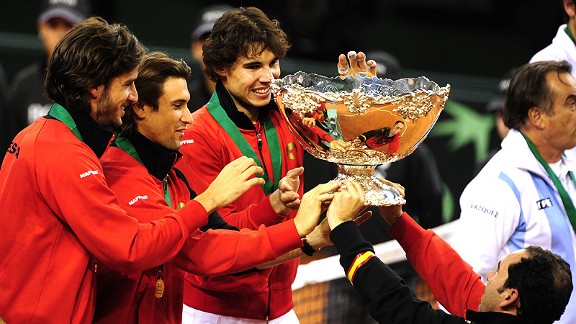
The Davis Cup is the premier international team competition in men's tennis, contested annually by squads from countries throughout the world in knockout format to determine each year's champion. First played in 1900 (between the United States and the British Isles) and originally called the International Tennis Challenge Trophy, the Davis Cup has grown to include more than 130 nations competing for the annual prize, named for one of the event's founders who commissioned the trophy.
Twelve nations have won the Davis Cup over its 110-year history, with the United States capturing the most titles (32), followed by Australia (with 28). The Czech Repulic team defeated Spain in the 2012 Davis Cup final round to win its first title since 1980.
While teams from more than 100 countries compete annually in Davis Cup play, only 16 nations qualify for the elite World Group that determines each year's champion. All other countries compete in various groups of zonal play or the World Group playoffs, earning points to improve their standing within the International Tennis Federation's ranking system.
Those rankings help to determine the seedings for the World Group, with the previous year's finalists serving as the top two seeds for the initial round of 16 within the World Group -- the first of four weekends spaced throughout the year that narrow the field down in knockout format through best-of-five match "ties."
Winners of that first round of 16 move on to the quarterfinals and ensure their place in the following year's World Group, while the losers fall into the World Group playoffs to face zonal winners for a place in the top tier for the next year.
In the World Group, World Group playoffs, and Groups I and II of zonal play, each round or "tie" is contested in a best-of-five match format, and is played over three days (usually Friday to Sunday). On the first day (Friday) there are two singles matches, and then the doubles match takes place on the following day. The reverse singles take place on the final day (Sunday). Each of the five matches is worth one point, with the team earning the most points capturing the tie. All individual matches are best of five sets, unless one team has won the first three matches. Then the teams will often agree to a best-of-three sets scenario (for remaining singles matches).
Home teams within the competition are determined by the draw. In matchups between countries who have played each other in the past, the "away" team from the most recent matchup between the two is deemed the home side and allowed to choose a location for the tie.
The draw also specifies which weeks are set up during the year for Davis Cup play, with all of the quarterfinals usually played the same weekend in July and each of the semifinals held simultaneously in September. The finalists meet in December of each year to square off for one of sports' most historic prizes.
The idea behind the competition that would become known as the Davis Cup emerged in 1899, when a group of Harvard tennis players suggested a contest between players from the United States and the British Isles. Dwight F. Davis, one of the Harvard men, suggested a tournament format and commissioned a trophy for the initial challenge event, to be hosted by the Longwood Cricket Club in Boston.
Davis was a member of the U.S. team in that first competition, played in 1900 and known as the International Lawn Tennis Challenge Trophy. The Americans triumphed by a 3-0 score, and then took the second challenge event two years later in Brooklyn, N.Y.
The Brits won the competition for the first time in 1903, in their third attempt to top the Americans. France and then Australasia (comprised of players from Australia and New Zealand) joined in Davis Cup play the following two years, with Australasia becoming the third nation to win the event in 1907.
Although the first World War kept the Davis Cup from being played from 1915 to 1919, the competition's popularity continued to grow as additional countries became involved in the annual competition. In those early years, the Davis Cup's defending champion advanced directly to the final round to await an opponent that survived among the rest of the participating nations. With the event attracting more countries, organizers in 1923 split up the participating nations into two zones -- the America zone and Europe zone -- with the winners of each zone facing each other to determine which would meet the defending champion in the final round.
During that decade, the U.S. team won seven straight titles from 1920 to 1926 (a record for successful defenses that still stands). The next year marked the beginning of another country's dominance, as the "Four Musketeers" of France captured the first of six consecutive Davis Cup titles. That stretch not only ended the dominance of Australasia, Great Britain and the U.S., but saw the finals move from grass courts to the clay (of Stade Roland Garros in Paris) for the first time.
Fred Perry led Great Britain to four consecutive title victories in the mid-1930s, before Davis Cup competition was again put on hold (due to World War II) from 1940 through 1945. Once the event returned to the annual sports schedule, the United States and Australia began to dominate the competition and were the only countries to claim Davis Cup titles between 1937 and 1973.
The competition's structure was revised again during that period, as the increase in participating nations saw a separate "Eastern Zone" added in 1955, while European countries were split into two distinct zones a decade later. And by the 1972, the defending champion no longer advanced directly to the final round and was required to compete from the opening rounds each year.
South Africa, Sweden and Italy captured their first Davis Cup titles in the 1970s, and the Czech Republic earned its only championship in 1980. In the following year, the tiered competition of a World Group and various levels of zonal play established in 1981.
Sweden won the Davis Cup three times in the 1980s, advancing to seven straight finals from 1983 to 1989. In the last two years of that stretch, the Swedes were defeated by Germany, which earned its first-ever title in 1988 and then became just the third nation to repeat as champions after the abolition of the challenge round in 1972.
The 1990s saw another increase in participating countries, with 1993 marking the first time that 100 nations took part in the competition. Three years later, the Davis Cup was won in the fifth set of the fifth rubber (of the final) for the first time, when France defeated Sweden.
The competition's celebrated its centennial in 1999, with traditional power Australia claiming another championship. Spain and Russia each lifted the trophy for the first time within the next three years, before the Aussies claimed a 28th Davis Cup title in 2004.
In 2005, Croatia became the 12th nation -- and first unseeded team -- to win the Davis Cup by defeating Slovak Republic 3-2 in the World Group Final. Two years later, the U.S. claimed a record 32nd Davis Cup after topping Russia in the final round ending a 12-year gap between Davis Cup successes, the longest in the nation's history.
Rafael Nadal and Spain captured back-to-back Davis Cup titles in 2008 and 2009, but the two-time defending champions were knocked out of the 2010 competition in the quarterfinal round by France, which then fell to Serbia in the final round. The Spanish team then regained the trophy in 2011, defeating Argentina in the final round to win its fifth overall title and third within a four-year period.
All-Time Davis Cup Champions
| Year | Winner | Runner-Up |
|---|---|---|
| 2012 | Czech Republic | Spain |
| 2011 | Spain | Argentina |
| 2010 | Serbia | France |
| 2009 | Spain | Czech Republic |
| 2008 | Spain | Argentina |
| 2007 | United States | Russia |
| 2006 | Russia | Argentina |
| 2005 | Croatia | Slovakia |
| 2004 | Spain | United States |
| 2003 | Australia | Spain |
| 2002 | Russia | France |
| 2001 | France | Australia |
| 2000 | Spain | Australia |
| 1999 | Australia | France |
| 1998 | Sweden | Italy |
| 1997 | Sweden | United States |
| 1996 | France | Sweden |
| 1995 | United States | Russia |
| 1994 | Sweden | Russia |
| 1993 | Germany | Australia |
| 1992 | United States | Switzerland |
| 1991 | France | United States |
| 1990 | United States | Australia |
| 1989 | Germany | Sweden |
| 1988 | Germany | Sweden |
| 1987 | Sweden | India |
| 1986 | Australia | Sweden |
| 1985 | Sweden | West Germany |
| 1984 | Sweden | United States |
| 1983 | Australia | Sweden |
| 1982 | United States | France |
| 1981 | United States | Argentina |
| 1980 | Czechoslovakia | Italy |
| 1979 | United States | Italy |
| 1978 | United States | Great Britain |
| 1977 | Australia | Italy |
| 1976 | Italy | Chile |
| 1975 | Sweden | Czechoslovakia |
| 1974 | South Africa | India |
| 1973 | Australia | United States |
| 1972 | United States | Romania |
| 1971 | United States | Romania |
| 1970 | United States | West Germany |
| 1969 | United States | Romania |
| 1968 | United States | Australia |
| 1967 | Australia | Spain |
| 1966 | Australia | India |
| 1965 | Australia | Spain |
| 1964 | Australia | United States |
| 1963 | United States | Australia |
| 1962 | Australia | Mexico |
| 1961 | Australia | Italy |
| 1960 | Australia | Italy |
| 1959 | Australia | United States |
| 1958 | United States | Australia |
| 1957 | Australia | United States |
| 1956 | Australia | United States |
| 1955 | Australia | United States |
| 1954 | United States | Australia |
| 1953 | Australia | United States |
| 1952 | Australia | United States |
| 1951 | Australia | United States |
| 1950 | Australia | United States |
| 1949 | United States | Australia |
| 1948 | United States | Australia |
| 1947 | United States | Australia |
| 1946 | United States | Australia |
| 1939 | Australia | United States |
| 1938 | United States | Australia |
| 1937 | United States | Australia |
| 1936 | Great Britain | Australia |
| 1935 | Great Britain | United States |
| 1934 | Great Britain | United States |
| 1933 | Great Britain | France |
| 1932 | France | United States |
| 1931 | France | Great Britain |
| 1930 | France | United States |
| 1929 | France | United States |
| 1928 | France | United States |
| 1927 | France | United States |
| 1926 | United States | France |
| 1925 | United States | France |
| 1924 | United States | Australia |
| 1923 | United States | Australia |
| 1922 | United States | Australiasia |
| 1921 | United States | Japan |
| 1920 | United States | Australiasia |
| 1919 | Australiasia | Great Britain |
| 1914 | Australiasia | United States |
| 1913 | United States | Great Britain |
| 1912 | British Isles | Australiasia |
| 1911 | Australasia | United States |
| 1910 | Australasia | United States |
| 1909 | Australasia | United States |
| 1908 | Australasia | United States |
| 1907 | Australasia | British Isles |
| 1906 | British Isles | United States |
| 1905 | British Isles | United States |
| 1904 | British Isles | Belgium |
| 1903 | British Isles | United States |
| 1902 | United States | British Isles |
| 1900 | United States | British Isles |
TOP STORY

Running on Empty
After a tough doubles loss for the U.S., Sam Querrey did his best against Novak Djokovic, but the top-ranked player clinched the tie for Serbia with a 7-5, 6-7, 6-1, 6-0 win. Scores »
DAVIS CUP QUICK FACTS
 Founded: 1900
No. of teams: 16 (World Group)
Defending champion: Czech Republic
Most titles: United States, 32
2013 World Group schedule
- First round: Feb. 1-3, 2013
- Quarterfinals: April 5-7, 2013
- Semifinals: Sept. 13-15, 2013
- Finals: Nov. 15-17, 2013
2013 DAVIS CUP
Final - Nov. 15-17
Semifinals - Sept. 13-15
Quarterfinals - April 5-7
Italy at Canada
Serbia at United States
France at Argentina
Czech Republic at Kazahkstan
Round of 16 - Feb. 1-3
Canada def. Spain, 3-2
Italy def. Croatia, 3-2
Serbia def. Belgium, 3-2
United States def. Brazil, 3-2
France def. Israel, 5-0
Argentina def. Germany, 5-0
Kazahkstan def. Austria, 3-1
Czech Republic def. Switzerland, 3-2
RELATED TOPICS
ESPN.com Topics brings you full coverage of the biggest events in tennis throughout the year.
| Australian Open Jan. 14-27, 2013 | French Open May 26-June 19, 2013 |
| Wimbledon June 24-July 7, 2013 | US Open Aug. 26-Sept. 10, 2013 |
| Davis Cup Final: Nov. 15-17, 2013 | ATP World Tour Finals Nov. 4-10, 2013 |