DETROIT -- Will Power didn't have the fastest car in qualifying for the first race of the Chevrolet Indy Dual in Detroit.
But he certainly did in the race itself -- which, combined with perfect pit stop strategy from Team Penske, allowed the Australian to score his second Verizon IndyCar Series win of the 2014 season and 23rd of his career.
Like so many Indy car races, this one was decided by fuel management and the timing of full-course cautions. Power started 16th after battling handling problems in qualifying, and his run to victory was keyed by an early pit stop under yellow on Lap 7 after Simon Pagenaud tapped the wall.
 AP Photo/Dave FrechetteWill Power gets a champagne shower courtesy of Graham Rahal, left, and Tony Kanaan on Saturday.
Power made the second of his three pit stops under green on Lap 30, turning a series of quick laps that allowed him to take control of the race from pole winner Helio Castroneves and the other drivers who stuck to a standard two-stop strategy. Once the final round of stops cycled through, Power led, and he held off a charging Graham Rahal by 0.3008 seconds at the flag.
"Graham made it very difficult -- man, he never gave up," Power remarked. "I thought I could pull a gap, and every time I'd relax, he'd be straight back on me.
"What a tough race," he added. "No fuel saving, just run hard, and good strategy from the guys. I'm very happy."
Power still probably wasn't as happy as Rahal, who posted his first podium finish in 22 races dating to Long Beach 2013.
Rahal ran a stint in the lead and he and Power were the only drivers to lap in the 1-minute 17-second bracket.
"I thought I was going to finally get the monkey off my back today," said Rahal, whose last Indy car race win came at the 2008 St. Petersburg GP. "I knew I had a car that was as quick as him.
"I said after Indy that this team was made of champions and that it would come in time, and we're going to win one," he added. "We're going to do it -- I can promise you that, and it's coming soon."
Castroneves led 30 of the 70 laps, but the two-stop strategy doomed him to fifth place, behind three-stoppers Tony Kanaan and Justin Wilson.
"When you can put Will out front and get him some clear laps, he certainly puts them together," said Team Penske president Tim Cindric.
"Things kind of fell our way. We needed some of those breaks to break the race up a bit and we really took advantage of it. An awesome day for all of us."
It was a big day for Power in the IndyCar Series championship, as he cut Ryan Hunter-Reay's lead from 40 points to three. Castroneves is third in the standings, 44 points behind Hunter-Reay.
The Indy 500 winner had a terrible Saturday in Detroit, with a crash in qualifying forcing him to start from the back row. Pushing hard at the end of the race, Hunter-Reay again crashed on the last lap, costing him a potentially crucial five points as he dropped from 11th to 16th place.
Power looked somewhat knackered when he stepped from his car, but he said that his stamina will not be an issue for Sunday's 70-lap contest (ABC, 3:30 p.m.ET).
"I was thinking on the last stint, 'Man, I've got to do this again tomorrow!'" Power admitted. "I was absolutely puffing.
"But that's why we do fitness and I'll try to recover the best I can to come back and do it again."
INDIANAPOLIS -- Five years between Indianapolis 500 victories is an eternity for Roger Penske.
It's a drought the legendary businessman/racing team owner has had to endure only once since 1979, when Rick Mears claimed the first of his four Indy wins, the second of Penske's record 15 triumphs in the famous Memorial Day race.
The seven-year gap between 1994 and 2001 in Penske's Indy win resume comes with an asterisk. In 1995, his cars failed to make the race, unable to muster the speed to make Indy's field of 33 in an era when there were far more entries than starting berths.
From 1996 to 2000, embroiled in the politics of the era, Penske chose not to participate at Indianapolis. But he simply couldn't stay away from a race he first attended in 1951, and since his return to Indy in 2001, Penske has won five times.
 Michael Hickey/Getty ImagesHelio Castroneves is hoping to win his fourth Indy 500 and break Team Penske's Indy drought in one fell swoop.
Still, the last win came courtesy of Helio Castroneves in 2009, and there have been only two Indy victory lane celebrations since Gil de Ferran capped a run of three straight for Team Penske all the way back in 2003.
Taking that absence from the late '90s away, the current five-year winless skein is Penske's longest in 35 years. Three years without a Penske win at Indy is a rarity, and that fact doesn't slip past him.
"I've seen a lot go on here at Indianapolis, and obviously we've had the success to have cars in the winner's circle 15 times," Penske said. "But that doesn't really mean anything. It's, 'What are you going to do this year?'
"For me it's another journey, this year with three great drivers," Penske added. "Helio [Castroneves], looking for his fourth win; Will [Power], leading the championship; and Juan Pablo Montoya, coming back from NASCAR after having the opportunity to drink the milk the last time he was here.
"I think with these three drivers we have the right combination, no question. And potentially we've got the winner."
There's no doubt that the re-expansion of Team Penske's effort in the Verizon IndyCar Series to three full-time cars this year was based on the desire for a stronger showing at Indianapolis. After all, Montoya led 167 of 200 laps to dominate the Indianapolis 500 in his only attempt (in 2000, while driving for Chip Ganassi), and he also boasts a strong record in the NASCAR Brickyard 400 at Indianapolis.
Perhaps not surprisingly, it was recently announced that Montoya will drive a Team Penske Ford at the Brickyard in late July.
Team Penske president Tim Cindric has been saying all season long that Indianapolis was where Montoya would start to show the form that won 12 Indy car races and a CART-sanctioned championship in 1999-2000. Montoya admitted Thursday at Indianapolis 500 Media Day that the recent Grand Prix of Indianapolis was the first time in four races this year that he had his Dallara-Chevrolet tuned to his liking.
"It's a shame we got behind at the start, because I could really push the car and I thought we were one of the fastest cars out there," Montoya said.
"At St. Pete, the team said, 'Take it easy.' I was always a session behind those guys [Power and Castroneves]," he continued. "At Long Beach, I decided to just go for it, and it worked a lot better. I'm starting to understand what I want out of the car and how to get the most out of the red tires."
Just when Montoya was starting to get comfortable on road and street courses again after seven and a half years out of formula cars, he got pitched onto the famous Indianapolis oval. Like at St. Pete, he seemed to be one session behind his teammates; he was disappointed to miss out on the Fast Nine in Saturday qualifying, then came back to post the second fastest speed of the day Sunday (231.007 mph vs. pole winner Ed Carpenter's 231.067) to lead the drivers competing for 10th on the grid.
Power ran a slightly slower speed but landed on the outside of the front row.
"The biggest thing for me about being back here is the honor of being with Penske -- the tradition, the history," Montoya said.
"I came here once and I won it, so I have a little bit of pressure to make it 2-for-2," he added with a chuckle. "I know how important this race is for everybody, and this year it's so close that the smallest detail can make the difference between having the winning car and not."
Castroneves' bid to tie Penske icon Rick Mears' record of four Indianapolis wins will be easy to follow on the racetrack. His Dallara-Chevrolet is decked out in a vivid yellow retro look that mimics the Pennzoil-sponsored cars that Mears drove to Indy wins for Penske in 1984 and '88.
"The color yellow helped me before on 'Dancing With the Stars,' so I'm hoping for the same," joked Castroneves, who will start from the inside of Row 2 on Sunday.
Meanwhile, some observers believe Power is the Penske driver who will end "The Captain's" victory drought. Any questions about the Australian's oval speed or racecraft were put to rest when he conclusively won the 500-mile 2013 IndyCar Series season finale at Auto Club Speedway.
"The 500-mile race in California was a big breakthrough for me," said Power, who is acknowledged as the top road racer in the series. "I'd never been so excited at the end of a race.
"But this is a very different place and a very different style of racing," he went on. "I feel like this year we have a much better car. I feel much more comfortable in traffic and seem to be able to pass and run in traffic a lot better."
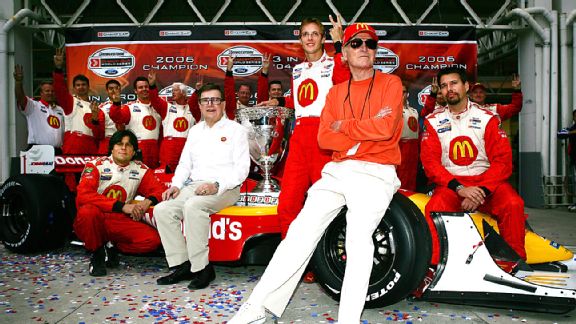 Darrell Ingham/Getty ImagesSebastien Bourdais, center, was the last in a long line of Newman/Haas Racing championship drivers. He is flanked by team owners, Carl Haas, left, and Paul Newman.
INDIANAPOLIS -- It still seems strange -- not to mention inaccurate -- to talk about Newman/Haas Racing in the past tense.
After all, NHR is still in operation at the team's longtime base in Lincolnshire, Ill., with Brian Lisles leading a small crew. However, Newman/Haas hasn't fielded a car in the IndyCar Series (or any other series) since the end of the 2011 season, and most of the team that won 107 open-wheel races and eight CART- and Champ Car-sanctioned Indy car championships has moved on to new opportunities.
Of course co-owner Paul Newman passed away in 2008, and Carl Haas is in declining health and retired from public life. But last weekend in Indianapolis, about 70 Newman/Haas team members, along with friends and families, came together to celebrate the team's long and successful run at the top.
 Jamie Squire/Allsport/Getty ImagesTeam owners Carl Haas, left, and Paul Newman might have seemed like an odd pairing, but together they ran one of the most successful teams in the history of Indy car racing.
Formed by former Can-Am competitors Newman and Haas in 1983 to field cars in the CART/PPG Indy Car World Series for Mario Andretti, Newman/Haas was a stalwart Indy car team for nearly 30 years.
From 1983 to 2011, Penske Racing was the only team that won more races; Chip Ganassi Racing, which began fielding Indy cars in 1990, won fewer races but boasts one more championship than NHR.
"You couldn't find two more opposite people [Newman and Haas] to work together, but they created one of the best race teams in America," said Sebastien Bourdais, who won four Champ Car-sanctioned titles for NHR between 2004 and '07. "I had a really enjoyable time driving for Carl and Paul, and obviously a lot of other people have really fond memories, too."
Bourdais, Cristiano da Matta and Michael Andretti -- representing 70 of Newman/Haas' 107 wins and six of the team's eight Indy car championships -- all attended the NHR reunion.
Guillaume "Rocky" Rocquelin, who engineered da Matta and Bourdais to four series championships in his five-year tenure with Newman/Haas, sent a video greeting. Rocquelin is now Sebastian Vettel's race engineer for Red Bull Racing in Formula One.
Now retired from racing, da Matta flew from Brazil to Indianapolis just to see his old teammates.
"I wouldn't have missed it for anything," he said. "The most favorite time of my career is the two years I was with Newman/Haas. Everyone, from Carl and Berni [Haas, Carl's wife] to all the guys that worked on the cars to the people who worked in hospitality, we are all a family."
People often think of Newman/Haas as "Mario's team," but Michael Andretti was actually the lead NHR flag-bearer for many years. Michael earned 30 of his 41 Indy car race wins while driving for Newman/Haas, as well as the 1991 CART-sanctioned championship.
Michael revealed that, as a 20-year-old aspiring racer, he had a hand in the creation of Newman/Haas Racing.
"Carl was smart," Michael said with a laugh. "He hired me first to drive his Formula Ford car as a way of getting closer to dad. Then he got dad to drive his Indy car. So I helped start it all."
 Jonathan Ferrey Allsport/Getty ImagesCristiano da Matta, left, said he wouldn't have missed the reunion for anything. Here he is celebrating winning the opening CART race of the 2002 season with team owner Carl Haas and teammate and third-place finisher Christian Fittipaldi.
Michael graduated to Indy cars at the end of Newman/Haas' first season in the CART series, but it wasn't until 1989 that Michael joined NHR for four memorable years teamed with his father.
"It was the most special time in my career, no question," Michael said. "We were a family there. It was everything you wanted in a race team. Carl and Paul would give you the equipment and support, and you wanted to do it for them. Great times, and it's so cool to see so many people here."
Andretti actually drove two stints for Newman/Haas; 1989-1992, the four years he lined up alongside his father in what Mario called "a dream scenario." Then, after a year of Formula One and a year with Ganassi's Indy car team -- in which he scored Chip Ganassi's first two race wins as a sole team owner -- Michael returned to Newman/Haas from 1995 to 2000.
Michael then drove for Team Green in 2001 and 2002, eventually acquiring ownership in the team now known as Andretti Autosport. In many ways, Michael's team has taken on the role Newman/Haas used to play as the main competitor for Penske and Ganassi.
It's not a surprise that, when NHR ceased racing operations, several team members found work with Andretti Autosport, and Michael said his time with Newman/Haas shaped his vision of how to operate a race team.
"There were times when Carl would do things and you'd think 'Why are you doing it that way?'" Andretti said. "Now, being on this side of the fence, I understand things that he would do and why he would do things. It's a different world being on the other side, for sure. But I definitely learned a lot from Carl and Paul."
POMONA, Calif. -- I have friends in the media who have ridden in a Shadow Can-Am car and a two-seat Indy car around Laguna Seca, and others who have been a passenger in a DTM car with Bernd Schneider at Hockenheim or in "maximum attack" mode next to Markus Gronholm through a rally stage.
But not too many of them have run an 8-second pass at Auto Club Raceway at Pomona like I did Saturday morning.
Mind you, I wasn't driving. The NHRA, in partnership with legendary drag racing instructor Frank Hawley, occasionally gives media members rides in a custom two-seat rail dragster with a 720-horsepower Chevrolet engine.
Hawley pilots the side-by-side special while the lucky press hack just tries to relax and take in the sensory overload that is part and parcel of drag racing.
Apart from actually taking the wheel, it's the best way to learn about what a drag racer experiences. Noise, vibration and harshness -- it's all there on vivid display when you're riding along. And it gives you even more respect for the guys and girls who wrestle those 10,000-horsepower nitro-fueled cars in the top classes down a 1,000-foot strip in less than four seconds as many as eight times in a race weekend.
 Courtesy NHRA John Oreovicz, left, gets some advice about running a dragster down the line from drag racing instructor Frank Hawley.
Hawley and his assistant explained how to operate the safety equipment in the unlikely event of an accident, and strapped me into the surprisingly spacious auxiliary cockpit. After being towed to the staging area by a golf cart driven by NHRA PR supremo Scott Smith, it was time to flip down the visor and go.
Riders are treated to the whole sequence of events leading up to a run, including a full burnout. Oddly enough, until we actually staged for the pass, my sense of smell overrode everything else. I remember smelling BBQ chicken during the tow through the paddock, and the strong waft of burned rubber as we pulled into the water box.
I was wearing earplugs, and this wasn't a nitro car, so the sound wasn't all that overwhelming to someone who has spent most of his adult life at racetracks. The physical force that hit my body once Hawley dropped the throttle seemed to be on a delayed reaction, the sensation reaching my brain only a second or two down the line. I've driven some reasonably fast cars in my time, but I've never experienced the rush of accelerating to 150 mph that quickly.
Of course, 8.666 seconds passes before you know it, and by the time my mind slowed down to start to pay attention to what Hawley was doing, we were already in coast-down mode, having crossed the line at 154.33 mph.
From my vantage point in the media center directly behind the start line, I've been struck this week by how much the nitro cars in particular move around during the course of a 1,000-foot run. But from inside the car, "my" run looked comparatively smooth and serene.
Hawley, who has taught drag racing techniques to thousands of students during a 30-year career, said that many drivers tend to over-drive the car.
 Albert L. Ortega/Getty ImagesWhen it comes to rolling NHRA-style, actress Kristy Swanson says check it out.
"The steering movements you need are very, very small and very, very precise," said the man who trained professionals ranging from Antron Brown to Tony Schumacher. "It's very easy to overcorrect."
Hawley has operated a drag racing school for years from a base in Gainesville, Fla., and he is expanding to offer a West Coast option at the newly reopened drag strip at Auto Club Speedway in Fontana, Calif.
Just $399 gets you a half-day Dragster Adventure course in a 700-horsepower single seat dragster similar to the two-seater I rode in. The $599 Dragster Adventure challenge gets you a full day with numerous quarter-mile passes, including side-by-side racing in an Eliminations-style competition.
It's often said that drag racing doesn't translate well on television. That's true to some extent, though the format (and frequent delays) of the events are made-to-order for edited highlights packages.
What TV doesn't get across are the sights, smells and ground-shaking sounds of the sport. Sitting in the grandstands as a spectator certainly checks all those boxes, but riding (or driving) a dragster is an even more effective way to experience everything drag racing has to offer.
But don't just take my word for it. A couple hours after my quick trip down the famous Pomona asphalt, Hawley gave a ride to actress Kristy Swanson of "Buffy the Vampire Slayer" movie fame.
"If you've never done this, you need to go do it," she enthused. "I just struck that off my bucket list. It's really incredible."
POMONA, Calif. -- The SoCal locals apologized for the cool temperatures and relative lack of sunshine for the first day of Qualifications at the 54th annual Winternationals at Auto Club Raceway in Pomona.
But the many NHRA Mello Yello Drag Racing Series teams that are based in Brownsburg, Ind., weren't complaining. After all, the wind chill back at home this morning was something like 15 degrees below zero.
 Mark J. Rebilas/USA TODAY SportsJohn Force started his 2014 Funny Car title quest with a national record on the first day of the Winternationals.
Meanwhile at Pomona, the partial cloud cover, combined with ambient temperatures in the 60s and track temperatures peaking in the 80s, made for nearly perfect drag racing conditions. That much was evident when John Force ran a track-record 3.983-second pass in his first run of the new season.
The 64-year-old legend obsoleted his first record run in the cool of the evening, going even faster at 3.966/324.17 mph. It's Force's first national record since 2004, though it's provisional for the time being because it could still be beat over the rest of the Pomona weekend.
"That old Ford Mustang, she's dancing!" exclaimed the 16-time and defending Funny Car champion after his first run. "When you win the championship, you come back and you never know how your old junk is gonna run."
After going even faster in the cool of the evening, he added: "How about that? I saw [teammate Robert] Hight run 3.99 so we knew it was out there. Didn't think it would run that quick, but you never know what Jimmy Prock is up to. He's got his stuff together. Never thought it would run a 96. That impressed me -- I told 'em 'Check the clocks!' "
"This is great for us," deadpanned crew chief Prock. "We worked on our stuff a little bit and it's a good start for us. The team is doing a great job."
It was a great day in general for John Force Racing, which announced a five-year contract extension with Auto Club of Southern California and a new major associate sponsorship agreement with PEAK Antifreeze and BlueDEF Diesel Exhaust Fluid.
Mike Neff, the crew chief for Robert Hight's Auto Club-sponsored Mustang out of the JF stable, said that Friday's conditions were pretty much ideal for speed.
"It's the beginning of our season, and everyone is trying different things trying to get them sorted out," Neff said. "Any time the air temperature is in the 60s and the track temp is in the 80s, I think you'll see some very good times."
Ron Capps was having a spectacular run in Round 2 in his Don Schumacher Racing Dodge, but blew an engine just short of the line. He still stopped the watches in 4.014 seconds for the fourth fastest time of the day despite rolling through the trap at just 304.67 mph.
"I'm OK," Capps said. "That was pretty sudden. Something came up and hit my helmet and went across the shield and there was a lot of fire, but IMPACT did a great job with the safety equipment."
"Funny Cars are fun to drive, but that kind of thing is going to happen to you once in a while," he added. "That was an exciting shutdown, but we're in the show, right?"
Courtney Force rebounded from a DNS in Round 1 (broken throttle stop) to post a 4.046-second pass in Round 2 with the top Funny Car trap speed of the day at 320.13 mph, putting herself solidly into the top five.
Defending Top Fuel champion Shawn Langdon started the 2014 season the way he left off, leading Round 1 with a 3.746-second pass to edge Doug Kalitta. Antron Brown went 3.734 in the very last run of the day to claim FTD honors.
2012 champion Allen Johnson's Dodge was fastest in Pro Stock, running 6.517/212.530 mph in the second session, while Vincent Nobile's 6.528/212.290 mph in the first session was good enough for P2 in his first official day on the job for KB Racing.
"The air got better and we missed it pretty horribly the first run," Johnson said. "We knew we had a little in the bank if we could get it through second gear.
"We'd like to get in the 40s here [a run in the 6.4-second bracket]," he added. "That would be a dream come true. If the weather gets a tick better, you might see a 49-9 [6.499] or something."
Saturday will feature two more rounds of qualifying, with Eliminations set for Sunday live at 2 p.m. ET on ESPN3 and highlights on ESPN and WatchESPN at 8 p.m. ET.
PORTLAND, Ore. -- Every time I visit my father in Portland, it gets me to thinking that the Indy car circuit should still be stopping here.
CART and Champ Car staged Indy car races at Portland International Raceway from 1986 to 2006, and for most of that time, it was a pretty successful event.
Portland is the only major U.S. market I can think of that features a natural terrain road course within 10 minutes of the city center. PIR will never be mistaken for Road America or Spa-Francorchamps, but it was a track that the drivers generally liked, and it was convenient for spectators.
 Gavin Lawrence/Getty ImagesAJ Allmendinger won the Champ Car World Series' Grand Prix of Portland on June 18, 2006.
Portland produced some memorable races from the start, when Mario Andretti passed his out-of-fuel son Michael in the sprint to the finish line to steal the inaugural victory. There was another photo finish in 1997, as Mark Blundell passed a prematurely celebrating Gil de Ferran at the stripe to claim PacWest Racing's first win.
But as is the story with several once-thriving Indy car events, Portland fell off the schedule when it lost its title sponsors -- Budweiser and the now-defunct chain of G.I. Joe's sporting goods stores. That left the promoter unable to afford a race-sanction fee, and the rest is history.
I also thought of Portland a couple of weeks ago when I was at the IndyCar Series doubleheader at Houston. That event made me reminisce about Cleveland, and Road America, and Michigan, and Phoenix, and a couple of other tracks that really ought to be on the modern Indy car schedule.
Houston is the fourth-largest city in America, so it makes sense for INDYCAR to try to crack that market. But staging races on a hastily erected, poorly conceived temporary circuit does not portray the IndyCar Series in a very positive light.
Of course the reason the IndyCar Series was racing in Houston is the money was there for it to do it. Shell Oil is headquartered in Houston, and it wanted a race in its hometown. Voilà!
I couldn't help but wish that Shell, or a similar company, would spend its sponsorship dollars at a more enjoyable venue for the participants and spectators. Like Road America. Or Portland.
Or Cleveland. In fact, Houston promoter Mike Lanigan also owns the rights to stage an Indy car race in Cleveland. But while Lanigan can't find the sponsorship to revive the popular Cleveland race (it was run from 1982 to 2006), the money dropped into his lap for the reviled Houston.
For longtime enthusiasts, it's frustrating to watch Indy cars bounce and lurch around on a slow, wall- and fence-lined parking-lot track like Houston when they really should be stretching their legs on proper racetracks, whether they are ovals like Michigan or purpose-designed road courses like Road America or Portland.
I would also argue that a purpose-built racetrack, whether a road course like Portland or an oval, is safer in most regards for drivers and spectators than temporary circuits are.
Cleveland is the rare example of a temporary track that really works. The unique Burke Lakefront Airport circuit creates exciting racing, and the entire track is visible from the grandstands, which is a rare treat in road racing. And only a small portion of the track is constrained by the walls and fences that are always a potential threat for drivers and cars.
Shell, or any other potential event sponsor, could create a ton of goodwill among Indy car racing's competitors and fan base if it just listened to what they are saying. Absolutely no one was clamoring for the revival of the Houston Grand Prix. But seemingly everyone wants to be at Road America.
Hulman & Co. CEO Mark Miles has said that the 2014 IndyCar Series schedule won't feature any significant changes, but a shake-up could be in store for 2015. Let's hope the future takes Indy car racing back to tracks where they belong.
INDIANAPOLIS -- It's fair to say the prospect of an IZOD IndyCar Series race on the Indianapolis Motor Speedway road course has polarized fans of Indy car racing and of IMS itself.
Brickyard loyalists would love to set the clock back to 1968, tear up the road course and reinstate the Indianapolis 500 as the only game in town, with a 30-day buildup of practice and four full days of qualifying.
 Mirco Lazzari gp/Bongarts/Getty ImagesRoad course races at Indianapolis Motor Speedway definitely have a different vibe.
I tend to agree with Bobby Rahal, who believes that tradition got thrown out the window as soon as IMS invited NASCAR to race on its hallowed rectangular oval.
The introduction of the Brickyard 400 nearly 20 years ago turned Indianapolis into another NASCAR town, and the recruitment of Formula One to the newly built IMS road course in 2000 only pushed Indy car racing further down the Speedway's pecking order.
But for a number of reasons, the Indy 500 has returned to the top spot here at our local racetrack, and the Indianapolis Motor Speedway's new boss, Hulman & Co. CEO Mark Miles, wants to reinvigorate the "Month of May" concept.
That's why Graham Rahal and Ryan Briscoe were pounding around the IMS road course on Wednesday in a pair of Dallara DW12 Indy cars. The test was billed as exploratory, but you can bet your bottom dollar that there will be an Indy car race on the IMS road course next year -- especially now that I'm starting to hear rumors that the IndyCar Series' event in Sao Paulo is going to fall by the wayside.
The notion of an IndyCar road race weekend kicking off the Indianapolis 500 activities has some old timers up in arms, but it's not the worst plan the Speedway could come up with.
"We've lost the whole 'Month of May,' and I think it would be cool to bring it back," said Graham Rahal, who was set to test a number of road course configurations Wednesday, running both clockwise on the Moto GP layout and counter-clockwise on the circuit most recently used by the Grand-Am sports car series.
"People complain a lot about this track, but I think it's a hoot," he continued. "Sure, there's not a lot of grip, so I wouldn't want to go around on a motorcycle. But sliding the car around out there is a lot of fun and I think we could put on a great race."
Indeed, the IMS road course has endured a fair bit of criticism, ever since seven-time Formula One world champion (and five-time Indianapolis GP winner) Michael Schumacher branded it "Mickey Mouse" back in 2000. Champion MotoGP riders, including Valentino Rossi, haven't been any kinder in their assessment of the two-wheeled layout.
But Rahal and Briscoe came away enthusiastic, especially after INDYCAR competition president Derrick Walker showed them plans for potential modifications to the track that would open up the slower parts while creating at least one additional hard braking zone to promote passing.
Oreovicz: Baltimore wreckfest
 Simon Pagenaud had every reason to celebrate after his second career IndyCar Series win Sunday in Baltimore. But he wasn't the big story over the weekend. Not even close, writes John Oreovicz. Story
One potential plan would see the cars running in the same direction as motorcycles and oval races, but proceed all the way through Turn 1 of the oval before diving into the infield for a sequence of turns. Graham Rahal suggested cutting out the current Turn 7-8-9 complex in favor of a very fast right-hander leading onto the Hulman Blvd. back straight.
My own suggestion is to cut out the fiddly bits altogether and create an extremely fast, 6-7 turn road course similar to Monza before it was slowed down by chicanes. The course would need to offer at least one hard braking zone and tight corner for passing, but an average speed faster than Juan Pablo Montoya's 2002 Monza F1 record of 161.4 mph (including chicanes!) would easily be possible. From my perspective, making Indianapolis the fastest road course in the world would only be appropriate.
I'm always amazed at how the character of IMS changes when the facility is used for a road racing event, especially an international flavored one like F1 or MotoGP. The challenge for Speedway management would be to create an Indy car event that has its own unique atmosphere and enhances everything already in place for the Indianapolis 500.
It's unrealistic to think that IMS will fill the massive facility with fans for an early May Indy car race, nor even attract a crowd of 100,000. But with the opening weekend of Indianapolis 500 practice reportedly drawing fewer than 7,500 fans, any moderately successful full-fledged race weekend would improve the Speedway's bottom line.
Indianapolis Motor Speedway traditionalists can howl in protest all they want, but it's clear that plans for an Indy car road race are well under way. Whether it happens in 2014 or further down the line, I hope the naysayers give the event a fair chance and eventually lend their support to the track they love so dearly.
INDIANAPOLIS -- Media dinners can go one of two ways.
Some can be a great opportunity to get to know a driver or key team member in a casual setting. Others are less satisfying, cold and calculated affairs in which pretty much everyone involved would rather be someplace else.
I suppose you could technically say that I attended a media dinner on Monday night. Yes, there were a handful of media members there -- myself, Robin Miller from Speed Channel, photographer Michael Levitt and Dave Furst of WRTV-6, the local ABC affiliate.
 Mike Levitt/LATJohn Oreovicz, top, celebrates the 50th anniversary of the 1963 Indianapolis 500 with Bobby Unser, Parnelli Jones and Johnny Rutherford.
But Steve Shunck, the former CART and INDYCAR publicist now working on behalf of BorgWarner, didn't invite us to Mo's Steakhouse in downtown Indianapolis because he was looking to place a story.
Though it probably wouldn't hurt to mention that in addition to providing the iconic Borg-Warner Trophy to the winner of the Indianapolis 500, BorgWarner supplies the turbochargers for all of the Chevrolet and Honda engines in this year's Indy field.
No, Shunck just figured as friends who have a genuine, longtime love for Indy car racing that we would enjoy spending an evening with his pals Parnelli Jones, Bobby Unser and Johnny Rutherford.
Looking at Parnelli, still fit as a fiddle at 79, it's hard to believe that 50 years have passed since his famous victory in the 1963 Indianapolis 500. The statistics don't show it, but Jones was one of the dominant drivers of his era, especially at Indianapolis over the six-year period from 1961-67.
Rutherford and Unser were Indy rookies in 1963, set to enjoy long and prosperous Indy car careers. Both ended up winning national championships and tasted three wins apiece at Indianapolis -- Unser in 1968, '75 and '81, Rutherford in 1974, '76 and '80.
Unser and Rutherford had their wives along, and our table was completed by longtime Indy car mechanic and crew chief Tim Coffeen. There was no business being conducted, no message to convey, no reputation to rescue, no product to sell.
Just a group of good people, talking racing.
Miller, who has been around long enough to be old friends with all three legends, brought a stack of photographs from his vast collection. They got passed around the table, bringing back the memories.
They talked about Bud Tinglestad, Bobby Grim, Jud Larson, Joe Leonard, Lloyd Ruby, and Don Branson. Winchester, Salem, Trenton and Langhorne.
Unser got positively weepy when he saw a picture of his 20-year-old self, barreling up Pikes Peak back in 1955 in a homebuilt jalopy.
 Courtesy of John OreoviczMario Andretti had plenty of stories to tell, and Bobby Unser, for one, was a captive audience.
"What a s---box!" needled Jones.
They talked in reverence of A.J. Foyt the racer, and they all had a funny story about Gordon Johncock.
Actually, they all had several hilarious Gordon Johncock tales.
As if the evening couldn't get any better, after dinner, a guy who has been around almost as long as Jones, Rutherford and Unser stopped by our table and offered to buy a round of wine.
Mario Andretti didn't break into Indy cars until 1964, but he immediately established himself as a star on and off the track. That much was obvious by the camaraderie he shared with his old friends.
Mario didn't have any obligation to visit, but he stayed and talked for an hour, trading quips with all the former racers.
"Remember going back and forth to Monza in '68?" Andretti asked Unser, before they shared the tale of trying to compete in the Italian Grand Prix and the Hoosier Hundred -- during the same weekend.
They chartered helicopters and private jets. They slept on the floor across the aisle of their TWA flights to and from Milan.
Although he was a native Italian, Andretti got Unser to drive their rental car over there and Uncle Bobby nearly ended up in jail.
"Twenty thousand will take care of it," Andretti told his American companion.
Unser panicked, not realizing that 20,000 Italian Lira amounted to about $10.
In the end, they weren't even allowed to race in Italy, on a rules technicality. In any event, it makes doing a double like Indianapolis and Charlotte look pretty tame in comparison.
All of those guys know they're lucky to be around; they survived racing's most dangerous era and lived to tell stories about escapades that even today's most colorful drivers couldn't dream of attempting.
It makes you wonder what a night out 40 years from now would be like with, say, Scott Dixon, Dario Franchitti and Helio Castroneves. Would they spark the same kind of reverence among younger generation race fans that the stars of the 1960s and '70s still earn today?
At the end of the evening, Jones, Unser and Rutherford signed copies of a 1963 Indianapolis 500 grid sheet. Of the 33 starters, only eight survive. Jones, a few months older than Unser, is the eldest.
They know they're not going to have too many more opportunities like they had Monday to get together with old friends to reminisce about old times. Good times.
"We've got to make sure to get Foyt here next year," Rutherford said.
"I don't know if he could make it up those steps," Unser replied.
They may be pushing 80, but the needle is sharp as ever.
INDIANAPOLIS -- E.J. Viso came within the blink of an eye of the first 230 mph lap in a decade at Indianapolis Motor Speedway on "Fast Friday."
Viso, driving a Dallara/Chevrolet for the Andretti Autosport team, uncorked a lap of 229.532 mph in his Citgo-sponsored machine.
Andretti Autosport claimed the top three speeds as Marco Andretti and rookie Carlos Munoz both topped 228 mph. Chevrolet-powered cars claimed the top eight positions on the speed chart, with three-time Indianapolis 500 winner Dario Franchitti the fastest Honda-powered competitor at 227.080 mph.
With an additional 10 mPA of turbocharger boost creating 40-45 extra horsepower, Friday practice speeds were approximately 4.5 mph faster than the previous best speed of the week -- 225.163 mph set by Munoz on Thursday.
Last year, the cool conditions of the final practice session on Saturday morning prior to qualifying produced laps about 0.3 mph quicker than Fast Friday of 2012.
 Jamie Squire/Getty ImagesE.J. Viso and the rest of the Andretti Autosport team were fastest on Fast Friday.
This year, Fast Friday conditions were not ideal for speed, with temperatures around 80 degrees and considerable humidity.
"I reckon we'd have been over 230 if we had a full day," Andretti said. "Obviously those were 'tow' laps.
"I think as a team, we're very comfortable with where we're at," he added. "But tomorrow is another day."
Andretti revealed that if he had his way, he'd sleep right through the Saturday 8 a.m. practice session.
"You don't learn a lot and in fact you can actually fool yourself," he said. "I think we were confident enough with our last couple of runs that we could just go out and qualify right now."
This is the second year that INDYCAR increased the turbo boost for Fast Friday and qualifying in an effort to produce speeds with a bit more sizzle. Last year, the drivers unanimously stated their desire to race with the additional horsepower, and most teams would prefer to have a consistent amount of power to work with as they develop their chassis setups.
"It's difficult for us to actually work on qualifying setups throughout the week, because typically the speeds build up gradually throughout the week and then on Friday you have this large buildup in terms of speed," explained Penske Racing president Tim Cindric. "You have to understand how the additional speed will affect the balance of the car. It's a lot to ask of these guys to have that difference in speed of 5-7 mph right before qualifying.
"I think it's good in terms of the overall impact to the sport, it's just difficult to do that in the short period of time like we have," he added. "But I'm certainly an advocate of trying to set new track records here, so I think we need to continue to work towards the right balance of safety and speed."
Teams lost nearly three hours of track time on Friday when rain swept into the Speedway at about 3:15 p.m. IMS officials called an end to the day's activity at 3:42 p.m. and moved the traditional draw for qualifying positions up to 5:00 p.m.
Oreovicz: Need for more speed
For generations, the Indy 500 -- even making it in -- was about faster and faster speeds. As qualifying looms this weekend, maybe it's time to loosen up to speed up, writes John Oreovicz. Story
"Today is the day when the pressure really begins to mount for the drivers, and when you get a weather situation like we had today where it looked like we'd only be able to run up to about 3 o'clock, that just amplifies the situation," Cindric said. "It depends on the engine manufacturers, but I think you'll see 230 in tomorrow morning's practice. 230 might be a stretch, and I don't want to put that expectation out there. But I think we'll see those laps with some draft."
Last year's four-lap average pole speed was set by Ryan Briscoe at 226.484 mph. Helio Castroneves had the fastest individual lap speed of the month last year at 227.744 mph.
"It's very difficult to predict anything right now," said Ed Carpenter -- the IndyCar Series' most recent 500-mile race winner at Auto Club Speedway last season -- who was quickest on opening day, but 16th on Fast Friday at 226.768 mph. "I think the pole will be in the high 227 or low 228 for four laps.
"I have a good idea of what I think we can run on Saturday, but I'm not sure what everyone else can do."
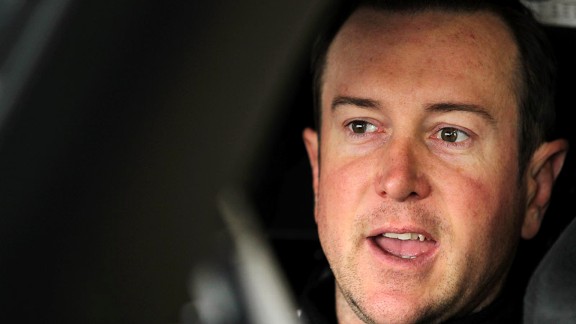 Todd Warshaw/Getty ImagesKurt Busch said doing the Memorial Day weekend double would make for a special one.
INDIANAPOLIS -- Last week, Kurt Busch took time off from his NASCAR duties for Furniture Row Racing to test an Australian V8 Supercar at Circuit of the Americas in Austin, Texas.
Now he's about to get back behind the wheel of an Indy car.
That's right, back.
Busch is set to test one of Andretti Autosport's Dallara-Chevrolets at the Indianapolis Motor Speedway on May 9. But it's a little-known fact the elder Busch brother actually tested an Indy car at Sebring International Raceway in February 2003. Busch wasn't looking to make a career change into open-wheel competition; at the time, he was firmly ensconced at Roush Racing and on the brink of winning the 2004 NASCAR Cup championship.
But in those days, Ford was the exclusive engine supplier to the CART-sanctioned Indy car series, and the Blue Oval arranged for Busch to take a spin in one of Team Rahal's Ford-Cosworth powered Lolas at the popular Florida test track.
Driving the car normally piloted by Michel Jourdain Jr., Busch certainly didn't embarrass himself. In what was basically his first-ever run in a rear-engine, open-wheel racing car, Busch lapped the 1.669-mile Sebring road course in 54.72 seconds -- just less than four seconds slower than test pacesetter Oriol Servia and less than 1.4 seconds slower than PK Racing rookie Patrick Lemarie.
Busch spun a couple of times, but overall, he made a deep impression on about 100 interested onlookers watching his 18-lap demonstration from a hillside between Turns 4 and 5.
 John Harrelson/Getty ImagesKurt Busch has a full-time job in NASCAR, but maybe one other race in the IndyCar Series isn't too much to ask.
"He looks good," remarked Jimmy Vasser, now an IndyCar Series team owner, but back then a driver who spectated during Busch's 30-minute demonstration run along with fellow CART drivers Servia and Paul Tracy. "The guy's obviously got talent because he won a bunch of Winston Cup races last year, and that's not easy."
Busch was grateful to have gotten the opportunity to drive the Team Rahal Champ Car. "The whole experience was first class," he said then. "Team Rahal went above and beyond what I'm used to in terms of telling me what to expect from the car, and Michel was very polite and very generous to let me drive his car today."
Busch spun early in his first flying lap, but he quickly settled into the mid-57 second bracket. After a pit stop to discuss the car with engineer Ray Leto and the Team Rahal crew, Busch returned to the track and steadily chipped away at the lap time until he put in a pair of sub-55 second tours. A second spin at Turn 2 ended his fun after 18 laps.
"After riding around with Michel this morning in a rental car, I knew the section between Turn 1 and Turn 3 was going to be difficult," Busch said then. "My first spin was down to cold tires, and on the last spin, I was just trying to carry too much speed because I was losing a lot of time there, due to the fact that I didn't trust the downforce.
"I probably lost 1.5 seconds of time on the lap just under braking," he added. "The braking was unlike anything I have ever comprehended in my life."
At the time, Busch expanded on his open-wheel experience in a column I ghost-wrote for the English magazine Autosport.
"Believe it or not, I call this my first experience in an open-wheel car," he told me. "I drove a Formula Ford at a Bondurant school four years ago, but that is irrelevant to driving a Champ Car. Many years ago, I went to Phoenix International Raceway to watch Modified and Super Modified cars race, and my dad told me it would be the closest thing I would ever see to an Indy car.
"So I am very appreciative to my friends at Ford for creating this chance, but I'm going to keep my day job," he added. "The door is open now and I enjoyed the experience, but I think I'll stick to what I'm accustomed to."
Busch could hardly have imagined that, more than 10 years later, he would get another shot at driving an Indy car -- this time, courtesy of Chevrolet and on a proper oval track.
Oreovicz: Power better get going
Will Power has dominated the streets of Sao Paulo in the IndyCar Series, but he's off to a slow start in 2013. Brazil might be the cure, but there are plenty of other contenders, writes John Oreovicz. Story
Team owner Michael Andretti said he and Busch came into contact last year when they were working on "another racing project" -- presumed to be Andretti Autosport's exploratory effort to enter NASCAR racing -- and he looks forward to seeing what a modern stock car star can do in an Indy car.
"I respect his talent and am happy to give him the opportunity to experience the raw speed of an Indy car," Andretti stated. "It's a unique feel and perspective -- it will be totally different than what he is used to driving each week on the Cup circuit."
Busch was already asked about the possibility of attempting the Indy 500/Coca-Cola 600 double, something only three drivers (John Andretti, Robby Gordon and Tony Stewart) have successfully completed.
"I have always enjoyed racing at Indianapolis, and when IMS and Michael presented me with the opportunity to test an Indy car prior to opening day of practice of the Indianapolis 500, I jumped at it," Busch said.
"I'm looking forward to this test and experiencing IMS at the speeds the Indy cars run," he added. "Let's see how the test goes, and then I can look at the opportunities that could be beyond this coming Thursday. Running the Indianapolis 500 would certainly be a highlight, and doing another 600 miles in a Cup car on the same day would make for a special weekend."
ABOUT THIS BLOG

John Oreovicz
John Oreovicz lives in the shadows of Turn 1 of the Indianapolis Motor Speedway.
His interest in racing was sparked by the battle between Niki Lauda and James Hunt for the 1976 Formula One World Championship, and he can remember watching the 1977 Long Beach Grand Prix and the 1979 Daytona 500 on the family RCA XL-100 television as if they happened yesterday.
These days, you're likely to find him at Pomona covering drag racing or Phoenix reporting on stock cars in addition to his usual role as one of the IndyCar Series' pressroom veterans.
With more than a decade writing for ESPN.com, his work has been published in more than a dozen countries around the world, and he co-authored "A Winning Adventure," a chronicle of Honda's successful CART Indy car engine program.
Contact him at indyoreo@earthlink.net.